Not without legal authorization. Costa Rica's maritime zone law prohibits fencing, building, cutting trees or exploiting plants and wildlife inside the 200 metre coastal strip unless the proper authority has approved it. The first 50 metres from the ordinary high-tide line are the public zone, and the law treats all mangroves as public zone too. Ask your attorney before planning any private works there at all.
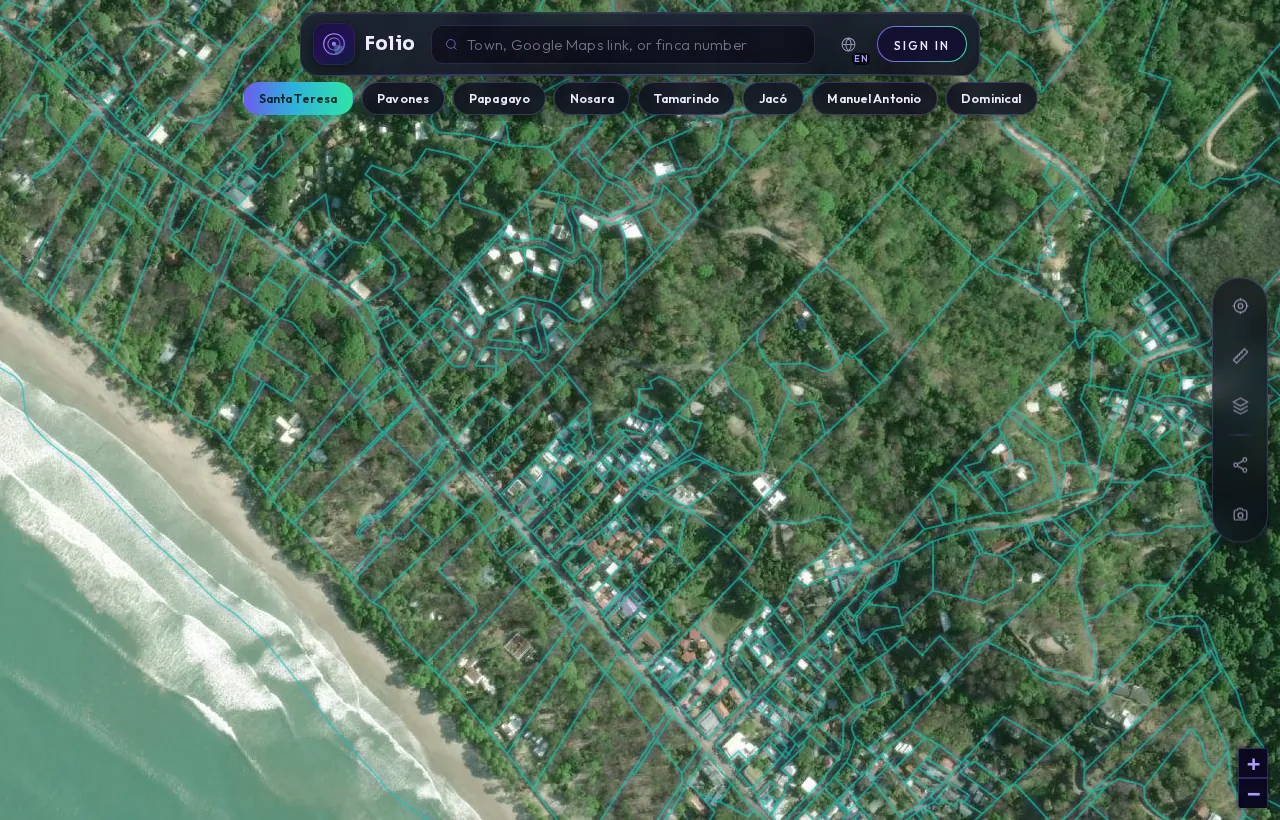
Any parcel, in the Folio app.
Search a town, a Google Maps link or a finca and Folio outlines the registered parcel from the national cadastre, with the maritime line, protected areas and water on top of it, before you call a lawyer or put down a deposit.
The short version: in Costa Rica's maritime zone, you need legal authorization before you put up a fence, build anything, clear vegetation or cut a tree. That rule applies even if a seller, a neighbour or a previous occupant has already done those things. Work that has already been done is not proof that it was ever permitted.
This matters most to buyers who see a lot "on the beach" and imagine a wall, a gate and a cleared view to the water. Before you plan any of that, you need to know whether the land sits inside the zone, which part of the zone it is in, and what has actually been authorized on paper.
What does the law actually prohibit?
The rule comes from the Ley sobre la Zona Marítimo Terrestre, Ley 6043, the law that governs the coastal strip. Article 12 says, in the original Spanish, that in the zone it is prohibited "sin la debida autorización legal, explotar la flora y fauna existentes, deslindar con cercas". In plain English: without proper legal authorization, you may not exploit the existing plants and animals or mark out boundaries with fences.
The same article goes on to cover building and other forms of development. So the practical list of things that need authorization first includes:
- Fencing, meaning marking out boundaries with fences. Ask your attorney whether walls or hedges are treated the same way.
- Building, from a house to a rancho, deck or storage shed.
- Cutting trees and clearing vegetation.
- Exploiting flora and fauna, a phrase your attorney can help you interpret for your land.
- Other development, a broad category your attorney can help you interpret for a specific plan.
The key words are "debida autorización legal" (proper legal authorization). The law does not say these things can never happen. It says they cannot happen without proper legal authorization.
Where does the maritime zone start and end?
The zona marítimo terrestre (maritime terrestrial zone, often shortened to ZMT) is defined in the law as "la franja de doscientos metros de ancho a todo lo largo de los litorales Atlántico y Pacífico". That is a strip 200 metres wide along both coasts, measured horizontally from the ordinary high-tide line.
The law then splits that strip in two:
| Section | Width | What it means for a buyer |
|---|---|---|
| Zona pública (public zone) | First 50 metres from the ordinary high-tide line | Public zone under the law. Ask your attorney before planning any fences, structures or clearing here. |
| Zona restringida (restricted zone) | The remaining 150 metres | Can be used under a concession, subject to the rules and plans that apply. |
There is one important exception to the neat 50 metre line. The law states that "zona pública es también, sea cual fuere su extensión, la ocupada por todos los manglares". All mangroves are public zone, whatever their size. If a property touches mangrove, the public area may extend well past what a simple measurement from the beach would suggest.
For a fuller walk-through of how the zone works, see our guide to the Costa Rica maritime zone explained for buyers.
Is the public zone treated differently from the restricted zone?
Yes. The law separates them: the public zone is the first 50 metres from the ordinary high-tide line, and the restricted zone is the remaining 150 metres. If you see an existing fence, wall or garden reaching into the first 50 metres, treat it as a question for your attorney, not a feature of the property.
The restricted zone is where private use is possible, but only through a concesión (concession), which is a right granted by the State to use the land for a period. It is not ownership. Do not assume a concession authorizes every fence or building either. Ask your attorney whether the works themselves also need to fit the coastal plan and be approved.
Foreign buyers face an extra condition. The law says concessions are not granted "a extranjeros que no hayan residido en el país por lo menos durante cinco años", meaning to foreigners who have not resided in Costa Rica for at least five years. Your attorney can explain how that rule applies to your situation and to any company structure you are being offered.
See whether a coastal lot is flagged for the maritime zone in the free map.
Check it freeWho gives the authorization?
This is where you need professional advice rather than a blog post. Ask your attorney which institutions are involved, since the specific steps can depend on where the land is and what you want to do.
The Instituto Costarricense de Turismo (ICT) maritime zone programme publishes information on coastal plans and regulations for the zone. Environmental review may also come into play, and SETENA, the national environmental technical secretariat, is one body you may hear about in that context. Ask your attorney to confirm which authorities apply to your plan and in what order.
Land use rules matter too. Even outside the maritime zone, what you can build depends on local zoning. Our guide to uso de suelo (land use) in Costa Rica explains how to check that before you commit.
Get the free Costa Rica buyer's checklist
What to ask for, what to pull from the registry and what to confirm on the map before you sign anything. One short email, no spam.
Why does a fence matter so much?
A fence looks like a small thing. In the maritime zone it is not. Article 12 specifically names "deslindar con cercas", marking boundaries with fences, as something that needs proper legal authorization.
What exists on the ground and what exists on paper may not match. A seller may show you a fenced, landscaped lot that feels private. The registry and the concession file may describe something quite different. The fence tells you what someone did. It does not tell you what anyone was allowed to do.
What about trees, gardens and clearing a view?
The prohibition on exploiting flora covers cutting trees and clearing vegetation without authorization. That includes the common wish to "open up the view" to the water. Coastal vegetation can do real work: holding sand, shading the beach and supporting wildlife.
If a listing promises an ocean view "once a few trees come down", treat that as a red flag rather than a selling point. No one can promise you the authorization that tree removal would require. Mangroves deserve special caution, since they are public zone in their entirety.
What should you check before you buy or plan any work?
- Confirm whether the land falls inside the 200 metre zone at all, and whether any part of it touches mangrove.
- Find out whether the land is titled private property, a concession in the restricted zone, or something else. These are very different situations.
- If it is a concession, ask your attorney to review the concession terms and whether existing structures and fences were approved.
- Check the applicable coastal plan and land use rules before assuming you can build, fence or clear.
- Get any authorization in writing before doing work, and keep it with your property documents.
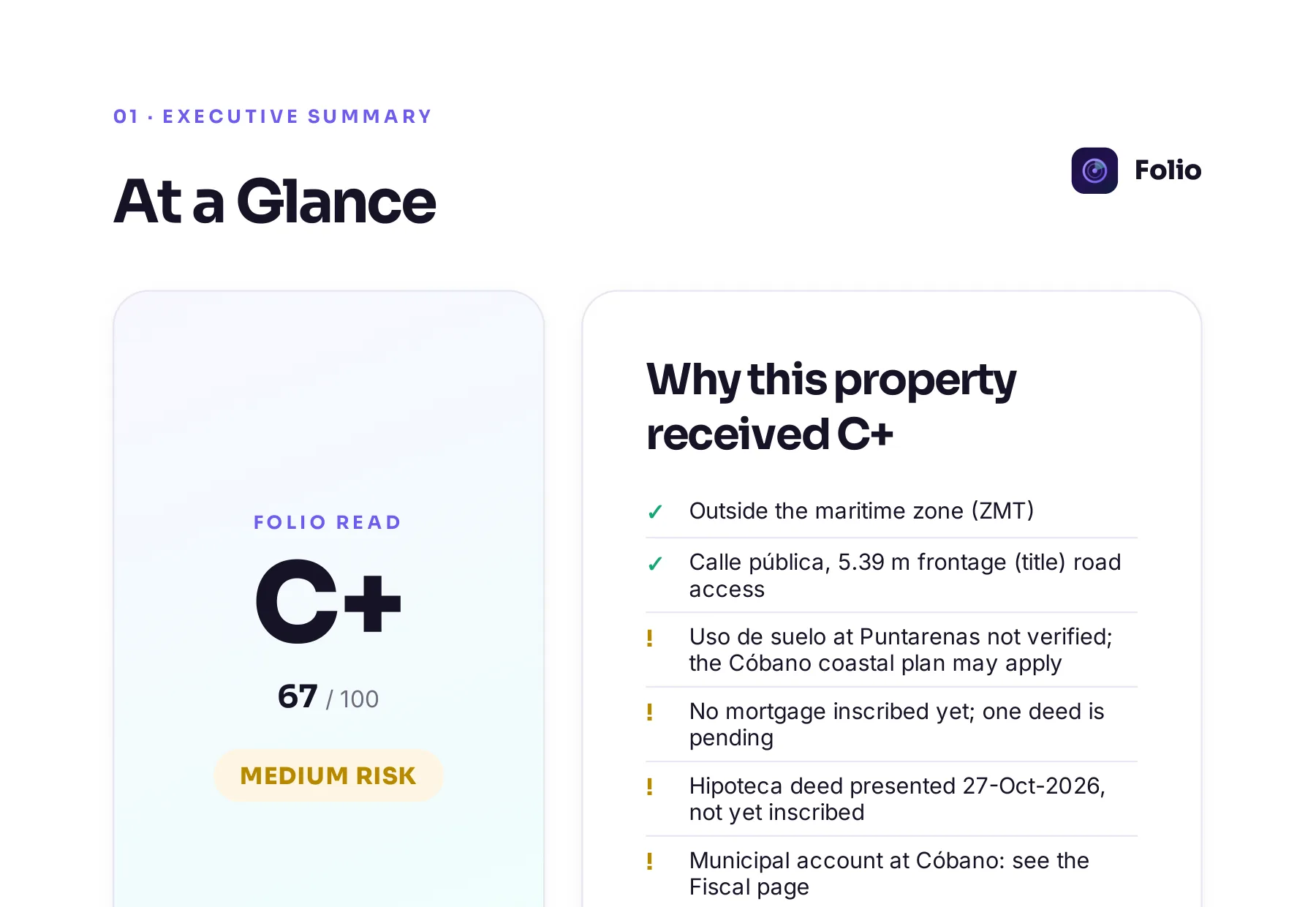
Folio can help with parts of the first two items. The free map check shows a maritime-zone flag along with the lot's area and boundary from the official cadastre. It does not show the registered owner or liens. The $29 verified report adds a human-checked records search, including the registered owner, liens, easements, nearby rivers and wells and the mapped maritime zone, delivered within 24 hours. That tells you what the public records say. Your attorney or notary tells you what it means for your plans and whether a specific fence, building or clearing can be authorized.
For broader context on how coastal land is recorded, see our study, The State of Costa Rica's Maritime Zone.
Know what you're buying before the deposit.
Most problems with a lot don't show up in the listing, and often the seller doesn't know about them either. Folio lets you find them now, before you pay a lawyer to start the purchase.
Frequently asked questions
Can I put up a fence on beachfront land in Costa Rica?
Not without legal authorization if the land is inside the maritime zone. The maritime zone law specifically prohibits marking boundaries with fences without proper authorization. The first 50 metres from the ordinary high-tide line are public zone. Ask your attorney before planning or installing anything.
Can I cut trees to get an ocean view in the maritime zone?
The law prohibits exploiting existing flora in the zone without legal authorization, which covers cutting trees and clearing vegetation. Any removal would need approval first, and no seller can promise you will get it. Mangroves are treated as public zone whatever their size, so they call for particular caution.
If the previous owner already built a fence or house, am I covered?
Not necessarily. Existing structures show what someone did, not what was authorized. Ask your attorney to check whether the concession and the works on the land were properly approved before you buy.
Can a foreigner hold land in the restricted zone?
The law says concessions are not granted to foreigners who have not resided in Costa Rica for at least five years. How that applies to you, or to a company you might buy through, is a question for your attorney.
Sources
- Ley sobre la Zona Marítimo Terrestre, Ley 6043 (full text published by ICT), Instituto Costarricense de Turismo (ICT)
- Zona Marítimo Terrestre (maritime zone programme, coastal plans and regulations), Instituto Costarricense de Turismo (ICT)
- SETENA, Secretaría Técnica Nacional Ambiental, SETENA
Educational, not legal advice. Folio reports what public records show; it does not replace a licensed Costa Rican attorney, notary or surveyor. Confirm material facts with them before any transaction. Photos are illustrative.