In Costa Rica, groundwater is overseen mainly by two national bodies: MINAE's Dirección de Agua, which handles water use concessions and well permits, and SENARA, which studies and protects aquifers. AyA and local water operators run public supply, so if a property depends on a well, you should check the well's paperwork with the Dirección de Agua and have your attorney confirm whether any SENARA restrictions apply to the land.
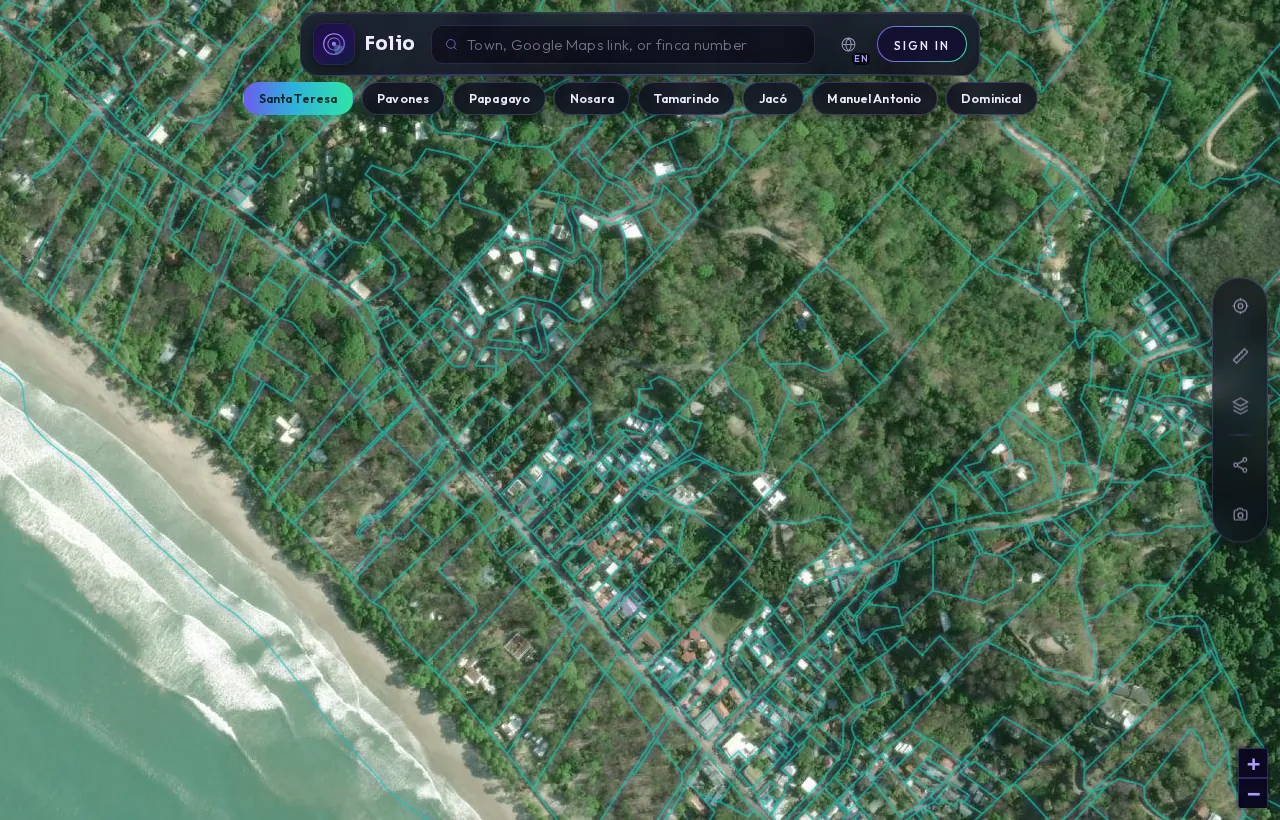
Any parcel, in the Folio app.
Search a town, a Google Maps link or a finca and Folio outlines the registered parcel from the national cadastre, with the maritime line, protected areas and water on top of it, before you call a lawyer or put down a deposit.
A well on a property is not the same as a right to use its water. In Costa Rica, several public bodies share responsibility for groundwater. If you are buying land that depends on a well, you need to know which office holds which record before you sign anything.
This guide explains who does what, what to ask each office, and which documents matter most. It describes how the system generally works. Your attorney or notary should confirm which specific rules apply to the property you are considering.
Which institutions are involved with wells and groundwater?
Three national institutions are involved when a buyer asks about water. Each answers a different question.
- Dirección de Agua (MINAE): the water directorate of the environment ministry. It is generally where water use concessions are granted and recorded, and where well drilling permits and well registrations are handled.
- SENARA: the national service for groundwater, irrigation and drainage. It studies aquifers and can weigh in on whether drilling or certain land uses are appropriate in an area.
- AyA: the national water and sewer utility. It runs public supply in many areas and plays a role in coordinating with community water operators.
Put simply, the Dirección de Agua answers "is this well and this use of water authorized?", SENARA answers "what is happening underground here, and are there limits?", and AyA (or the local operator) answers "can this lot get public water instead?"
What does the Dirección de Agua handle?
For most buyers, this is the office that matters most. Water in Costa Rica is treated as a public resource. Owning land does not automatically give you the right to pump groundwater from under it. Using that water generally requires authorization, usually called a concesión de agua (water use concession).
When a seller says the lot "has its own well", the useful follow-up questions are about paperwork, not plumbing:
- Was a permit obtained to drill the well?
- Is the well registered with the Dirección de Agua?
- Is there a current concession to use the water, and for what purpose (domestic, irrigation, commercial)?
- In whose name is the concession, and can it pass to a new owner?
A concession may have conditions, a set term, or a limited permitted volume. It may be in the name of the seller personally rather than tied to the land. Ask your attorney how any existing concession would be handled in the sale, and whether a new application would be needed.
What does SENARA do with groundwater?
SENARA's role is more technical. It studies aquifers, maps where groundwater is and how vulnerable it is to contamination, and gives technical input when wells or certain developments are proposed. In some areas, that work can lead to restrictions on how land is used, particularly where an aquifer is considered sensitive.
For a buyer, SENARA matters in two ways. First, its review can affect whether a new well is likely to be approved. Second, aquifer protection can shape what you are allowed to build, how septic systems must be designed, or whether a project fits the area at all.
That is why groundwater questions overlap with land use. A municipal uso de suelo (land use certificate) tells you what the local zoning allows. It is sensible to ask your attorney whether any aquifer protection or SENARA criteria also apply to the lot, since the two do not always appear in the same document.
Check a lot's cadastral boundary and area in the free Folio app.
Check it freeWhere does AyA fit in?
AyA is the national water utility. In many towns it supplies water directly. In others, supply comes from a municipality or from an ASADA (a community water association that runs a local system). Which one serves an area depends on where the property is.
If a lot is near a public network, the operator can issue a carta de agua (water availability letter). That letter can be required for building permits. Whether a well can serve as a substitute or a supplement depends on local requirements and on the well's authorization. Do not assume a well removes the need for an availability letter. Ask the municipality and your attorney what the permit process will actually require.
Does a well on the lot give you the right to use its water?
No, not by itself. A physical well, a pump and a working tank prove only that water comes out. They say nothing about whether the well was legally drilled or whether anyone holds a concession to use it.
A well may have been drilled without a permit, its concession may have lapsed, or it may serve a use that differs from what was authorized. Any of these can turn into a problem when you apply for building permits, try to expand, or later sell to a buyer whose lawyer asks the same questions.
The broader picture of how water rights attach (or do not attach) to land is covered in our guide to water rights and Costa Rica property.
Get the free Costa Rica buyer's checklist
What to ask for, what to pull from the registry and what to confirm on the map before you sign anything. One short email, no spam.
What should you ask before you buy a property with a well?
Work through these questions with the seller and your attorney, in roughly this order:
- Ask the seller for every water document they hold: drilling permit, well registration, concession resolution, and any correspondence with the Dirección de Agua.
- Have your attorney verify those documents directly with the Dirección de Agua, rather than relying on copies alone.
- Confirm the concession's holder, permitted use, permitted volume and term, and whether it can be transferred to you.
- Ask whether the area has any SENARA aquifer protection criteria or restrictions that could affect wells, septic systems or construction.
- Find out which operator (AyA, the municipality or an ASADA) serves the area, and whether a water availability letter can be obtained.
- Check the municipal land use certificate so that water and zoning tell a consistent story.
- Have a water quality test done by a qualified lab. Paperwork does not tell you whether the water is fit to drink.
What red flags should you watch for?
- The seller has no permit or concession documents and describes the well as "always having been there".
- The concession is in someone else's name, such as a previous owner or a neighbor.
- The authorized use is irrigation, but the house relies on the well for drinking water.
- A shared well serves several lots with no written agreement or recorded easement.
- The listing promises water for a future development without any availability letter or concession to back it up.
None of these automatically kills a deal. They do mean the price, the timeline and the contract terms should reflect the work needed to regularize the water, and your attorney should advise on whether that is realistic.
Where do public records help, and where do they stop?
Registry and cadastre records tell you who owns the land, what is recorded against it, and where its boundaries lie. Water authorizations sit largely with the Dirección de Agua, so a title search on its own may not show whether a well is legal.
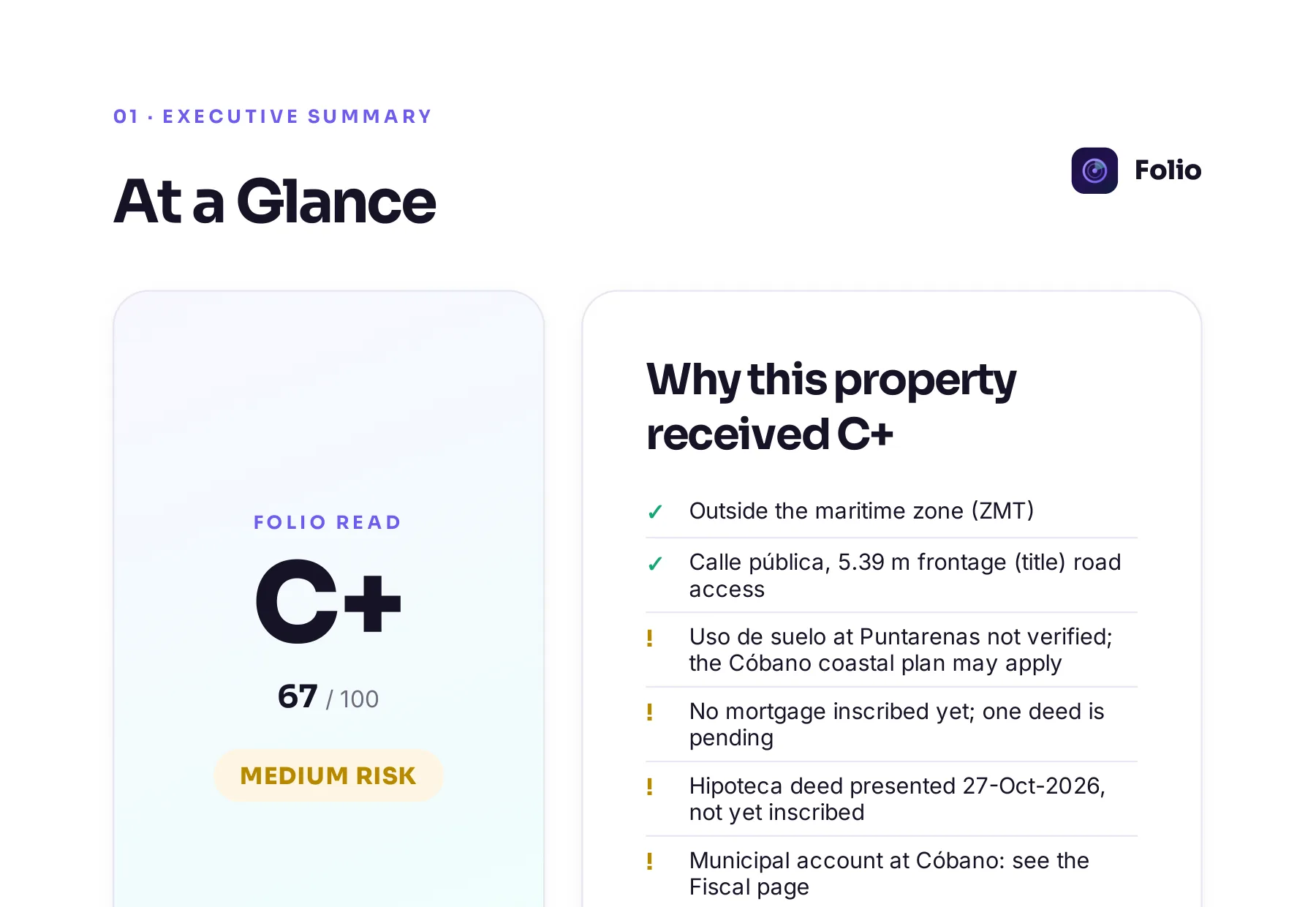
Folio's free map shows a lot's finca number, area, perimeter and cadastral boundary, plus a maritime zone flag. It does not show water rights, owners or encumbrances. Our $29 verified report is a human-checked records search that includes registered owner, liens, taxes, water rights and the exact maritime line, delivered within 24 hours. It shows what the public records say. Your attorney or notary is the person who advises on what that means for your purchase.
Know what you're buying before the deposit.
Most problems with a lot don't show up in the listing, and often the seller doesn't know about them either. Folio lets you find them now, before you pay a lawyer to start the purchase.
Frequently asked questions
Who issues well permits in Costa Rica?
Well drilling permits and water use concessions are generally handled by the Dirección de Agua, part of MINAE. SENARA may provide technical input on groundwater conditions in the area. Ask your attorney to confirm the exact process for the property you are considering.
Can I use a well on land I own without a concession?
Owning land does not automatically give you the right to use groundwater beneath it. Water is treated as a public resource, and use generally requires authorization. Have your attorney check whether the well is registered and whether a valid concession exists.
Does a well replace the need for a carta de agua?
Not necessarily. Municipalities may require a water availability letter from AyA, the municipality or the local ASADA for building permits. Whether an authorized well can substitute depends on local requirements, so confirm with the municipality and your attorney.
What does SENARA have to do with buying land?
SENARA studies aquifers and can influence whether new wells are approved and how land in sensitive groundwater areas may be used. Those limits can affect construction and septic design. Ask your attorney whether any SENARA criteria apply to the lot.
Will a title search show whether a well is legal?
Not always. Registry records cover ownership and recorded encumbrances, while water authorizations are largely kept by the Dirección de Agua. A records report can include water rights information, but your attorney should verify the well paperwork directly with the authority.
Sources
- SENARA, Servicio Nacional de Aguas Subterráneas, Riego y Avenamiento, SENARA
- Dirección de Agua (MINAE), MINAE, Dirección de Agua
- AyA, Instituto Costarricense de Acueductos y Alcantarillados, AyA
Educational, not legal advice. Folio reports what public records show; it does not replace a licensed Costa Rican attorney, notary or surveyor. Confirm material facts with them before any transaction. Photos are illustrative.