Most buyers deal with the National Registry and its cadastre (title and survey), the municipality (land use and the building permit), the CFIA (where your engineer or architect registers the plans), and the water and power providers. Depending on the lot and the project, SETENA (environmental viability) and INVU (national planning rules) may also be involved, so ask your attorney to confirm which offices apply to your case.
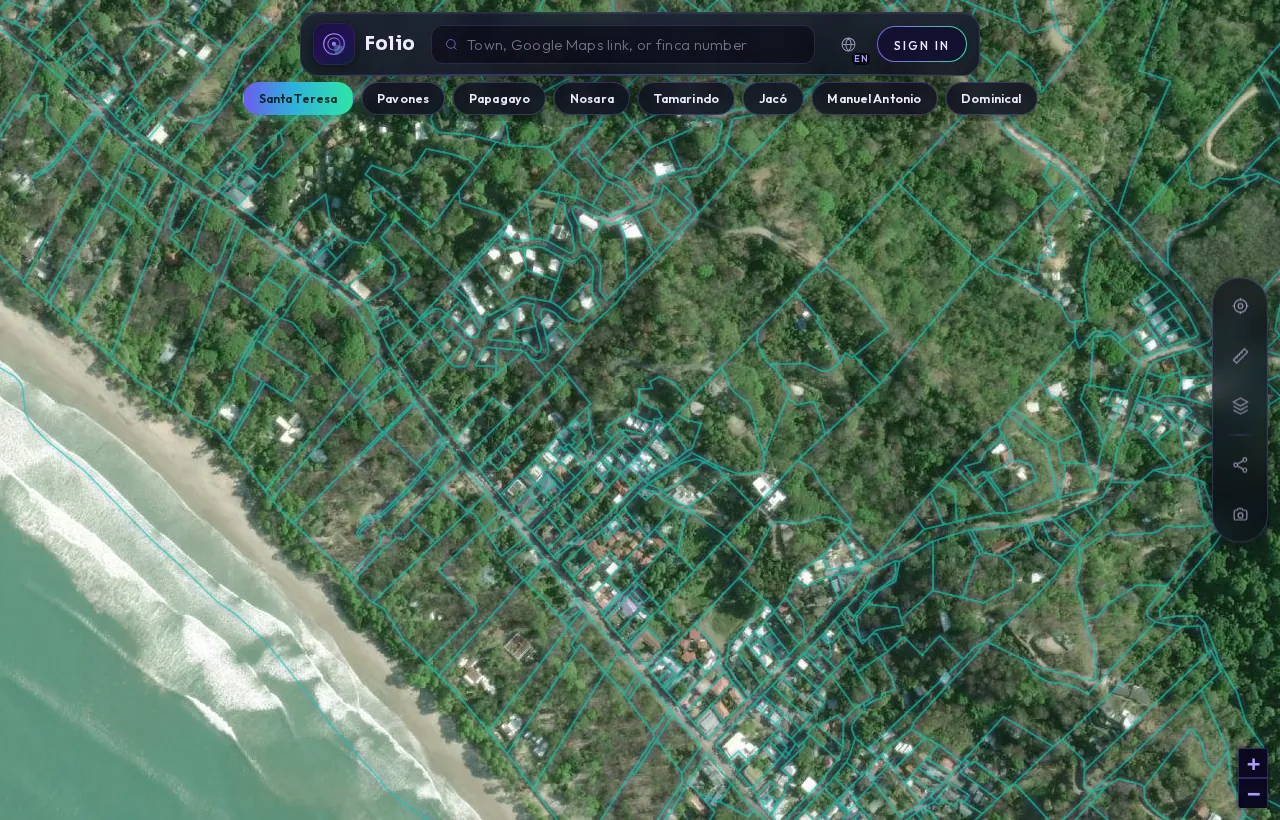
Any parcel, in the Folio app.
Search a town, a Google Maps link or a finca and Folio outlines the registered parcel from the national cadastre, with the maritime line, protected areas and water on top of it, before you call a lawyer or put down a deposit.
Buying a lot in Costa Rica and building on it is not a single transaction. It is a chain of approvals from different offices. Each one looks at a different question: who owns the land, what it can be used for, whether the plans are professionally sound, whether the environment allows it, and whether services can reach it.
Buyers who understand that chain before signing make better decisions. This guide walks through the offices you are likely to meet in the building permit process for a Costa Rica lot, in roughly the order they matter. It describes how the process generally works. The exact requirements vary by municipality and by project, and your attorney and your engineer or architect should confirm them for your lot.
What does the route from lot to permit look like?
In broad strokes, the journey usually follows this sequence:
- Confirm what you are buying at the National Registry and the cadastre.
- Ask the municipality what the land can be used for.
- Confirm that water, electricity and legal access are available.
- Hire a registered engineer or architect, who prepares plans and registers them with the CFIA.
- Obtain environmental clearance from SETENA if your project requires it.
- Submit the building permit application to the municipality.
The early steps are the ones that should happen before you commit money. The later steps belong to construction. A problem found in the first three can usually be handled by negotiating or walking away. A problem found during the permit stage tends to be far more expensive.
Which office tells you what you actually bought?
The Registro Nacional (National Registry) holds two records you need to read together. The property registry shows the finca (the registered property), its owner, and any gravámenes (encumbrances) such as mortgages, easements or court notices. The cadastre holds the plano (the registered survey plan), which describes the lot's shape, area and boundaries.
For building, the plano matters. Municipalities generally want the lot's survey to match the registry entry and the physical land. A lot whose plano is missing, outdated, or inconsistent with the title can stall a permit application before anyone looks at your house design.
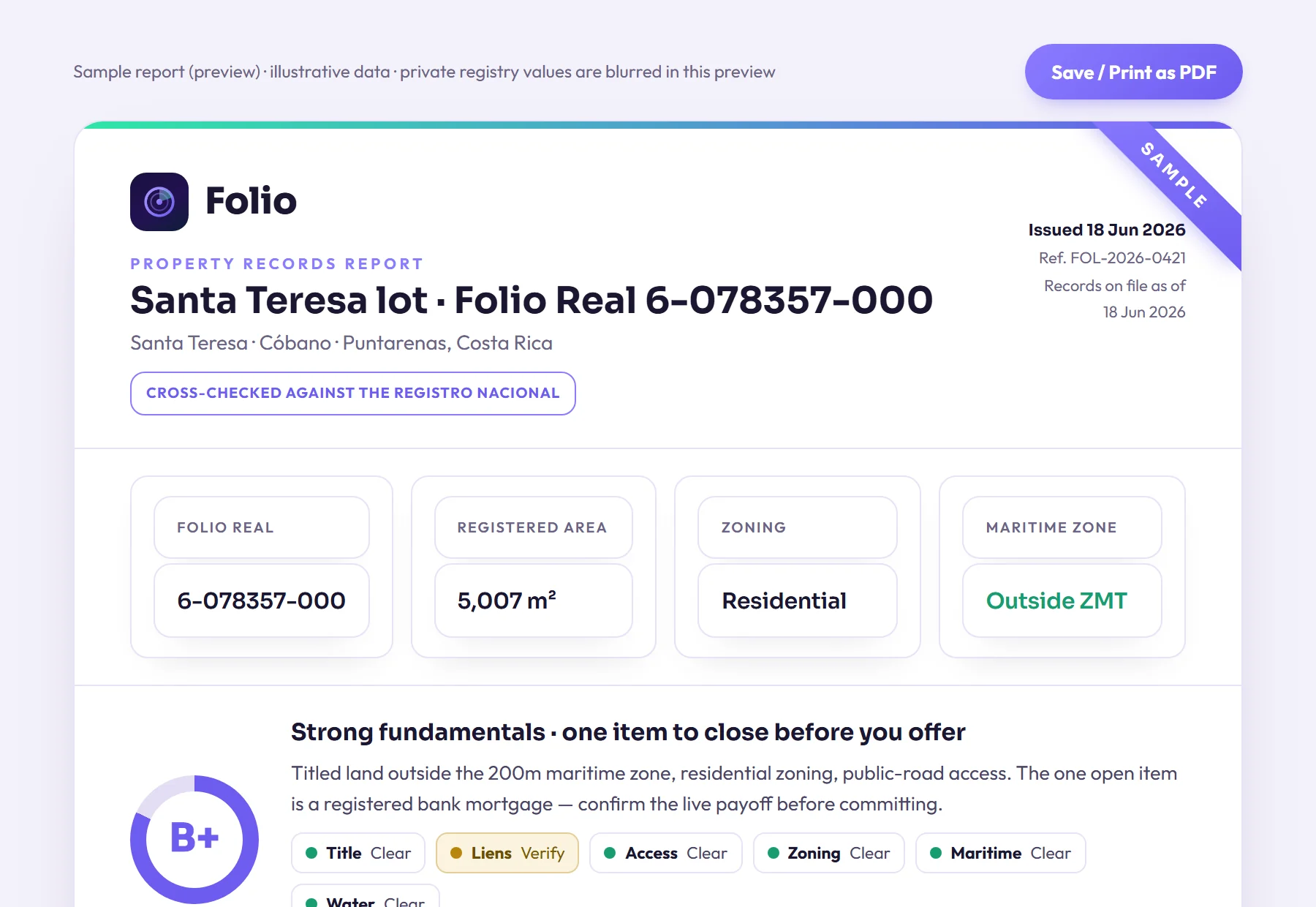
Read the registry and cadastre records with the same care you would give a contract. Our property due diligence checklist lists what to request and what to compare. If you want a human-checked summary, Folio's verified report costs $29 and covers the registered owner, liens, taxes, water rights and the exact maritime line, delivered within 24 hours. It shows what the public records say. Your attorney or notary interprets them and advises you.
Why should you visit the municipality before you buy?
The municipality is the office you will deal with most. It issues the uso de suelo (land use certificate), which states what activities are allowed on a property under local zoning. It also issues the building permit itself, collects the related municipal charges, and may also review survey plans for consistency with local rules.
Where a canton has a plan regulador (local zoning plan), that plan sets the rules for density, setbacks, building height and permitted uses. Where it does not, other planning rules fill the gap, and the answer can be less obvious. Either way, a land use certificate is the closest thing to a written answer to the question "can I build what I want here?"
Request it before signing, not after. Our guide to checking uso de suelo before you buy explains how to request one and how to read the answer. A lot that looks perfect for a home can turn out to be zoned for agriculture, conservation or a use that limits what you can put on it.
What role does the CFIA play?
The CFIA (Colegio Federado de Ingenieros y de Arquitectos) is the professional body for engineers and architects. Construction plans in Costa Rica are generally prepared by a professional who is a member of the CFIA, and that professional registers the plans and the project with the CFIA before they go to the municipality.
As a buyer, you usually do not deal with the CFIA directly. Your engineer or architect does. What you should do is confirm that the professional you hire is an active member in good standing and that your contract clearly says who handles the registration and who supervises the work. That professional may also coordinate the other approvals, so choose carefully.
If you are buying a home that a developer has not yet built, ask to see evidence that the plans have been registered and that permits exist. Our guide to the risks of buying pre-construction property covers what to request from a developer.
See a lot's official boundary and area in the free Folio map.
Check it freeWhen does SETENA get involved?
SETENA (Secretaría Técnica Nacional Ambiental) is the national environmental review body. It assesses whether certain projects can go ahead from an environmental standpoint, a clearance often called viabilidad ambiental (environmental viability).
Not every project needs a full SETENA review. Whether yours does generally depends on factors such as the size and type of the project and the sensitivity of the location. Lots near rivers, wetlands, steep slopes, forest or protected areas deserve extra attention. Larger developments, subdivisions and commercial projects are more likely to need SETENA involvement than a modest single home, but your engineer and attorney should confirm the specific requirement for your plans.
Environmental review can add real time to a project, so it belongs in your planning from the start. If a seller or developer says a site has environmental clearance, ask for the document.
What is INVU's part in the process?
The INVU (Instituto Nacional de Vivienda y Urbanismo) is the national housing and urban planning institute. It sets planning and urbanisation rules at the national level and is involved in how local zoning plans are developed and approved.
For an individual buyer, INVU's influence is usually indirect. Its rules can matter most where a canton has no local zoning plan, and when a lot is being subdivided or a new development is being created. If you are buying a lot that is part of a recent subdivision, ask your attorney whether the subdivision was approved under the applicable planning rules. A lot carved out of a larger property without the right approvals can create problems at the permit stage.
Get the free Costa Rica buyer's checklist
What to ask for, what to pull from the registry and what to confirm on the map before you sign anything. One short email, no spam.
Which utility letters do buyers forget?
A building permit application usually needs proof that the lot can receive basic services. These letters come from offices outside the planning system, and they are easy to overlook:
- Water availability. Depending on the area, this comes from AyA (the national water utility), a local ASADA (a community water association), or the municipality. A lot without confirmed water availability can be very hard to build on.
- Electricity. Depending on the region, the supplier may be ICE or a local electric cooperative. Ask whether service reaches the lot and what an extension would involve.
- Legal access. The lot should front a public road or have a registered right of way. An informal track across a neighbour's land is not the same as legal access.
Water deserves particular care. In some areas new connections are restricted, and a seller's assurance that "water is no problem" is not a letter from the provider.
Are there other offices for special lots?
Some lots bring extra offices into the picture:
- Coastal lots. Land in the maritime zone is generally held under a municipal concession rather than titled ownership, and it follows its own planning rules. Confirm exactly where the maritime line falls before you assume you can build.
- Lots near protected areas, rivers or wetlands. Environmental authorities may need to weigh in, and protection setbacks can reduce the area you can build on.
- Commercial or tourism projects. These may involve health authorities and other sector offices in addition to the usual permits.
Your attorney is the right person to identify which of these apply. The aim is to know about them before you buy, not to discover them when the permit is refused.
How should you sequence the work as a buyer?
A practical approach is to split the offices into two groups. Before signing, you want answers from the registry and cadastre (title, encumbrances and survey), from the municipality (land use), and from the utilities (water, power, access). These tell you whether the lot can support what you plan to build.
After signing, the work shifts to your engineer or architect: registering plans with the CFIA, obtaining any SETENA clearance, and filing the municipal permit. If you can, make the purchase conditional on the pre-signing answers coming back satisfactory, and have your attorney draft that condition.
Know what you're buying before the deposit.
Most problems with a lot don't show up in the listing, and often the seller doesn't know about them either. Folio lets you find them now, before you pay a lawyer to start the purchase.
Frequently asked questions
Do I need a building permit before I buy a lot in Costa Rica?
No, the building permit normally comes after you own the lot and have professional plans. What you should get before buying is a land use certificate from the municipality, a careful review of the registry and cadastre records, and confirmation of water, power and access. These tell you whether a permit is realistic.
Can I apply for a building permit myself?
Construction plans are generally prepared and registered by an engineer or architect who is a CFIA member, and that professional usually coordinates the application. You remain the owner and sign where required. Confirm the arrangement in writing with your professional.
Does every house need SETENA approval?
Not necessarily. Whether a project needs SETENA review generally depends on its size, type and location, with sensitive sites and larger developments more likely to require it. Your engineer and attorney should confirm the requirement for your specific plans.
What can make a lot hard to build on?
Problems can come from zoning that does not allow the intended use, survey plans that do not match the title, missing water availability, or lack of legal access. Each of these can be checked before you sign. Have your attorney review the results with you.
Sources
Educational, not legal advice. Folio reports what public records show; it does not replace a licensed Costa Rican attorney, notary or surveyor. Confirm material facts with them before any transaction. Photos are illustrative.