In Costa Rica, the certificado de uso de suelo (land use certificate) is issued by the municipality of the canton where the property sits, usually through its urban planning or engineering office. It tells you how the local zoning rules classify that parcel and whether a specific use, such as a home, a rental cabin or a shop, is allowed there. It does not confirm who owns the land, whether there are debts on it, or that you can build without further permits.
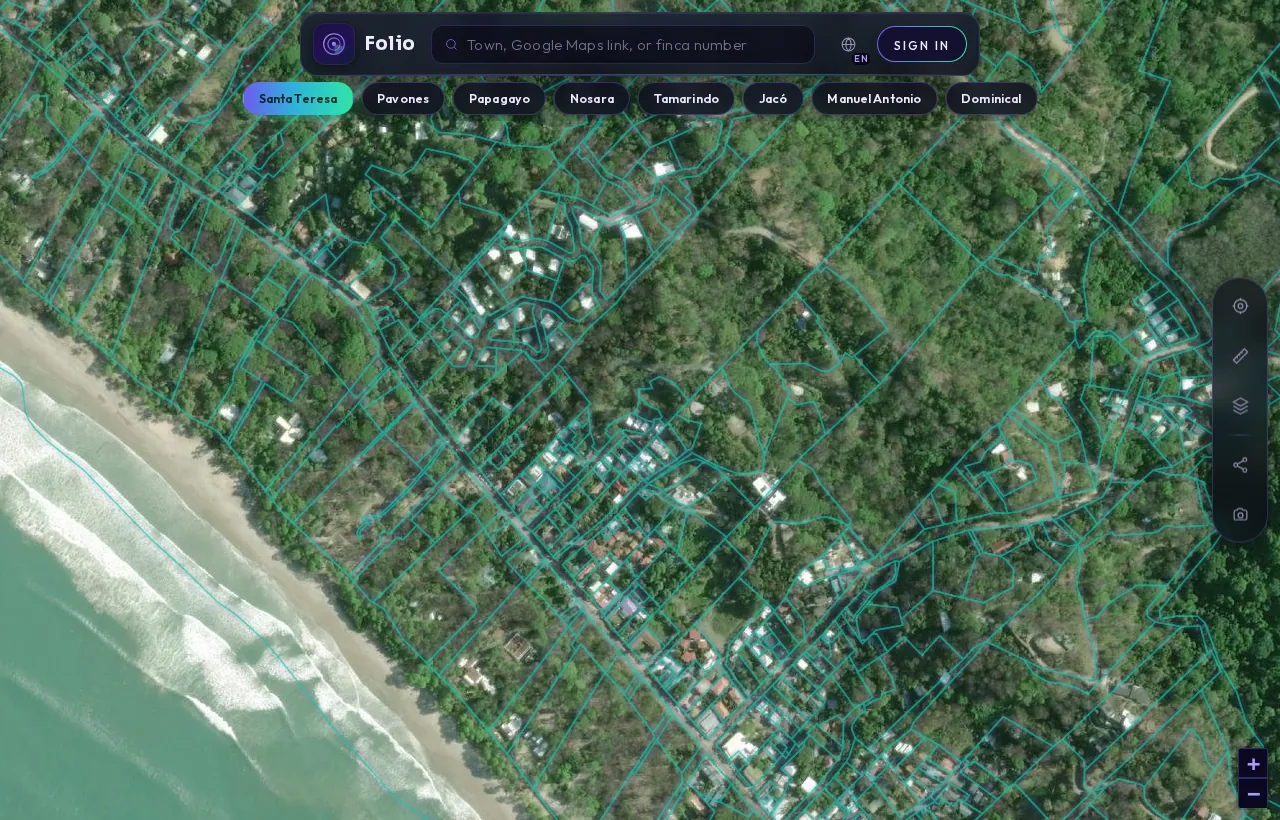
Any parcel, in the Folio app.
Search a town, a Google Maps link or a finca and Folio outlines the registered parcel from the national cadastre, with the maritime line, protected areas and water on top of it, before you call a lawyer or put down a deposit.
Who actually issues the uso de suelo?
The uso de suelo is a municipal document. Each of Costa Rica's cantons has its own municipalidad (local government), and that office is the one that answers the question "what is this land allowed to be used for?" You do not get it from the Registro Nacional (National Registry) or from a notary.
In practice, you or your attorney submit a request to the municipality with the parcel identified by its registered survey plan, and state the use you have in mind. The municipal planning or engineering department then checks the parcel against the local zoning rules and issues a written certificate. The exact office name, forms and requirements vary from canton to canton, so ask the municipality directly what it needs.
That local variation is the single most important thing to understand. Two parcels a few kilometres apart, but in different cantons, can be governed by completely different rules.
What is a plan regulador, and why does it matter?
The certificate is only as specific as the rules behind it. Many municipalities have a plan regulador (regulatory or zoning plan) that divides the canton into zones, such as residential, commercial, mixed use, agricultural or protection areas, and sets conditions for each.
Where a canton has an up to date plan regulador, the uso de suelo will usually name the zone your parcel falls in and list what is permitted, conditional or prohibited there. Where a canton has no plan, or only a partial one that covers the town centre, the municipality relies on other applicable regulations, and the certificate can be more general. Ask your attorney to confirm which rules apply to the parcel you are considering, because this affects how much weight you can put on the document.
Plans also change. A municipality can adopt a new plan or amend an existing one, and a certificate reflects the rules in force on the day it was issued. Treat an old certificate from the seller as background, not as current evidence.
Where do INVU and IFAM fit in?
You may come across two national institutions while researching zoning, and it helps to know what each one does so you contact the right office.
- INVU, the Instituto Nacional de Vivienda y Urbanismo, is the national housing and urban planning institute. It works on national urban planning policy and regulations and is involved in the process by which municipalities prepare and approve their regulatory plans. It is a good place to understand the planning framework, but it is not where you request a certificate for a specific lot.
- IFAM, the Instituto de Fomento y Asesoría Municipal, supports and advises municipalities. It is not where you request a certificate for a specific lot either.
Neither institution replaces the municipality as the issuer. If someone offers you a land use answer that did not come from the canton's own office, ask where it came from.
What does a uso de suelo certificate tell a buyer?
Read properly, the certificate answers a narrow but valuable question: can you legally do what you plan to do on this land? Depending on the municipality and its plan, it typically shows:
- The zone classification of the parcel under the local rules.
- Whether your requested use is conforme (compatible) or no conforme (not compatible) with that zone. This line answers the question you asked.
- Permitted, conditional and prohibited uses, for example whether short term rental units, a restaurant or light commercial activity are allowed alongside a home.
- Building parameters, where the plan defines them, such as maximum lot coverage, height limits, minimum lot size, density and setbacks (retiros) from boundaries, roads or rivers.
- Conditions or restrictions the municipality wants to flag, such as the need for further studies or approvals before any permit.
For a buyer, this turns a seller's promise ("you can build three cabins here") into something you can check against an official document. If the certificate says the use you want is not compatible, that is information you need before you sign, not after.
For a fuller walkthrough of requesting and interpreting the certificate, see our guide on checking land use before you buy in Costa Rica.
Check a parcel's cadastre, maritime zone and protected areas in the free app.
Check it freeWhat does the uso de suelo not tell you?
The certificate is a zoning answer, and it is silent on most of the other questions in a purchase.
- Ownership. It does not confirm who the registered owner is. That comes from the National Registry.
- Gravámenes (encumbrances) and anotaciones (pending annotations). Mortgages, liens, easements and court notes appear in the registry record, not in the municipal certificate.
- Building permission. A compatible use is not a construction permit. You will still need plans, approvals and a municipal building permit.
- Water and utilities. Being zoned residential does not mean a water connection or well permit is available.
- Environmental and coastal restrictions. Protected areas, river protection strips and the maritime zone can limit a parcel regardless of how the municipal zoning reads.
- Whether the survey matches reality. The certificate relies on the plan you submit. If that plan is wrong or belongs to a different parcel, the answer is about the wrong land.
A clean, compatible uso de suelo is a good sign about one question. It is not a clean bill of health for the property.
Get the free Costa Rica buyer's checklist
What to ask for, what to pull from the registry and what to confirm on the map before you sign anything. One short email, no spam.
How should you request and read one?
- Confirm which canton the parcel is in, using the registered survey plan rather than the seller's description or the nearest town name.
- Request a fresh certificate in your own process, ideally through your attorney, stating the specific use you intend.
- Check that the parcel described on the certificate matches the registry record and the survey plan you are buying.
- Read the conforme or no conforme line first, then the conditions and building parameters.
- Ask the municipality or your attorney about anything written as "conditional" or requiring further approval, and what that approval involves.
- Note the date of issue and ask whether a plan update is in progress that could change the classification.
Is it different near the coast?
Yes, and the difference is large. Land within the Zona Marítimo Terrestre (maritime terrestrial zone) along the coast is generally public domain and is not owned in the usual titled way. Use there is normally granted through concessions, and development depends on a coastal regulatory plan for that stretch of shoreline.
That means a municipal land use answer for a beachfront parcel has to be read together with where the maritime zone line falls and whether a coastal plan exists. If you are looking near the sea, start with our explainer on the Costa Rica maritime zone for buyers, and see our study of the state of the maritime zone for the wider picture of how coastal land is planned and administered.
How does the uso de suelo fit into your due diligence?
Think of the certificate as one layer in a stack. The municipality tells you what the land may be used for. The National Registry tells you who owns it and what is registered against it. The cadastre tells you where it is and how big it is. Environmental and coastal layers tell you what is off limits regardless of zoning.
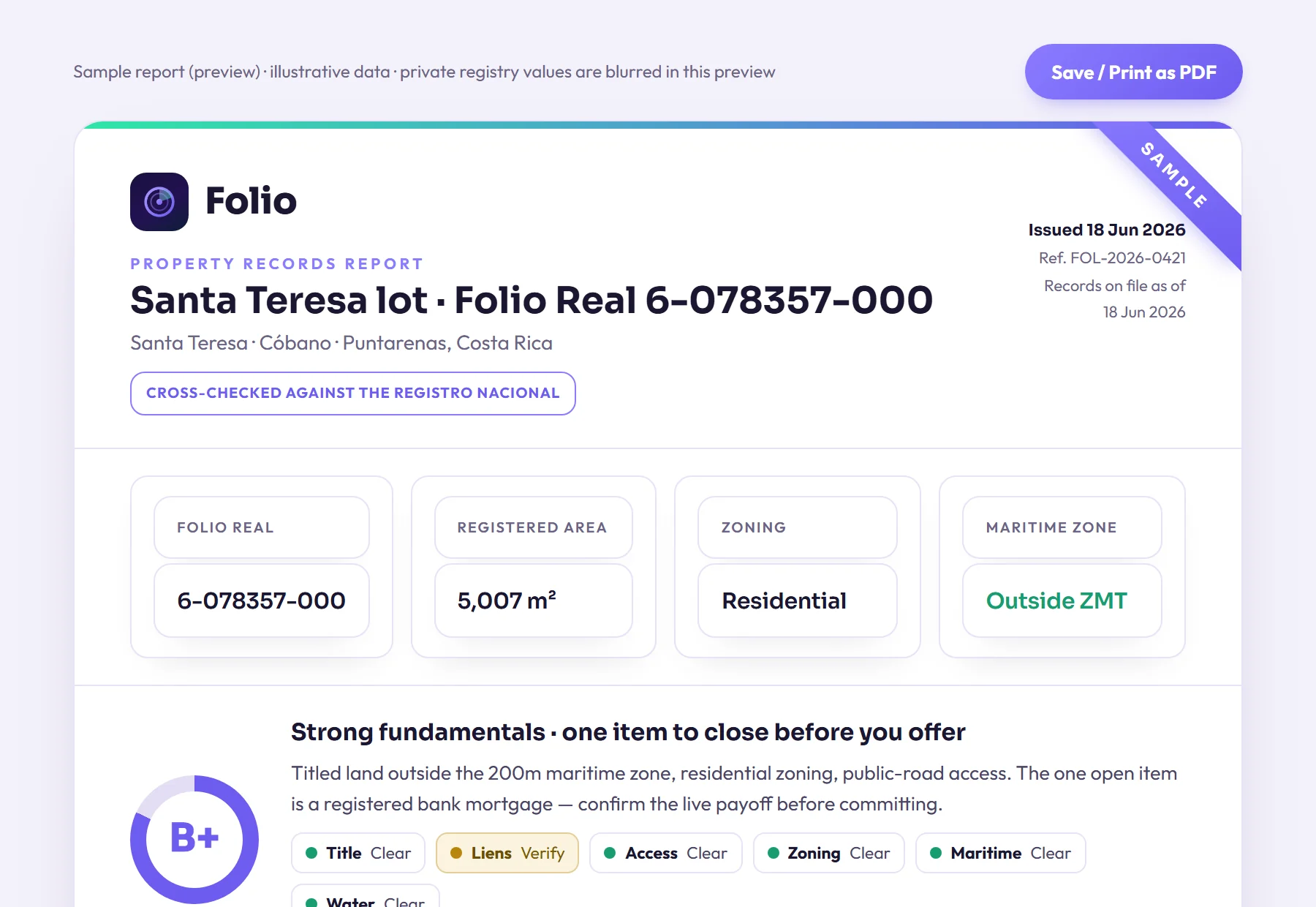
Checking these layers against each other is how problems surface. A parcel zoned for housing that overlaps a river protection strip, or a lot whose survey sits partly inside the maritime zone, is more likely to show up when you compare sources. Folio's free check looks at the official cadastre, maritime zone, protected areas and water layers for a parcel, and the $29 verified report adds a human-checked search of the registered owner, liens, taxes, water rights and the exact maritime line, delivered within 24 hours. Neither one replaces the municipal certificate or your attorney's advice. They show what the public records say, so your attorney can advise you with the full picture.
Know what you're buying before the deposit.
Most problems with a lot don't show up in the listing, and often the seller doesn't know about them either. Folio lets you find them now, before you pay a lawyer to start the purchase.
Frequently asked questions
Who issues the uso de suelo certificate in Costa Rica?
The municipality of the canton where the property is located issues it, normally through its planning or engineering office. National bodies such as INVU and IFAM work on planning policy and municipal support, but they do not issue certificates for individual parcels.
Is a uso de suelo the same as a building permit?
No. The uso de suelo tells you whether a use is compatible with local zoning. You still need approved plans and a separate municipal construction permit before building.
Can I rely on a uso de suelo the seller gives me?
Use it as background only. The certificate reflects the rules in force when it was issued and the use the seller asked about, which may differ from yours. Request a fresh one for your intended use, ideally through your attorney.
What if the municipality has no plan regulador?
The municipality still answers land use requests, but it relies on other applicable regulations, and the certificate may be more general. Ask your attorney to confirm which rules govern the parcel and how much weight to give the document.
Does a compatible uso de suelo mean the property has no problems?
No. It answers only the zoning question. Ownership, liens, survey accuracy, water availability, protected areas and the maritime zone all need to be checked separately in the official records, with your attorney advising on the results.
Sources
Educational, not legal advice. Folio reports what public records show; it does not replace a licensed Costa Rican attorney, notary or surveyor. Confirm material facts with them before any transaction. Photos are illustrative.