Before you put down a deposit on Costa Rica land, confirm in the public records that the seller is the registered owner, that the title carries no liens or pending annotations you have not agreed to, and that the survey plan matches the land you walked. Then check the parcel against the maritime zone, protected areas and water layers, confirm legal access and paid taxes, and make sure the deposit is held under written conditions that let you recover it if the records turn up a problem.
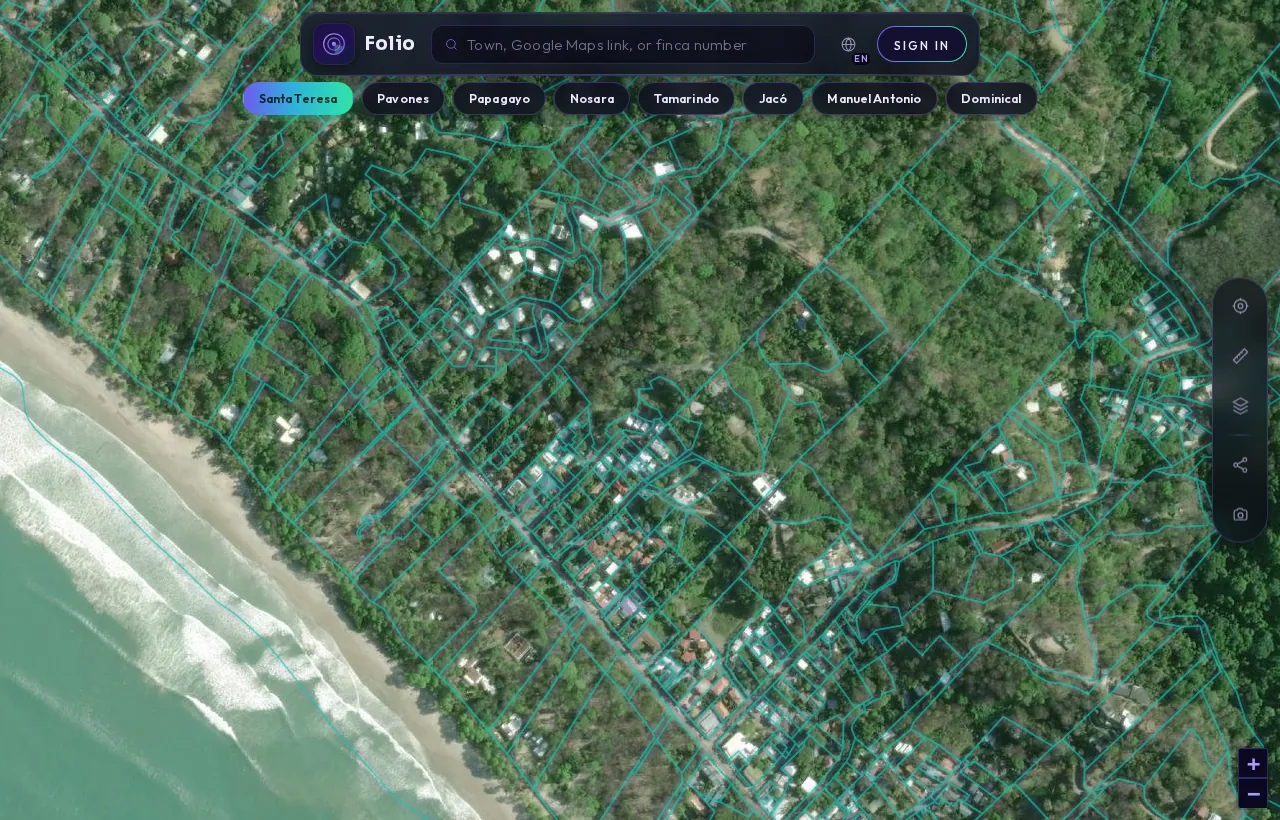
Any parcel, in the Folio app.
Search a town, a Google Maps link or a finca and Folio outlines the registered parcel from the national cadastre, with the maritime line, protected areas and water on top of it, before you call a lawyer or put down a deposit.
The deposit is the point where a casual interest becomes money at risk. Once you sign a reservation or option agreement and transfer funds, getting that money back depends on what the paperwork says, not on what the seller promised over coffee. That makes the days before the deposit the cheapest time to find problems.
Most of what you need is already in the public record. The work is reading it carefully and comparing it with what you have been told.
Why does the deposit matter more than the closing?
By closing day, a good attorney will have run a full title study. The trouble is that buyers may pay a reserva (reservation deposit) or sign an opción de compra (purchase option) weeks earlier, sometimes under pressure from an agent who says other buyers are interested. If the records later reveal a lien, a boundary problem or a seller who cannot legally sell, your leverage depends entirely on the conditions written into that early agreement.
So treat the pre-deposit stage as a short, focused version of due diligence. You are not trying to answer every question. You are trying to catch anything that should stop the deal, or that should be written into the deposit terms as a condition.
Is the seller actually the registered owner?
Start with the Registro Nacional (National Registry). Every titled property has a registry entry, and you can request a consultation or certificación (certified extract) through the Registro Nacional digital services. That entry shows who the registered owner is, the property's measured area, and what is recorded against it.
Compare the owner on the record with the person or company you are dealing with. Common mismatches include:
- The seller is a relative or partner of the owner, not the owner.
- The owner is a sociedad anónima (corporation), and the person signing has not shown they hold the power to sell on its behalf.
- The seller is acting under a poder (power of attorney) that may be limited, expired or revoked.
- The owner has died and the estate has not been legally settled.
Any of these can be resolved, but none should be glossed over. Title fraud can rely on a buyer not checking who really holds the property and who has authority to sign. Our guide on how to spot and avoid property title fraud covers the warning signs in more detail.
What is recorded against the title?
The registry entry also lists gravámenes (encumbrances) and anotaciones (annotations). This is where a deal can quietly change shape. Look for:
- Hipotecas (mortgages): the seller may owe a bank, and the debt has to be cancelled before or at closing.
- Embargos (court-ordered attachments): a creditor has asked a court to secure the property against a debt.
- Servidumbres (easements): a right of way or utility line crossing the land, which may limit where you can build.
- Anotaciones: pending documents or legal actions noted on the record but not yet resolved, which can affect who ends up owning the property.
An encumbrance is not automatically a deal breaker. A mortgage being paid off from the sale proceeds can be a normal part of a sale. What matters is that you know about it before you pay, and that the deposit agreement says how it will be cleared. Ask your attorney to confirm what each entry means for your purchase.
Does the plano match the land you walked?
The plano catastrado (registered survey plan) is the official drawing of the parcel's boundaries and area. It is linked to the registry entry, and it should match both the title and what you saw on the ground.
Pull up the parcel on SNIT, the national territorial information viewer, and compare. Questions to ask yourself:
- Does the area on the plano match the area on the title?
- Do the boundaries on the map line up with the fences, roads and landmarks you were shown?
- Does the parcel overlap with a neighbouring lot, a road or a river?
- Is the land you were shown actually part of the parcel being sold, or partly next door?
Mismatches here can happen. A small discrepancy may only need a new survey. A large one can mean the "ocean view lot" you fell for is mostly someone else's land.
Check a lot against the official map layers in the free Folio app.
Check it freeIs the parcel touched by the maritime zone, a protected area or water?
Three overlays can sharply limit what you can own or build, and none of them are obvious from walking the land.
The maritime zone
Land near the coast may fall within the zona marítimo terrestre (maritime terrestrial zone). Parts of that zone are not private property at all and are held under municipal concessions rather than titles. If a beach parcel is sold to you as titled land, confirm exactly where the maritime line falls relative to it.
Protected areas
National parks, wildlife refuges and other protected areas can overlap or border private parcels. Inside or near them, building and land use can be heavily restricted.
Water
Rivers, streams and springs often carry protection setbacks, and water availability for a home is a separate question from title. A parcel without a reliable, legal water source may be very hard to build on. Ask your attorney which setback rules apply to the specific parcel.
Is there legal access, and are taxes paid?
A parcel needs legal access to a public road. Physical access, such as a dirt track you drove in on, is not the same thing. If access crosses a neighbour's land, check whether a registered easement exists or whether you are relying on goodwill that could end.
Ask the seller for proof that municipal property taxes are current. Unpaid amounts can follow the property, and a seller who resists showing this is telling you something. While you are at it, ask about any municipal land use plan (plan regulador) that sets what can be built in the area.
Get the free Costa Rica buyer's checklist
What to ask for, what to pull from the registry and what to confirm on the map before you sign anything. One short email, no spam.
Is anyone living on it or suing over it?
The registry tells you who owns the land on paper. It does not tell you who is living on it. Occupants who have been on a property for a long time may assert rights, so ask your attorney what rights they could claim and what removing them would involve. Visit the land, look for signs of occupation, talk to neighbours, and read our guide on squatter rights in Costa Rica before you assume an empty-looking lot is empty.
Court disputes over the property or the seller can also matter, especially inheritance cases, divorces and debt claims. The Poder Judicial (judicial branch) provides public information about court processes, and your attorney can check for cases involving the seller or the property.
How should the deposit itself be protected?
Even when the records look clean, write the deposit agreement as if they might not be. A careful agreement usually:
- Names the property by its registry and cadastre references, so there is no doubt what is being sold.
- Sets a due diligence period during which you can withdraw and recover your deposit.
- Lists specific conditions, such as cancellation of a mortgage or correction of the survey, that must be met before closing.
- Has funds held by a neutral escrow agent rather than paid directly to the seller or agent.
- States clearly what happens to the deposit if either side backs out.
A Costa Rica attorney or notary should draft or review this agreement. They work within rules you will not know as a buyer, and our article on whether you need a lawyer to buy property in Costa Rica explains what their role covers.
A short pre-deposit checklist
- Get the registry entry and confirm the registered owner matches the seller.
- Confirm the signer has authority to sell, especially for corporations or powers of attorney.
- Read every encumbrance and annotation, and decide how each will be cleared.
- Compare the plano with the title and with what you saw on the ground.
- Check the parcel against the maritime zone, protected areas and water layers.
- Confirm legal road access and current municipal taxes.
- Look for occupants and ask about court cases.
- Have an attorney review the deposit agreement and use escrow.
Where does Folio fit?
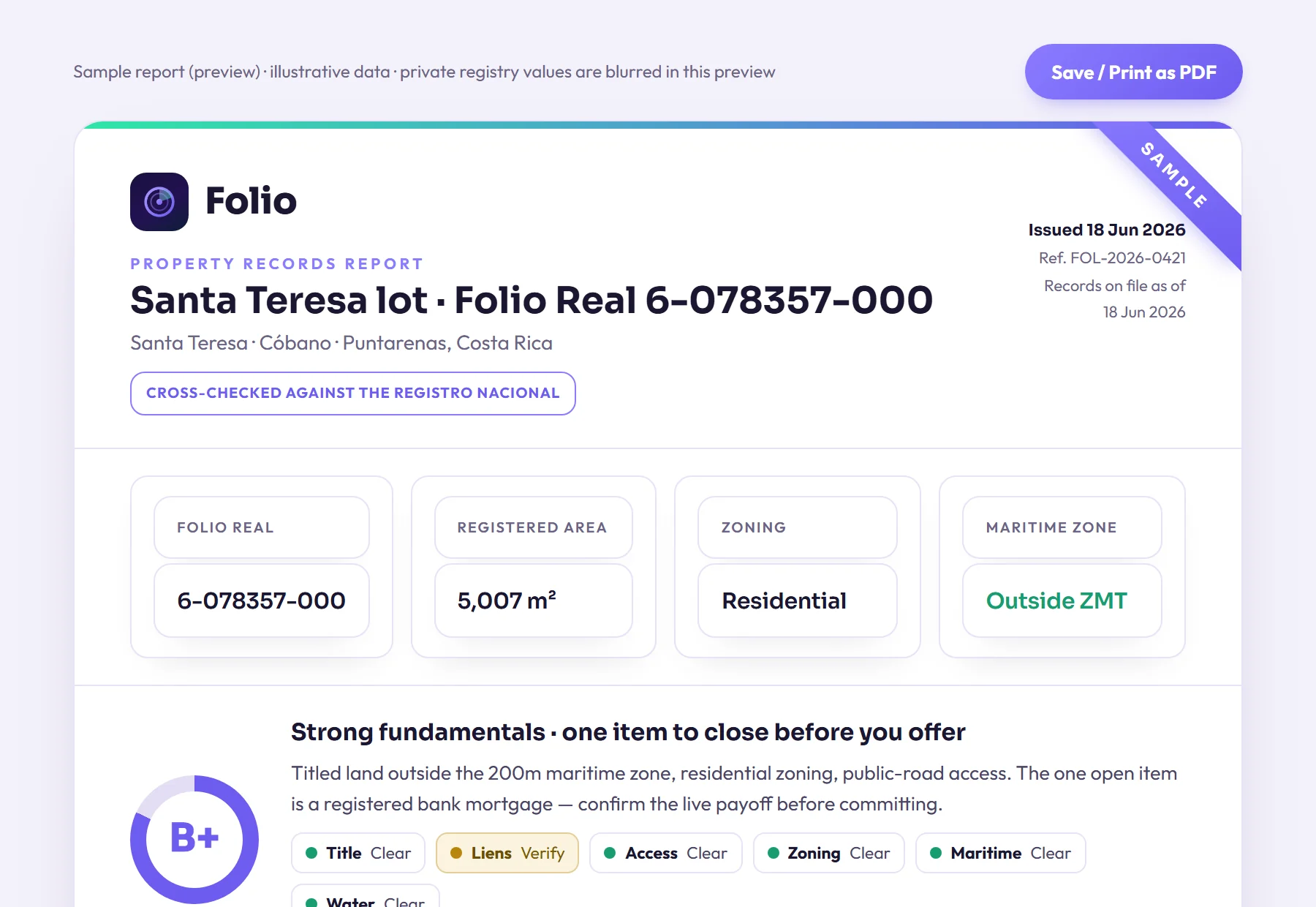
Folio reads the public records so you can see what they say before you commit money. The free Folio check screens a parcel against the official cadastre, maritime zone, protected areas and water layers. The $29 verified report adds a human-checked title and records search covering the registered owner, liens, taxes, water rights and the exact maritime line, delivered within 24 hours.
That gives you a clear picture of the records to bring to your attorney. It does not replace their advice, and it is not a judgment on whether you should buy. It simply means you walk into the deposit conversation knowing what the paperwork shows.
Know what you're buying before the deposit.
Most problems with a lot don't show up in the listing, and often the seller doesn't know about them either. Folio lets you find them now, before you pay a lawyer to start the purchase.
Frequently asked questions
Is a reservation deposit refundable in Costa Rica?
It depends entirely on what the signed agreement says. An agreement may allow a refund only if specific conditions are not met within a set period. Have an attorney review the terms before you pay, and avoid paying a deposit directly to the seller without written conditions.
Can I check who owns a property in Costa Rica myself?
Yes. The Registro Nacional offers registry consultations and certified extracts through its digital services, and these show the registered owner and what is recorded against the title. Reading the entries correctly takes practice, so ask your attorney to confirm what any encumbrance or annotation means.
What is the difference between the title and the plano?
The title is the registry entry that records ownership and any encumbrances. The plano catastrado is the registered survey plan showing the parcel's boundaries and area. They should agree with each other and with the land on the ground, and mismatches are worth resolving before you pay a deposit.
Does a clean registry entry mean there are no problems?
No. The registry does not show occupants on the land, physical access issues, water availability or every possible court dispute. You still need a site visit, questions to neighbours and a review by an attorney who can check the points the registry does not cover.
Sources
- Registro Nacional digital services (certificaciones and registry consultations), Registro Nacional de Costa Rica
- SNIT, Sistema Nacional de Información Territorial (official geospatial viewer), Instituto Geográfico Nacional / Registro Nacional
- Poder Judicial de Costa Rica, Poder Judicial
Educational, not legal advice. Folio reports what public records show; it does not replace a licensed Costa Rican attorney, notary or surveyor. Confirm material facts with them before any transaction. Photos are illustrative.