Under Ley 6043, Costa Rica's maritime terrestrial zone is a 200 metre strip along both coasts. The first 50 metres from the ordinary high-tide line are the public zone, and the remaining 150 metres are the restricted zone. All mangroves count as public zone regardless of how far inland they reach.
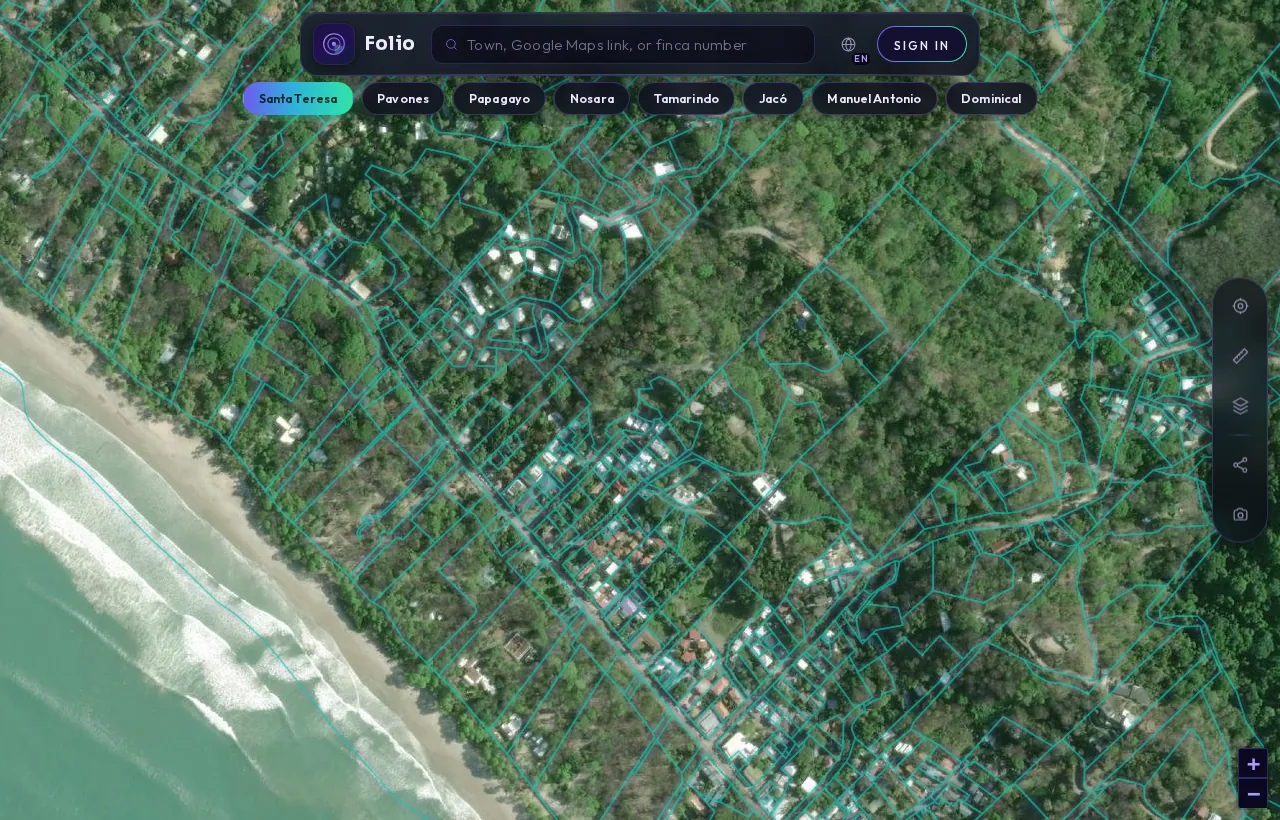
Any parcel, in the Folio app.
Search a town, a Google Maps link or a finca and Folio outlines the registered parcel from the national cadastre, with the maritime line, protected areas and water on top of it, before you call a lawyer or put down a deposit.
The short version: Costa Rica's coastal strip has two layers. The public zone (zona pública) sits closest to the sea. The restricted zone (zona restringida) sits behind it. Ley 6043 draws that line in a few sentences, and those sentences matter more than anything a listing agent tells you about "beachfront" land.
This article reads Articles 9, 10 and 11 of the law using the text itself, then covers two neighbouring rules (Articles 12 and 47) that are relevant to buyers. If you want the wider background first, start with our guide to how the Costa Rica maritime zone works.
What does Ley 6043 say the maritime zone is?
Article 9 defines the whole strip. The text, as published by the Instituto Costarricense de Turismo (ICT) in the full text of the Ley sobre la Zona Marítimo Terrestre, reads:
"Zona marítimo terrestre es la franja de doscientos metros de ancho a todo lo largo de los litorales Atlántico y Pacífico de la República"
In plain English, the zona marítimo terrestre (maritime terrestrial zone, often shortened to ZMT) is a band 200 metres wide running along the entire Atlantic and Pacific coastlines. It is measured horizontally from the ordinary high-tide line, called the pleamar ordinaria.
Two details in that definition are worth noting. First, the measurement is horizontal, so a steep slope does not stretch or shrink the zone. Second, the starting point is the ordinary high-tide line, not the edge of the water on the day you visit. Where exactly that line falls for a given parcel is a technical question for a surveyor and your attorney, not something you can judge by eye.
Where does the public zone end and the restricted zone begin?
Article 10 splits the 200 metres into two parts. The first part is the public zone:
"la Zona Pública, que es la faja de cincuenta metros de ancho a contar de la pleamar ordinaria"
That is the strip 50 metres wide counted from the ordinary high-tide line. The second part is the restricted zone:
"la Zona Restringida, constituida por la franja de los ciento cincuenta metros restantes"
That is the remaining 150 metres. Put together, the two layers look like this:
| Layer | Spanish term | Width under Article 10 | Measured from |
|---|---|---|---|
| Public zone | Zona pública | First 50 metres | Ordinary high-tide line |
| Restricted zone | Zona restringida | Remaining 150 metres | Inland edge of the public zone |
| Whole maritime zone | Zona marítimo terrestre | 200 metres in total | Ordinary high-tide line |
Notice what the law does here. It does not describe the restricted zone as private land or as something lesser than the zone itself. Both layers are part of the same maritime zone. The difference is in how each layer is treated, which the rest of the law fills in.
Why do mangroves change the map?
Article 11 adds a rule that can move the public zone well past 50 metres:
"Zona pública es también, sea cual fuere su extensión, la ocupada por todos los manglares"
All land occupied by mangroves is public zone, whatever its extent. So if a mangrove reaches deep inland along an estuary, the public zone follows it. A parcel that looks comfortably inside the restricted zone on a simple distance calculation can still touch public zone if mangroves are present.
This is one reason a tape-measure approach can fail where mangroves are present, such as near estuaries. When you review a property near water, ask your attorney specifically whether mangroves have been mapped on or next to it, and how that affects the boundary the authorities recognise.
See whether a coastal lot touches the maritime zone in the free app.
Check it freeWhat can and cannot happen inside the zone?
Article 12 applies to the whole maritime zone, not only the public part. The verified text begins:
"En la zona marítimo terrestre es prohibido, sin la debida autorización legal, explotar la flora y fauna existentes, deslindar con cercas"
Without proper legal authorisation, the law prohibits exploiting the existing plants and animals and putting up fences. The article goes on to cover building, cutting trees and other development. The key phrase is sin la debida autorización legal (without due legal authorisation). Activity in the zone depends on having the right permission in place.
What this means in practice:
- A wall, fence or structure you see on a coastal lot is not evidence that it was authorised. Ask for the permits.
- Landscaping, clearing or tree removal can raise the same question.
- Ask your attorney whether the rules on what may be authorised differ between the public and restricted zones, and which rules apply to the exact footprint of the land you are looking at.
The ICT's maritime zone programme page covers coastal plans and regulations, and it is a useful starting point for understanding which plans and regulations exist. Whether a plan covers a particular stretch of coast, and what it allows, is something your attorney should confirm.
Get the free Costa Rica buyer's checklist
What to ask for, what to pull from the registry and what to confirm on the map before you sign anything. One short email, no spam.
How does the split affect what you can actually hold?
This is the practical heart of the issue. Land inside the maritime zone is generally held through a concesión (concession), a right granted under the law, rather than as titled property in the National Registry. Land outside the zone can be titled in the normal way. Our guide to concession vs titled property explains how the two differ and what each looks like in the records.
Ley 6043 also limits who can hold a concession. Article 47(a) excludes:
"A extranjeros que no hayan residido en el país por lo menos durante cinco años"
That is, foreigners who have not resided in Costa Rica for at least five years. If you are presented with a structure that places a concession inside a company, that arrangement raises its own legal questions, and only an attorney can tell you whether a particular structure complies with the law.
The practical point is simple. Before you discuss price, find out whether the land you are being offered is titled, held under a concession, or a mix of both, and which zone each part falls in.
What the law cannot tell you about a specific lot
Articles 9 to 11 give you the rule. They do not tell you where the line sits on a given parcel. A few gaps are worth checking when reading coastal records:
- The high-tide line is an official reference. The boundary depends on where the authorities have placed it, not on where the water looks to be today.
- A survey plan can be older than the current boundary. The cadastral plan (plano catastrado) attached to a property may not reflect later boundary work. Ask your attorney whether it does.
- Mangroves and estuaries move the public zone. Article 11 means a simple 50 metre measurement can understate it.
- Titled land can sit right next to the zone. A lot can be properly titled and still border, or partly overlap, the maritime zone. The overlap is the part that needs attention.
Our study of Costa Rica's maritime zone looks at these issues in more depth. Treat any figures there as a sample, not a full census of the coast.
Questions to put to your attorney
Folio shows what the public records say. Your attorney or notary interprets them and advises you. Bring these questions to that conversation:
- Does any part of this parcel fall within the 200 metre maritime zone, and if so, in which layer?
- Where is the ordinary high-tide line for this stretch of coast, and how was it established?
- Are there mangroves on or next to the land that would extend the public zone?
- Is the land titled, held under a concession, or both, and does the paperwork match what the seller describes?
- Do the existing fences, buildings and clearing have the legal authorisation that Article 12 requires?
- If a concession is involved, does the holder meet the requirements of Article 47, and does any company structure hold up?
The difference between the public zone and the restricted zone takes two sentences of law to state. Applying it to a real piece of coast takes records, a survey and professional advice. Reading the law first gives you the right questions to ask.
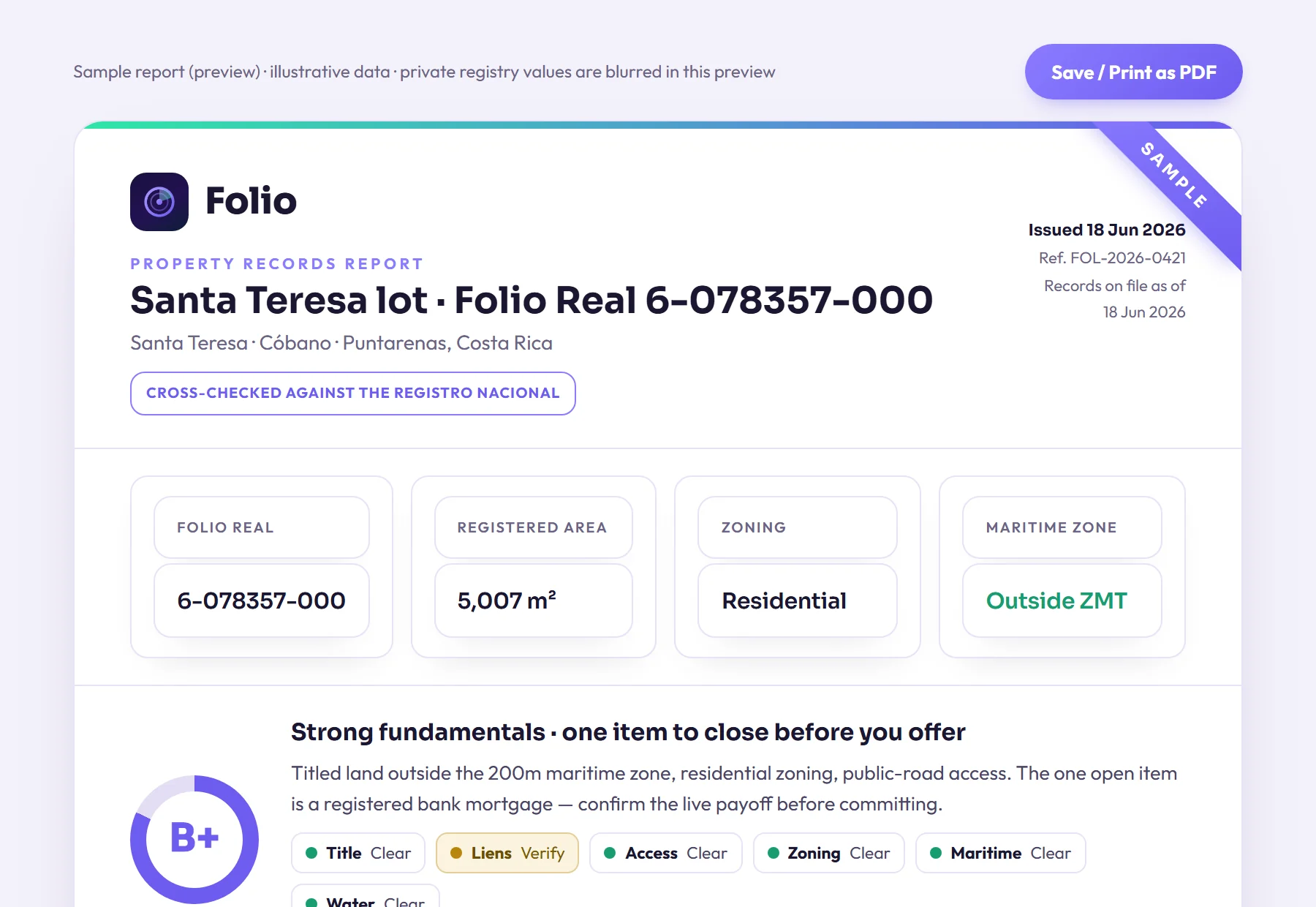
Know what you're buying before the deposit.
Most problems with a lot don't show up in the listing, and often the seller doesn't know about them either. Folio lets you find them now, before you pay a lawyer to start the purchase.
Frequently asked questions
How wide is the public zone in Costa Rica?
Under Article 10 of Ley 6043, the public zone is the first 50 metres measured from the ordinary high-tide line. Article 11 extends it to cover all mangroves, whatever their extent, so it can reach further inland than 50 metres.
How wide is the restricted zone?
The restricted zone is the remaining 150 metres of the 200 metre maritime terrestrial zone, lying inland of the public zone. It is still part of the maritime zone, so it is generally held through a concession rather than titled ownership. Ask your attorney to confirm how this applies to a specific parcel.
Can I build or put up a fence in the maritime zone?
Article 12 of Ley 6043 prohibits fencing, building, cutting trees and other development in the maritime zone without due legal authorisation. Ask your attorney whether authorisation is possible and what it would allow, including how the zone the land is in and any applicable regulations affect that. An attorney should review any existing structures and permits before you buy.
Can a foreigner hold a concession in the restricted zone?
Article 47(a) of Ley 6043 says concessions are not granted to foreigners who have not resided in Costa Rica for at least five years. If you are offered a company structure instead, it needs careful review by an attorney to confirm it complies with the law.
Sources
- Ley sobre la Zona Marítimo Terrestre, Ley 6043 (full text published by ICT), Instituto Costarricense de Turismo (ICT)
- Zona Marítimo Terrestre (maritime zone programme, coastal plans and regulations), Instituto Costarricense de Turismo (ICT)
Educational, not legal advice. Folio reports what public records show; it does not replace a licensed Costa Rican attorney, notary or surveyor. Confirm material facts with them before any transaction. Photos are illustrative.