A servidumbre de vista is a view easement: a registered burden on one property that protects a view or an opening (such as a window or terrace) belonging to a neighboring property. Depending on its wording, it may limit what you build on the burdened lot. The exact limits depend on the deed behind the registry entry, so read that document and ask your attorney what it means for your plans.
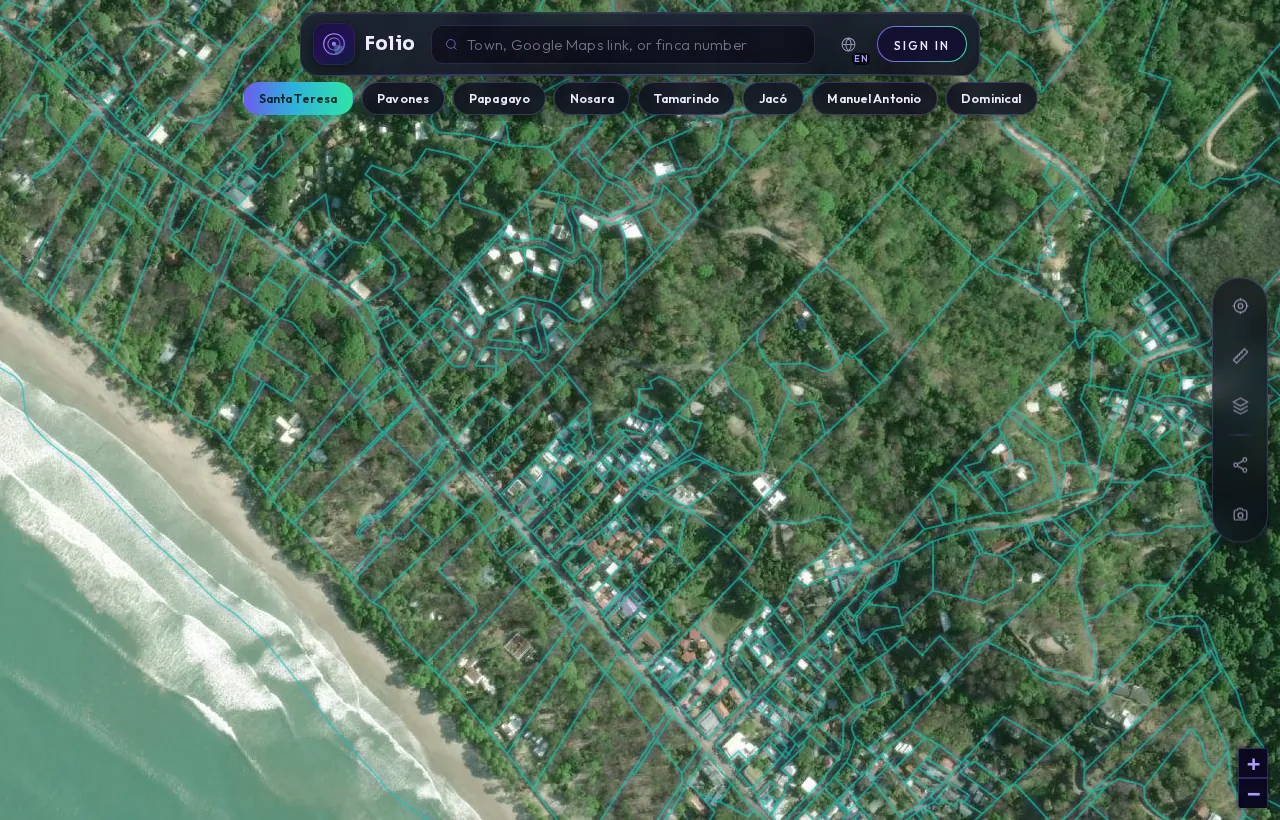
Any parcel, in the Folio app.
Search a town, a Google Maps link or a finca and Folio outlines the registered parcel from the national cadastre, with the maritime line, protected areas and water on top of it, before you call a lawyer or put down a deposit.
What turned up in our small sample
Counts come from 15 recent Folio verified reports from September and October 2026, a small sample and not a national rate.
What is a servidumbre de vista, in plain terms?
A servidumbre (easement) is a right that one property holds over another. The property that benefits is called the dominant property, and the property that carries the burden is the servient one. A servidumbre de vista is the version of this that deals with views and sightlines.
If the lot you want to buy carries a view easement in favor of a neighbor, you may not be free to build whatever you like wherever you like on it. If the lot you want benefits from one, it may protect the outlook you are paying for. The registry entry tells you which side you are on. The underlying deed tells you what the restriction actually says.
That second point matters. There is no single template we can point to that every view easement follows. Some may cap building height, some may keep a strip clear of structures, some may deal with windows or openings facing a boundary. Treat any general description, including this one, as a starting point for questions, not as the answer for a specific lot.
Where does a view easement appear on the registry certificate?
The document to read is the certificación literal, the full registry certificate for a finca (registered property) issued by the Registro Nacional. You can request certificates and run registry consultations through the Registro Nacional digital services.
On the certificates we have pulled, the layout is consistent. The certificate first describes the finca itself: NATURALEZA (what the property is, for example a lot for building), LINDEROS (boundaries), area, PLANO (the cadastral survey plan), IDENTIFICADOR PREDIAL, VALOR FISCAL and the owner. Then comes a block called ANOTACIONES SOBRE LA FINCA (annotations on the property), then a block called GRAVAMENES o AFECTACIONES (encumbrances and limitations).
Easements sit in that last block. Each entry starts with a heading line naming its type, so a view easement will be headed as a servidumbre de vista. Do not confuse this with NATURALEZA, which describes the property, not the encumbrance.
The fields worth reading inside the entry
- A FAVOR DE LA(S) FINCA(S): the property or properties that benefit from the easement.
- EN CONTRA DE LA(S) FINCA(S): the property or properties that carry the burden.
- CITAS: the registry reference for the document behind the entry. This is how your attorney finds the actual deed and its wording.
- LONGITUD, ANCHO, RUMBO: length, width and direction of an easement strip, where the entry describes one.
- MONTO: an amount. On easements in our sample this was a nominal value, not a market price for the right.
- INICIA EL / FINALIZA EL: start and end dates, where the entry has them.
- CANCELACIONES PARCIALES: whether part of the entry has been cancelled.
- ANOTACIONES DEL GRAVAMEN: notes recorded against that specific entry.
How often did we find view easements?
Not often, in a small sample. We looked at 15 Folio verified reports from September and October 2026, each built on a certificación literal pulled from the Registro Nacional. This is a small set of recent paid reports, not a national rate, and it should not be read as one.
| Entry type on the certificate | Reports | Share of the 15 |
|---|---|---|
| Any servidumbre (de paso, sirviente, de vista, agrícola) | 6 | 40% |
| Servidumbre de paso (right of way) | 5 | 33% |
| Servidumbre de vista (view easement) | 1 | 7% |
| Reservas y restricciones carried from an older parent finca | 4 | 27% |
So a view easement turned up on 1 of 15 certificates, while rights of way were far more common. The broader picture is the one to remember: 13 of the 15 reports (87%) had at least one entry under gravámenes o afectaciones, and only 2 (13%) had neither encumbrances nor annotations on the property. A certificate with something in the encumbrance block is the norm in our sample. What matters is what each entry says.
What can a view easement restrict?
Because the wording lives in the deed, the honest answer is "whatever that deed says, as interpreted by your attorney." The questions to ask are practical:
- Can you build to the height you planned, or is there a limit that protects a neighbor's outlook?
- Is there a zone on the lot where structures are not allowed?
- Are trees, hedges or other plantings affected?
- Does it concern windows, balconies or openings near a boundary?
- Does it run to a date, or does the entry have no end date?
Bring your architect's sketch to the conversation with your attorney. A restriction that sounds minor on paper can decide whether a second floor or a pool deck fits the lot.
See a lot's official boundary and area on the free Folio map.
Check it freeWhich side of the easement are you on?
This is the first thing to establish, and the certificate answers it directly. If the property you are buying appears under EN CONTRA DE, your lot carries the burden. If it appears under A FAVOR DE, your lot benefits, and the easement may be part of what you are paying for.
A benefiting easement is worth reading just as carefully. You want to know what view it protects, against which neighboring property, and whether any partial cancellation or note has narrowed it since it was first recorded. Your attorney can check this against the deed referenced in CITAS.
Get the free Costa Rica buyer's checklist
What to ask for, what to pull from the registry and what to confirm on the map before you sign anything. One short email, no spam.
Is a view easement the same as a zoning rule?
No. A servidumbre de vista is a registered right between properties, recorded on the finca. Zoning and land use are set by the municipality and checked through the uso de suelo (land use certificate). Both can limit what you build, and they can overlap, so you need to check both. Our guide on checking uso de suelo before you buy covers the municipal side.
If views are a big part of why you want a lot, read any view easement especially carefully. If you are looking near the shore, read our guide to buying a beachfront lot in Costa Rica as well, since maritime zone rules are a separate layer again.
What should you do before you sign?
- Get a current certificación literal for the exact finca you are buying, not a summary from the seller.
- Read the GRAVAMENES o AFECTACIONES block line by line and note every entry heading, including any servidumbre de vista.
- Check A FAVOR DE and EN CONTRA DE to see whether your lot benefits or carries the burden.
- Ask your attorney to pull the deed referenced in CITAS and explain the actual wording.
- Look at ANOTACIONES SOBRE LA FINCA too. In our sample, 3 of 15 reports (20%) had entries there, including administrative warnings, registry freezes over inconsistencies, and a sale deed presented but not yet fully recorded.
- If the certificate shows a demanda (lawsuit annotation), your attorney can look into the case through the Poder Judicial.
- Compare the easement against your building plans and the municipal uso de suelo before you commit.
What the records can and cannot tell you
The registry tells you that an easement exists, which properties it links, and where to find the document behind it. It does not tell you how a neighbor will react to your plans, whether the easement has been respected on the ground, or how a dispute would be resolved. Those are questions for your attorney or notary.
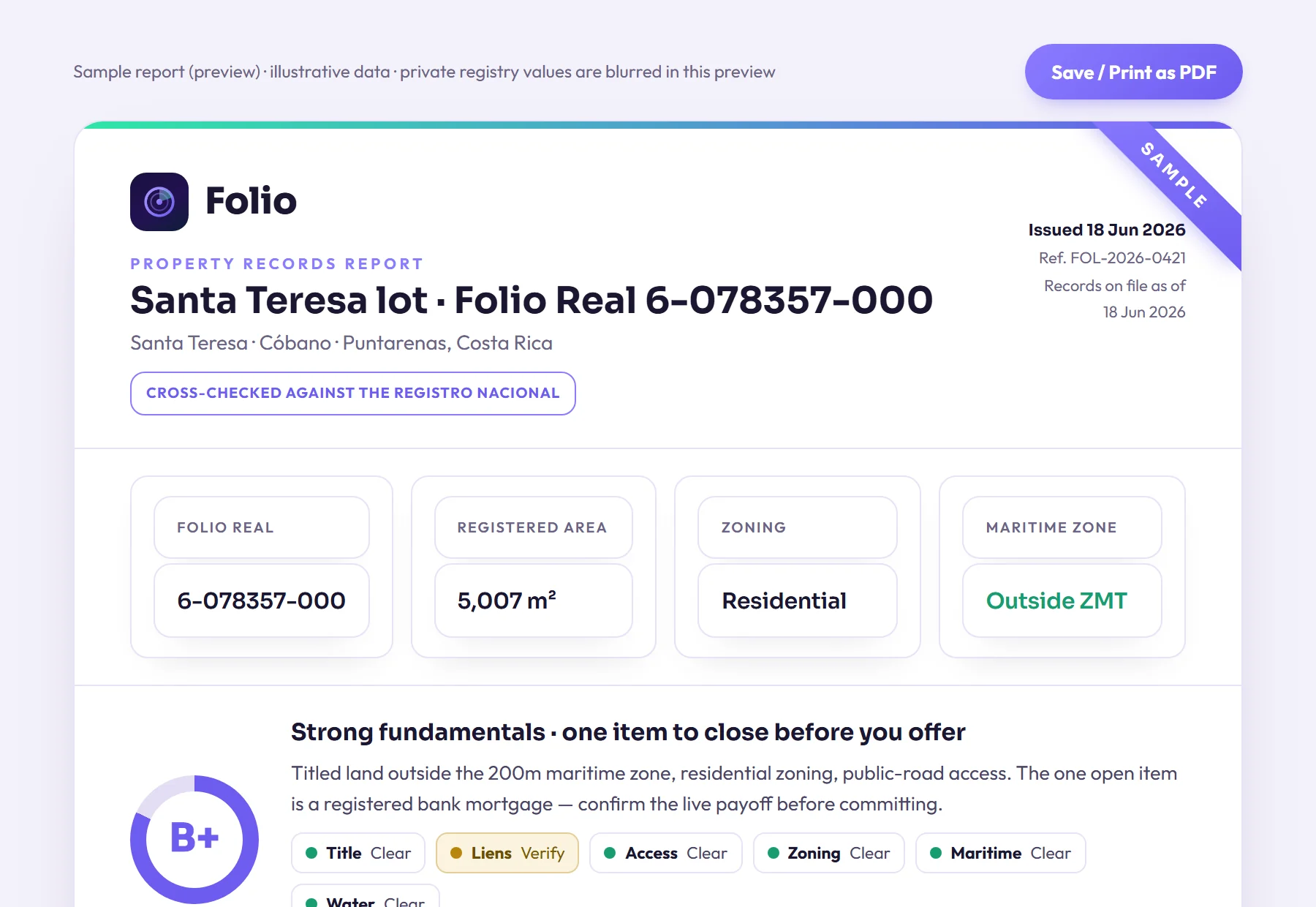
Folio's free map check is a map tool: it shows a lot's finca number, area, perimeter and boundary from the official cadastre, plus a maritime zone flag, and that is all. Title details such as the registered owner, liens and easements come from the $29 verified report, a human-checked title and records search delivered within 24 hours. You can see exactly what a Folio property report includes before ordering. The report shows what the public records say; your attorney advises on what it means.
Know what you're buying before the deposit.
Most problems with a lot don't show up in the listing, and often the seller doesn't know about them either. Folio lets you find them now, before you pay a lawyer to start the purchase.
Frequently asked questions
Does a servidumbre de vista stop me from building on my lot?
Not necessarily, but it can limit how or where you build. The restriction depends on the wording of the deed behind the registry entry, which your attorney can locate through the CITAS reference. Compare that wording with your plans before you buy.
How do I know if a lot has a view easement?
Read the GRAVAMENES o AFECTACIONES block of the certificación literal from the Registro Nacional. Each entry starts with a heading naming its type, so a view easement will be labeled as a servidumbre de vista. Make sure the certificate is current and covers the exact finca you are buying.
Are view easements common in Costa Rica?
In our small sample of 15 recent Folio verified reports, only 1 carried a servidumbre de vista, while 5 carried a right of way easement. That sample is too small to give a national rate. Check every certificate individually rather than assuming.
Is a view easement a good or bad thing for a buyer?
It depends on which side you are on. If your lot is listed under A FAVOR DE, the easement may protect your view; if it is listed under EN CONTRA DE, your lot carries the restriction. Your attorney can explain the practical effect for your specific plans.
Sources
- Registro Nacional digital services (certificaciones and registry consultations), Registro Nacional de Costa Rica
- Poder Judicial de Costa Rica, Poder Judicial
- Folio data: Registro Nacional certificates pulled for recent paid Folio reports, aggregated and anonymized.
Educational, not legal advice. Folio reports what public records show; it does not replace a licensed Costa Rican attorney, notary or surveyor. Confirm material facts with them before any transaction. Photos are illustrative.