Yes. A lawsuit that concerns a property can be annotated on the finca's record at the Registro Nacional, where it appears as a "demanda" entry that anyone pulling a certificate can see. In a small sample of 11 recent Folio verified reports, we found a demanda annotation on 1 of them, so it does happen, but this sample is too small to say how often. If you see one, have your attorney identify the court case before you sign or pay anything.
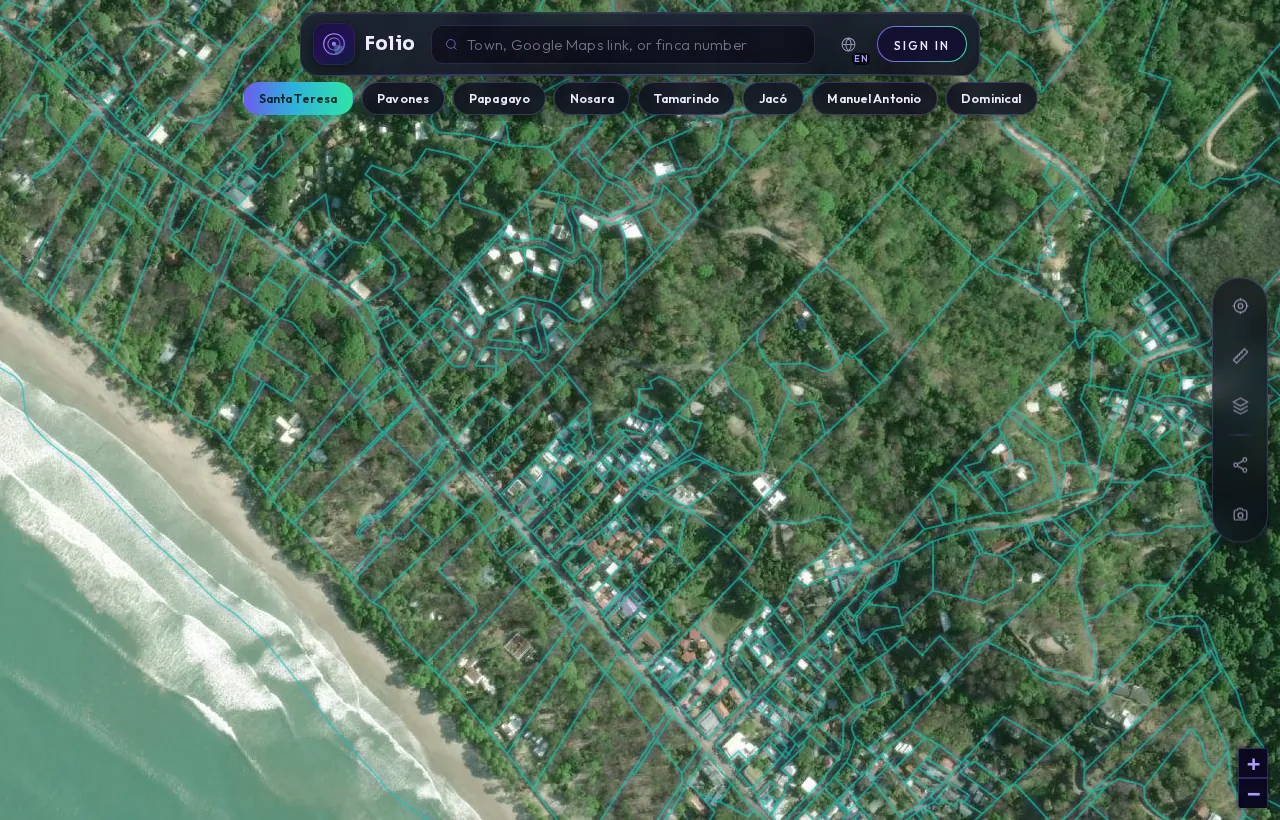
Any parcel, in the Folio app.
Search a town, a Google Maps link or a finca and Folio outlines the registered parcel from the national cadastre, with the maritime line, protected areas and water on top of it, before you call a lawyer or put down a deposit.
What turned up in our report sample
Counts come from 11 recent Folio verified reports pulled from the Registro Nacional, a small sample and not a national rate.
Can a lawsuit really show up on a property's registry record?
Yes. In Costa Rica, every registered property is a finca with its own record at the Registro Nacional. When a court case concerns that property, the case can be annotated on the record as a demanda (a lawsuit annotation). Once it is there, it appears on the official certificate that any buyer, lender or notary can request.
The annotation does not tell you who is right. It tells you a dispute exists and points to the court filing behind it. What the annotation means for a buyer depends on the type of case and the rules that apply to it, and that is a question for your attorney, not for a search result.
You can request certificates and run registry consultations through the Registro Nacional's digital services. The document Folio pulls for each verified report is the certificación literal, which reproduces the full current record of the finca.
What does a demanda anotada look like on a certificate?
A certificate follows a predictable order. It first describes the finca itself: its naturaleza (what the land is, for example a lot for building), location, linderos (boundaries to the north, south, east and west), area, plano (the cadastral survey plan), parcel identifier, fiscal value and owner. Then come two blocks of entries.
- ANOTACIONES SOBRE LA FINCA: annotations on the property, meaning notices that something is pending or flagged.
- GRAVAMENES o AFECTACIONES: gravámenes (encumbrances) and afectaciones (legal limitations), such as easements and statutory reservations.
Each entry starts with a heading line that names its type. For a lawsuit, the heading names it as a demanda. Do not confuse it with the NATURALEZA field at the top of the certificate, which describes the land, not the entry.
Under the heading, these fields matter most when you read a lawsuit entry:
- CITAS: the registry reference of the document behind the entry. For a demanda, this is your trail back to the court filing.
- AFECTA A FINCA: the finca the entry affects. Confirm it matches the property you are buying.
- MONTO: an amount stated in the entry. In our sample, the lawsuit annotation carried a MONTO field. Ask your attorney what it represents, and do not assume it is a payoff figure.
- ANOTACIONES DEL GRAVAMEN and CANCELACIONES PARCIALES: notes recorded against the entry, and whether part of it has been cancelled.
How often did we find lawsuits in Folio reports?
Once, in a sample too small to call a rate. We looked at the Registro Nacional certificación literal pulled for each of 11 paid Folio verified reports, issued in September and October 2026. One of them carried a demanda annotation. That is 9% of this sample, and it says nothing reliable about how common lawsuits are across the country.
The wider picture from the same 11 certificates is more useful. Almost every record had something on it.
| What appeared on the certificate | Reports | Share of sample |
|---|---|---|
| At least one gravamen or afectación | 10 | 91% |
| Any servidumbre (easement) | 5 | 45% |
| Anotaciones sobre la finca | 3 | 27% |
| Inmovilización por inconsistencia (registry freeze) | 2 | 18% |
| Advertencia administrativa (administrative warning) | 2 | 18% |
| Demanda (lawsuit annotation) | 1 | 9% |
| Nothing in either block | 1 | 9% |
The lesson is not that lawsuits are everywhere. The lesson is that a clean-looking listing tells you little, and only 1 of the 11 records had no entries at all. You need to read every entry and know which kind you are looking at.
Look up any lot's boundary and area in the free Folio map.
Check it freeIs an annotation the same as a lien?
Not quite, and the difference changes what you do next. Entries in the gravámenes block, like a servidumbre de paso (right-of-way easement) or a forestry reservation, describe conditions on the land. In our sample, some were generic reservations carried from an older parent finca. Ask your attorney how each one affects you as an owner.
Annotations are different. In our sample, they flagged things that looked open or pending. The annotations on the finca included:
- a sale deed presented to the registry but not yet fully recorded,
- administrative warnings, and
- registry freezes over an inconsistency, whose text cited an administrative file (expediente).
Whichever block it appears in, a lawsuit annotation is a signal that a question about the property is still being decided somewhere else. An easement may be something you accept and live with. An open lawsuit or freeze is something to understand with your attorney before money changes hands.
What should you do if a demanda appears on the finca?
Do not panic, and do not ignore it. Work through it in order with your attorney.
- Get a current certificación literal, not a copy the seller supplied weeks ago. Records change.
- Note the CITAS reference and any MONTO shown in the entry, plus anything under ANOTACIONES DEL GRAVAMEN.
- Ask your attorney to identify the court case and its current status. Case information is held by the Poder Judicial, and a lawyer can tell you what the filing actually claims.
- Ask what it would take for the annotation to be cancelled on the registry, and who is responsible for getting that done.
- Ask your attorney whether to hold off on deposits, option agreements or closing until the answers are clear, and which conditions to write into your contract.
A seller may tell you the case is "finished" or "nothing serious". That may be true. But the registry still shows it until a cancellation is recorded, so ask for the paper, not the reassurance.
Get the free Costa Rica buyer's checklist
What to ask for, what to pull from the registry and what to confirm on the map before you sign anything. One short email, no spam.
Why does this matter for title fraud?
Lawsuits over property sometimes exist precisely because someone disputes who owns it, or how a previous transfer happened. A demanda on the record can be the visible trace of an earlier problem, including one involving a forged or contested deed.
That is one reason to read the annotations block carefully alongside the ownership history. Our guide to spotting and avoiding property title fraud in Costa Rica covers warning signs to discuss with your attorney.
The reverse also matters. The registry only shows what has been presented to it. A dispute that has not been annotated will not appear on the certificate, so a record without a demanda is information, not a promise. Your attorney's own checks fill that gap.
What can a records check tell you, and what can it not?
A records check tells you what the public registry says today: the owner, the entries in both blocks, and the references behind them. It cannot tell you how a court will rule, whether a seller's explanation is accurate, or whether a deal structure protects you. Those are legal judgments.
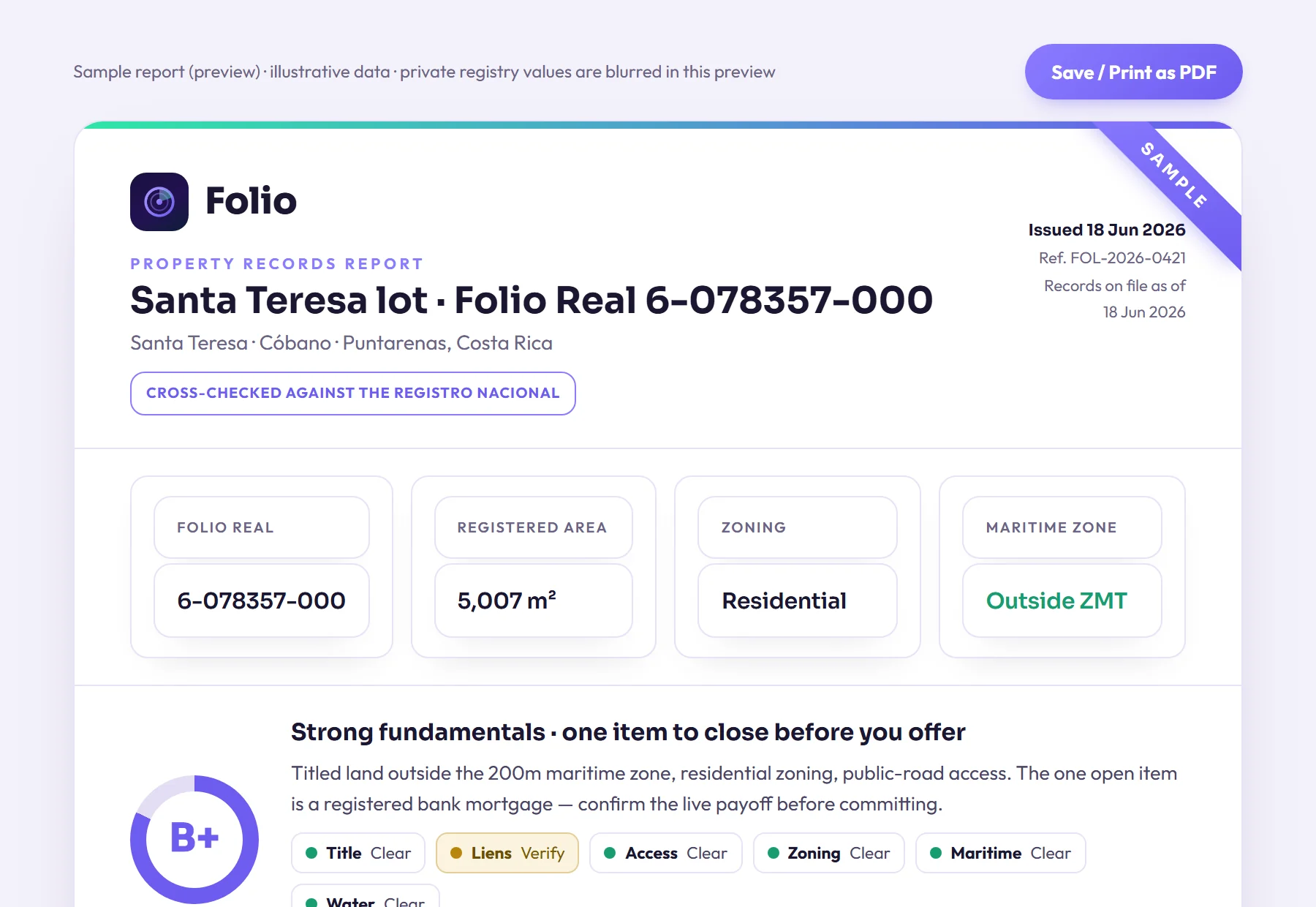
Folio's $29 verified report is a human-checked title and records search covering the registered owner, liens, taxes, water rights and the exact maritime line, delivered within 24 hours. You can see the full scope in what a Folio property report includes. Use it to arrive at your lawyer's office with the right questions.
If you are still deciding whether you need legal help at all, read do you need a lawyer to buy property in Costa Rica. When a lawsuit shows up on the finca, the short answer is yes.
Know what you're buying before the deposit.
Most problems with a lot don't show up in the listing, and often the seller doesn't know about them either. Folio lets you find them now, before you pay a lawyer to start the purchase.
Frequently asked questions
What does "demanda" mean on a Costa Rica registry certificate?
It is a lawsuit annotation recorded on the finca. It tells anyone reading the certificate that a court case concerns the property and gives a CITAS reference pointing to the filing. It does not tell you who is right or how the case will end.
How common are lawsuit annotations on Costa Rica properties?
We cannot give a national rate. In a small sample of 11 recent Folio verified reports, 1 certificate carried a demanda annotation. Other entries, such as easements and inherited reservations, were more common in the same sample.
Can I still buy a property that has a lawsuit annotated on it?
That depends on the case, what it claims and whether it can be resolved or cancelled before closing. Your attorney should identify the case, explain its effect on you, and advise on contract conditions. Ask your attorney before paying any deposit.
If there is no demanda on the certificate, does that mean there is no dispute?
Not necessarily. The registry shows only what has been presented to it, so a dispute that was never annotated will not appear. Treat a record without a demanda as useful information and let your attorney run their own checks.
How does a lawsuit annotation get removed from the record?
It stays on the certificate until a cancellation is recorded at the registry. Which document is needed, and who must obtain it, depends on the case. Ask your attorney to confirm the route and whether to make the cancellation a written condition of your purchase.
Sources
- Registro Nacional digital services (certificaciones and registry consultations), Registro Nacional de Costa Rica
- Poder Judicial de Costa Rica, Poder Judicial
- Folio data: Registro Nacional certificates pulled for recent paid Folio reports, aggregated and anonymized.
Educational, not legal advice. Folio reports what public records show; it does not replace a licensed Costa Rican attorney, notary or surveyor. Confirm material facts with them before any transaction. Photos are illustrative.