Easements turned up often enough in our recent registry pulls that you should be ready to read one. In a small sample of 9 recent Folio verified reports, 4 titles (44%) listed some kind of servidumbre (easement), and 3 (33%) listed a servidumbre de paso, a right-of-way easement. The sample is too small to be a national rate, but it shows why you should read every easement entry, and especially its direction, before you sign.
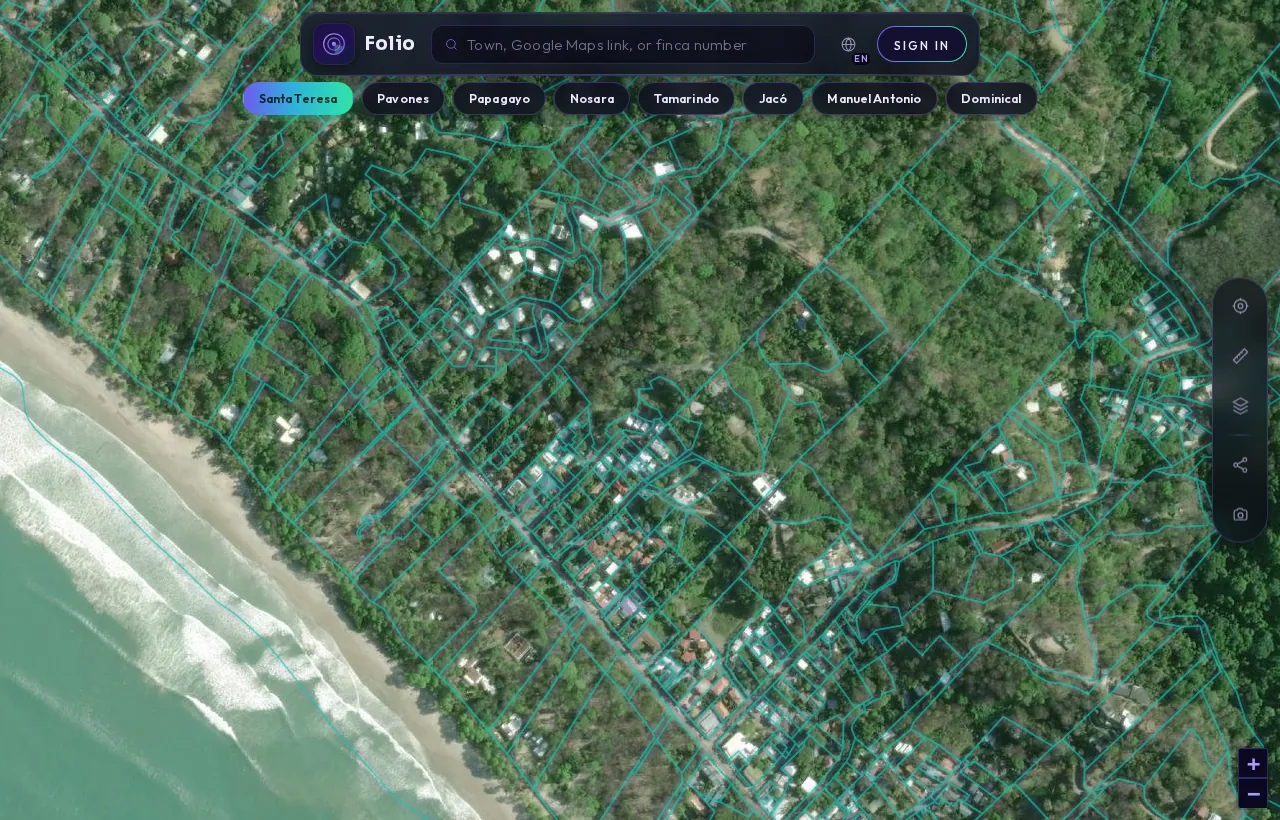
Any parcel, in the Folio app.
Search a town, a Google Maps link or a finca and Folio outlines the registered parcel from the national cadastre, with the maritime line, protected areas and water on top of it, before you call a lawyer or put down a deposit.
What our recent registry pulls showed
Counts come from 9 Folio verified reports delivered in September and October 2026, a small sample and not a national rate.
How often did easements appear in our recent registry pulls?
For every paid verified report, Folio pulls the certificación literal, the full registry certificate for the property, from the Registro Nacional (available through its digital services portal). We looked at the anonymized certificates from reports delivered in September and October 2026. There are only 9 of them, so treat what follows as a pattern worth knowing about, not a statistic about the whole country.
Across those 9 certificates, 4 (44%) listed at least one servidumbre. We counted any kind of easement in that figure: de paso (right of way), sirviente (servient), de vista (view) or agrícola (agricultural). Looking at specific types, 3 reports (33%) carried a servidumbre de paso and 1 report (11%) carried a servidumbre de vista.
Only 1 of the 9 certificates (11%) came back with nothing at all in either the gravámenes (encumbrances) section or the anotaciones (annotations) section. The other 8 had something you would want a lawyer to read.
What else showed up in the gravámenes and anotaciones sections?
On the certificate, the heading is GRAVAMENES o AFECTACIONES (encumbrances or affectations). Of our 9 reports, 8 (89%) had at least one entry there. Easements were only part of it. The table below lists the entry types we saw across both the gravámenes and the anotaciones sections, and how many reports contained each one. A single report can appear in several rows.
| Entry type on the certificate | Reports | Share of 9 reports |
|---|---|---|
| Any servidumbre (easement) | 4 | 44% |
| Servidumbre de paso (right of way) | 3 | 33% |
| Reservas y restricciones carried from an older parent finca | 3 | 33% |
| Inmovilización (registry freeze over an inconsistency) | 2 | 22% |
| Advertencia administrativa (administrative warning) | 2 | 22% |
| Servidumbre de vista (view easement) | 1 | 11% |
| Water law reservation | 1 | 11% |
| Roads law reservation | 1 | 11% |
| Forestry reservation | 1 | 11% |
| Forest protection limitation | 1 | 11% |
| Demanda (lawsuit annotation) | 1 | 11% |
| Obligaciones (registered obligations) | 1 | 11% |
The "reservas y restricciones" rows deserve a note. When a lot is split off from a larger property (a segregación), entries from the older parent finca can be carried forward onto the new title. That is one reason a small, recently created lot can still show a list of inherited entries. Some are routine, some are not, and the certificate alone may not tell you which.
The demanda annotation also matters. If a lawsuit is noted on the finca, your attorney can look into the case itself through the court system, starting from the Poder Judicial. The registry tells you a case exists; it does not tell you how it will end.
Which fields describe a servidumbre on the certificate?
An easement entry is not a single line of text. The certificates in our sample used a consistent set of field labels. Knowing what each one means makes the entry much easier to read.
- NATURALEZA: this describes the finca itself (for example a lot for building), not the easement. The type of entry, such as servidumbre de paso, is given by the heading line that starts the entry.
- LONGITUD and ANCHO: the length and width of the easement strip.
- RUMBO: the bearing or direction the strip runs.
- A FAVOR DE LA(S) FINCA(S): the property or properties that benefit from the easement.
- EN CONTRA DE LA(S) FINCA(S): the property or properties that carry the burden.
- AFECTA A FINCA: which finca the entry affects.
- CITAS: the registry reference of the document (deed, resolution or court filing) behind the entry.
- INICIA EL and FINALIZA EL: start and end dates, where the entry has them.
- CANCELACIONES PARCIALES and ANOTACIONES DEL GRAVAMEN: partial cancellations and notes attached to that specific encumbrance.
The certificate is a summary. If you need to know exactly what the easement allows (vehicles or only people on foot, who maintains the path, whether it can be moved), the answer is usually in the deed that the CITAS field points to. Ask your attorney to pull and read it.
See what the official maps show for your lot in the free Folio app.
Check it freeWhy does the direction of a servidumbre de paso matter?
This is the part worth slowing down for. The same easement can be good news or a real limitation, depending on which side of it your lot sits.
When your lot carries the burden
If the finca you are buying appears under EN CONTRA DE, your lot is the servient property. Someone else has a registered right to use a strip of it. With a right of way, that usually means a neighbor can cross your land along the path described by LONGITUD, ANCHO and RUMBO. That can affect where you build, where you put a gate or fence, and how private the lot really is.
When your lot benefits
If your finca appears under A FAVOR DE, the easement works for you. For a lot without direct frontage on a public road, a registered right of way in your favor may be how access is documented at all. If you expected access over a neighbor's land and you cannot find an entry in your favor, ask your attorney how the lot legally reaches the road before you go further.
Because easements involve at least two properties, it can help to read the certificate of the other finca too, and check whether the entry matches on both sides. If it does not, that is a question for your lawyer, not a detail to wave off.
Get the free Costa Rica buyer's checklist
What to ask for, what to pull from the registry and what to confirm on the map before you sign anything. One short email, no spam.
How does an easement relate to the survey plan?
The certificate describes the easement in words and measurements. The survey plan shows the land itself. A right of way strip described on the title should make sense when you look at the registered survey, the plano catastrado, and at what is physically on the ground.
Walk the lot with the plan in hand. Look for a path, a driveway, or a gate that suggests an easement in use. Look also for the opposite: a track that neighbors clearly use but that no registry entry mentions. Informal use and registered rights are not the same thing, and only your attorney can tell you what an unregistered path might mean.
What should you do when a title lists an easement?
An easement on the title is not necessarily a reason to walk away. It is a reason to read carefully. A sensible sequence looks like this:
- Get the full certificación literal, not a summary. It shows every entry in full.
- Read the heading line of the entry so you know which kind of servidumbre you are dealing with.
- Look at the direction: is your finca listed under A FAVOR DE or EN CONTRA DE?
- Note the length, width and bearing, then compare them with the plano and the lot itself.
- Ask your attorney to pull the deed cited in CITAS and explain the terms in plain language.
- Read every other entry in the gravámenes and anotaciones sections, not just the easement.
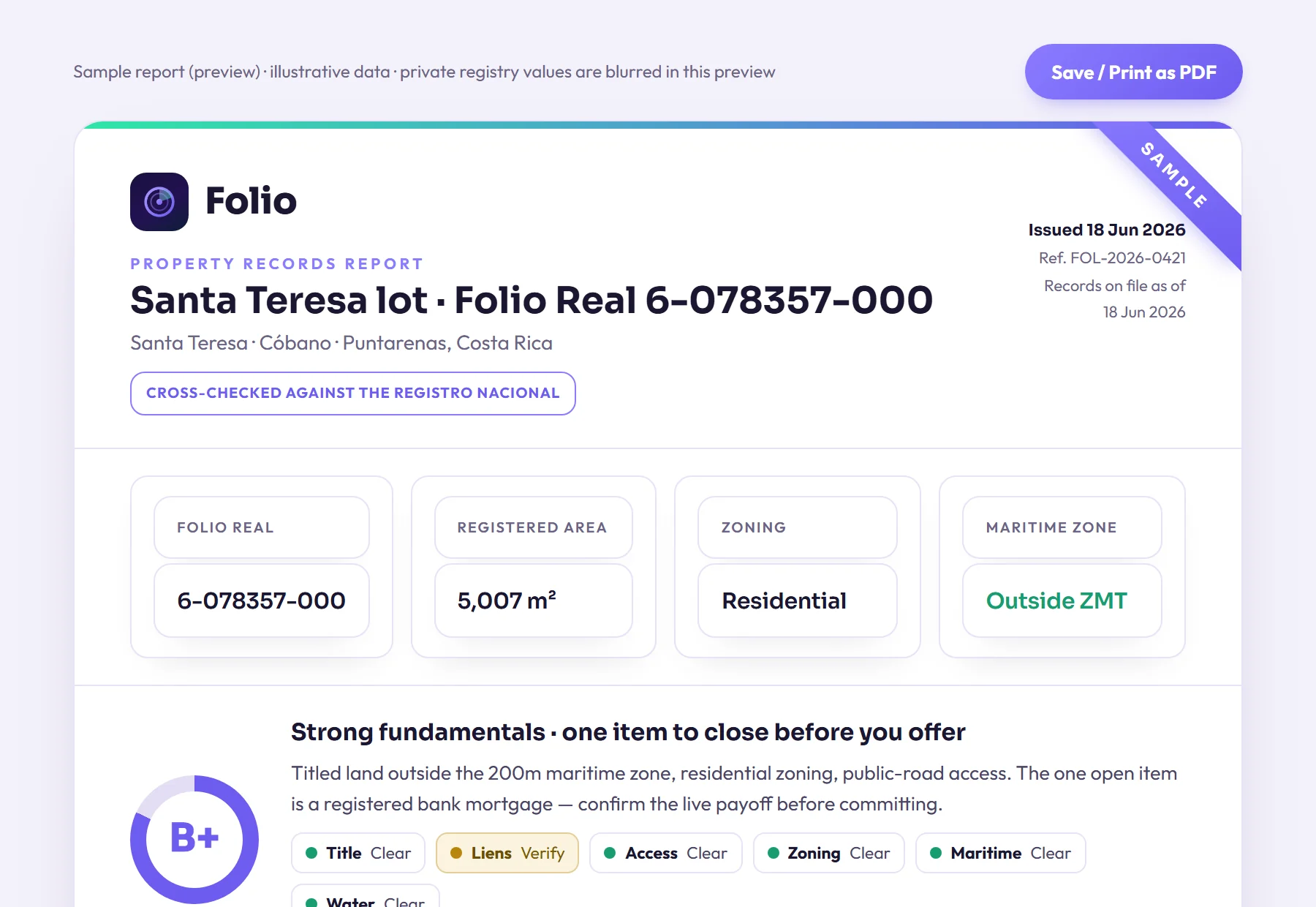
Easements belong on a wider list of checks. Our Costa Rica property due diligence checklist puts them in context alongside taxes, liens and zoning questions. If you want to see how these entries appear in a Folio report, read what a Folio property report includes.
Folio shows you what the public records say. Deciding what those records mean for your purchase is the job of a Costa Rica attorney or notary, and an easement is exactly the kind of entry worth paying them to read.
Know what you're buying before the deposit.
Most problems with a lot don't show up in the listing, and often the seller doesn't know about them either. Folio lets you find them now, before you pay a lawyer to start the purchase.
Frequently asked questions
Is it normal for a Costa Rica property title to have a servidumbre?
In our small sample of 9 recent registry certificates, 4 listed some kind of easement and 3 listed a right of way. That is too few reports to call a national rate, but it is a reason to be ready to read easement entries carefully. Ask your attorney whether a specific easement limits what you want to do with the land.
What is the difference between A FAVOR DE and EN CONTRA DE on the certificate?
A FAVOR DE lists the property that benefits from the easement, such as a lot that uses a path across its neighbor. EN CONTRA DE lists the property that carries the burden and must allow that use. The direction tells you whether the easement gives your lot a right or places a limit on it.
Where can I find the full terms of an easement?
The registry certificate summarizes the easement with fields like length, width and bearing. The full terms are usually in the deed referenced in the CITAS field. Your attorney or notary can obtain that deed and explain what it allows and requires.
What else did Folio find in the gravámenes section besides easements?
Of the 9 reports, 8 had at least one entry under gravámenes o afectaciones. Across the gravámenes and anotaciones sections, besides easements, we saw reservations carried from older parent properties, water, roads and forestry reservations, a forest protection limitation, registered obligations, a lawsuit annotation, administrative warnings and registry freezes. Only 1 certificate had no entries in either the gravámenes or anotaciones sections.
Sources
- Registro Nacional digital services (certificaciones and registry consultations), Registro Nacional de Costa Rica
- Poder Judicial de Costa Rica, Poder Judicial
- Folio data: Registro Nacional certificates pulled for recent paid Folio reports, aggregated and anonymized.
Educational, not legal advice. Folio reports what public records show; it does not replace a licensed Costa Rican attorney, notary or surveyor. Confirm material facts with them before any transaction. Photos are illustrative.