If the person selling you a Costa Rica property is not the owner named on the Registro Nacional certificate, stop and find out why before any money moves. There are ordinary explanations, such as a company owner, a purchase not yet recorded, or someone acting on the owner's behalf. Only the registry record and your attorney can confirm which explanation applies to your deal.
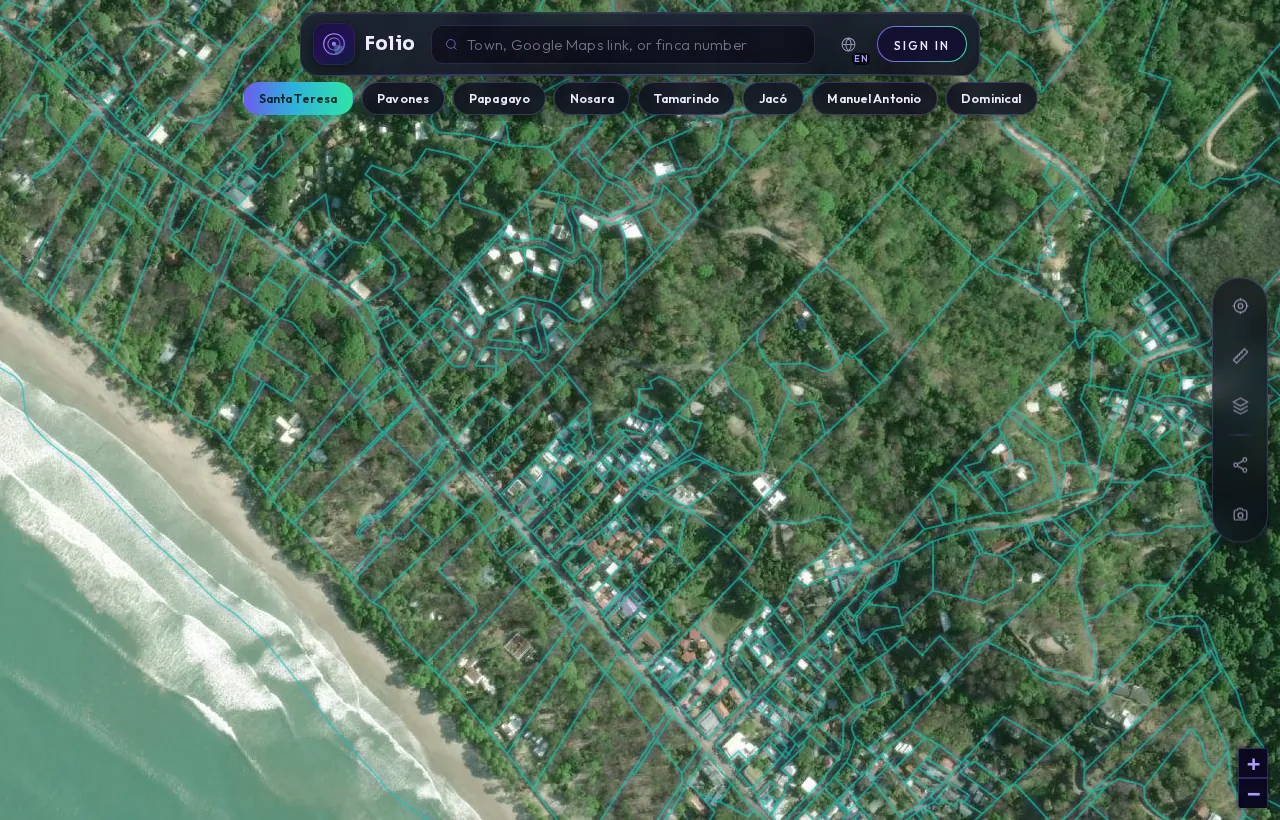
Any parcel, in the Folio app.
Search a town, a Google Maps link or a finca and Folio outlines the registered parcel from the national cadastre, with the maritime line, protected areas and water on top of it, before you call a lawyer or put down a deposit.
What 15 recent Folio reports showed
Counts from a small sample of Folio verified reports pulled in September and October 2026, a snapshot and not a national rate.
Who decides who owns the land: the seller or the registry?
The registry does. In Costa Rica, the record held by the Registro Nacional is the reference point for who holds title to a finca (a registered property). What a seller tells you and what a listing says are secondary to that record.
So when the name on the certificate does not match the person across the table, treat it as a question that needs a documented answer. It is not automatically a scam. It is also not something to wave through because the explanation sounds reasonable.
Where does the owner's name appear on the certificate?
One document you can request is a certificación literal, a full transcript of the finca's registry record. You can request certificates and run consultations through the Registro Nacional's digital services. If you have never done this, our guide on how to search the Costa Rica property registry yourself walks through it.
On the certificates we read, the record follows a consistent order. It first describes the finca itself, then the owner, then lists entries in two blocks:
- NATURALEZA: what the finca is (for example, a lot for building).
- LINDEROS: the boundaries, described by what lies to the north, south, east and west.
- PLANO: the number of the cadastral survey plan linked to the finca. Our guide on what a plano catastrado is explains why it matters.
- IDENTIFICADOR PREDIAL: a parcel identifier code.
- VALOR FISCAL: a fiscal value recorded in colones.
- The registered owner, named in this opening description.
- ANOTACIONES SOBRE LA FINCA: notes recorded against the property as a whole.
- GRAVAMENES o AFECTACIONES: encumbrances and limitations, such as easements and reservations.
The owner line is the one to compare against the seller's identity document. Compare it letter by letter. Similar names, a missing second surname, or an identity number that does not match are all worth raising.
Why might the seller's name differ from the registered owner?
Several explanations are possible. Each one points to a different document your attorney should see.
- The owner is a company. A property can be held by a corporation rather than a person. The seller may be a shareholder or officer. Your attorney will want to confirm who actually has authority to sign for that company today.
- The seller bought recently and the deed is not fully recorded. A purchase deed can be presented to the registry before it is finally recorded. Until it is, the previous owner may still appear on the record.
- Someone is acting for the owner. A relative, agent or representative may claim authority to sell. That authority should exist on paper, and your attorney should verify its scope and that it is still in force.
- The owner has died. A family member may be selling on behalf of heirs. Whether they can transfer title yet depends on the status of the estate, which is a matter for your attorney and possibly the courts.
- The seller is not entitled to sell at all. This is the case you are protecting yourself against. A mismatch you cannot document an answer for is a reason to pause the deal.
Match a lot to its finca number and boundary in the free Folio map.
Check it freeWhat can the ANOTACIONES SOBRE LA FINCA block tell you?
This block is where a mismatch sometimes explains itself. In the certificates Folio has pulled, notes here included a sale deed presented to the registry but not yet fully recorded, administrative warnings (advertencias administrativas), and registry freezes called inmovilización por inconsistencia, whose text cites an administrative file (expediente).
Our own numbers are a small sample, so read them as a snapshot rather than a national rate. Across 15 verified reports from September and October 2026, 3 (20%) had at least one entry under ANOTACIONES SOBRE LA FINCA. Within that sample, 2 reports (13%) showed an inmovilización por inconsistencia and 2 (13%) showed an advertencia administrativa. Separately, 1 report (7%) showed a demanda, a lawsuit annotation on the finca.
Entries carry a CITAS line: the registry reference of the deed, resolution or court filing behind it. That reference is what your attorney can use to pull the underlying document. Where a lawsuit is involved, the case itself sits with the Poder Judicial, and your attorney can follow it there.
A pending sale deed in this block can support a seller's story that they bought recently. A freeze or a warning in this block, or a lawsuit annotation anywhere on the record, points the other way. Ask your attorney what it means for the record and whether a sale could be recorded while it stands.
What does the certificate not tell you?
The registry record is powerful, but it has limits. Knowing them keeps you from reading more into it than it says.
- It does not tell you whether a company's officers or a representative currently have authority to sign. That sits in other records and documents.
- It does not tell you whether a power of attorney is genuine, still valid, or broad enough for a sale.
- It does not show private agreements, unrecorded promises to sell, or family disputes that never reached the registry.
- It does not confirm the person in front of you is who they claim to be. Identity checks are your attorney's or notary's job.
- It is a snapshot. A new entry can appear after the date of the certificate, which is why it is worth asking your attorney to check again close to signing.
The free Folio map is useful early on for matching a lot to its finca number, area and boundary from the cadastre. It does not show the registered owner, so it cannot answer this question on its own.
Get the free Costa Rica buyer's checklist
What to ask for, what to pull from the registry and what to confirm on the map before you sign anything. One short email, no spam.
Which questions should you put to your attorney?
Bring the certificate and the seller's explanation, then ask directly:
- Who is the registered owner, and how is the seller connected to them?
- What document gives the seller the right to sign, and have you verified it is current and covers this sale?
- Is there anything under ANOTACIONES SOBRE LA FINCA, and what do the CITAS references lead to?
- If a deed is pending, what happens to my purchase if it is never fully recorded?
- Is there any freeze, warning or lawsuit that would stop my deed from being recorded?
- Should any deposit be held in a way that protects me until the ownership question is settled?
- Will you pull a fresh certificate just before closing?
A good attorney will welcome these questions. If the answers are vague, or the seller pushes to skip them, take that as information.
How do you check this before you get attached to a property?
Check ownership early, ideally before you make an offer. It costs far less to walk away at that stage than after you have paid a deposit or started planning a build.
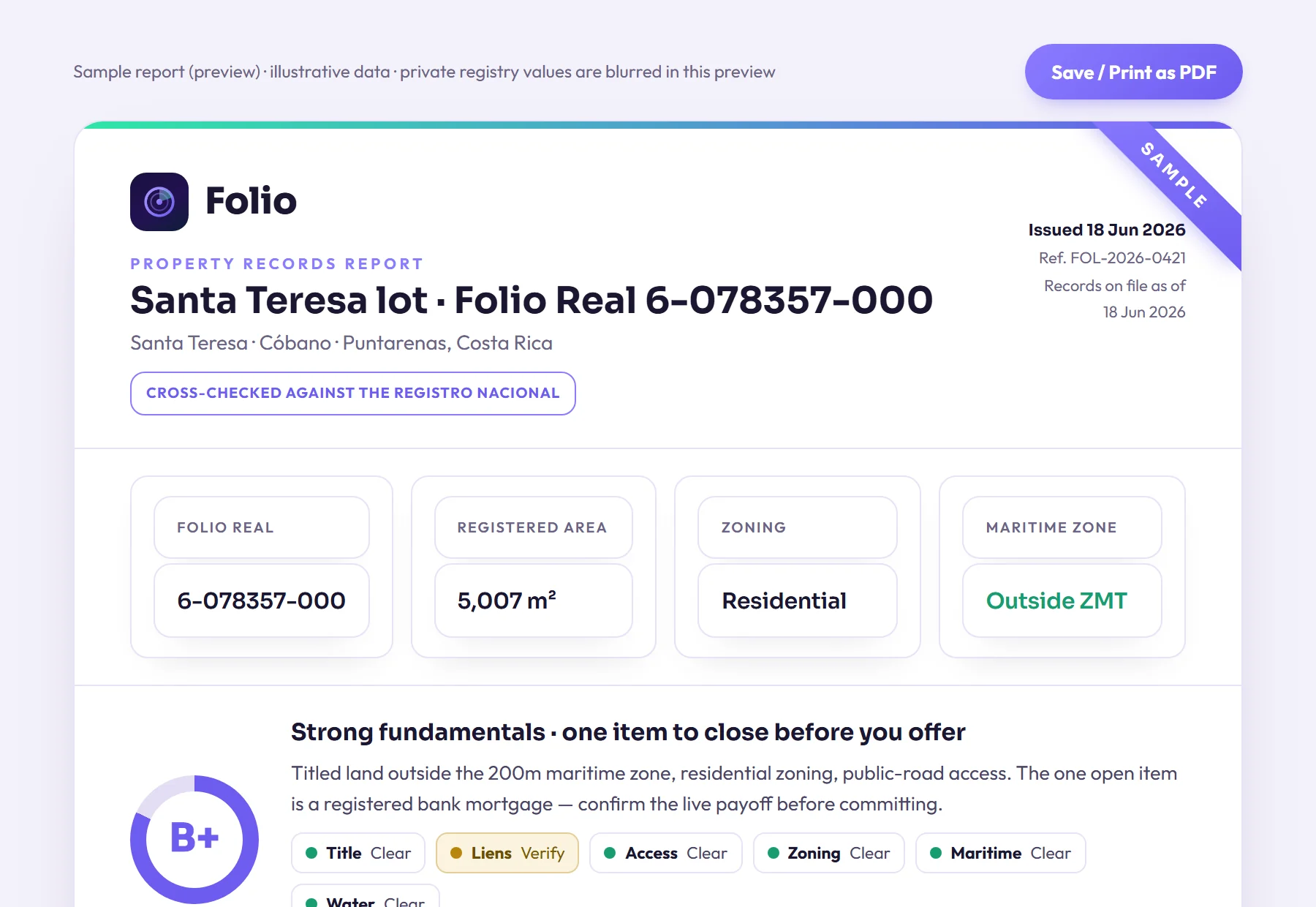
You can pull a certificate yourself and read it with the field labels above. If you would rather have someone do it, a Folio verified report costs $29 and is a human-checked title and records search covering the registered owner, liens, taxes, water rights and the exact maritime line, delivered within 24 hours. Our page on what a Folio property report includes shows the format.
Folio shows you what the public records say. Your attorney or notary decides what those records mean for your purchase and advises you on how to proceed.
Know what you're buying before the deposit.
Most problems with a lot don't show up in the listing, and often the seller doesn't know about them either. Folio lets you find them now, before you pay a lawyer to start the purchase.
Frequently asked questions
Is it always a scam if the seller is not the registered owner?
No. A company may own the property, the seller may have bought recently and their deed may still be pending, or a representative may be acting for the owner. Each of these should be backed by documents your attorney can verify before you pay anything.
Where do I find the owner's name on a Costa Rica registry certificate?
On a certificación literal, the owner appears in the opening description of the finca, after fields like NATURALEZA, LINDEROS, PLANO, IDENTIFICADOR PREDIAL and VALOR FISCAL. Compare it carefully against the seller's identity document, including both surnames.
Can a pending sale deed explain why the seller's name is missing?
It can. In certificates Folio has reviewed, the ANOTACIONES SOBRE LA FINCA block sometimes showed a sale deed presented to the registry but not yet fully recorded. Ask your attorney what happens to your purchase if that deed is never completed.
Does the free Folio map show who owns a lot?
No. The free map shows the finca number, lot area, perimeter and boundary from the official cadastre, plus a maritime-zone flag. The registered owner, liens and encumbrances are only in the verified report.
How common are notes under ANOTACIONES SOBRE LA FINCA?
In Folio's small sample of 15 verified reports from September and October 2026, 3 had at least one such note, or 20%. That is a snapshot of recent paid reports, not a national rate, so check your own property's record rather than relying on averages.
Sources
- Registro Nacional digital services (certificaciones and registry consultations), Registro Nacional de Costa Rica
- Poder Judicial de Costa Rica, Poder Judicial
- Folio data: Registro Nacional certificates pulled for recent paid Folio reports, aggregated and anonymized.
Educational, not legal advice. Folio reports what public records show; it does not replace a licensed Costa Rican attorney, notary or surveyor. Confirm material facts with them before any transaction. Photos are illustrative.