Linderos are the boundary description on a Costa Rica registry record. They state what lies to the north, south, east and west of the finca (the registered property). Reading them shows you whether the land on paper touches a public road, a river or other properties, but they do not prove where the line sits on the ground, so ask your attorney to compare them with the plano and the site.
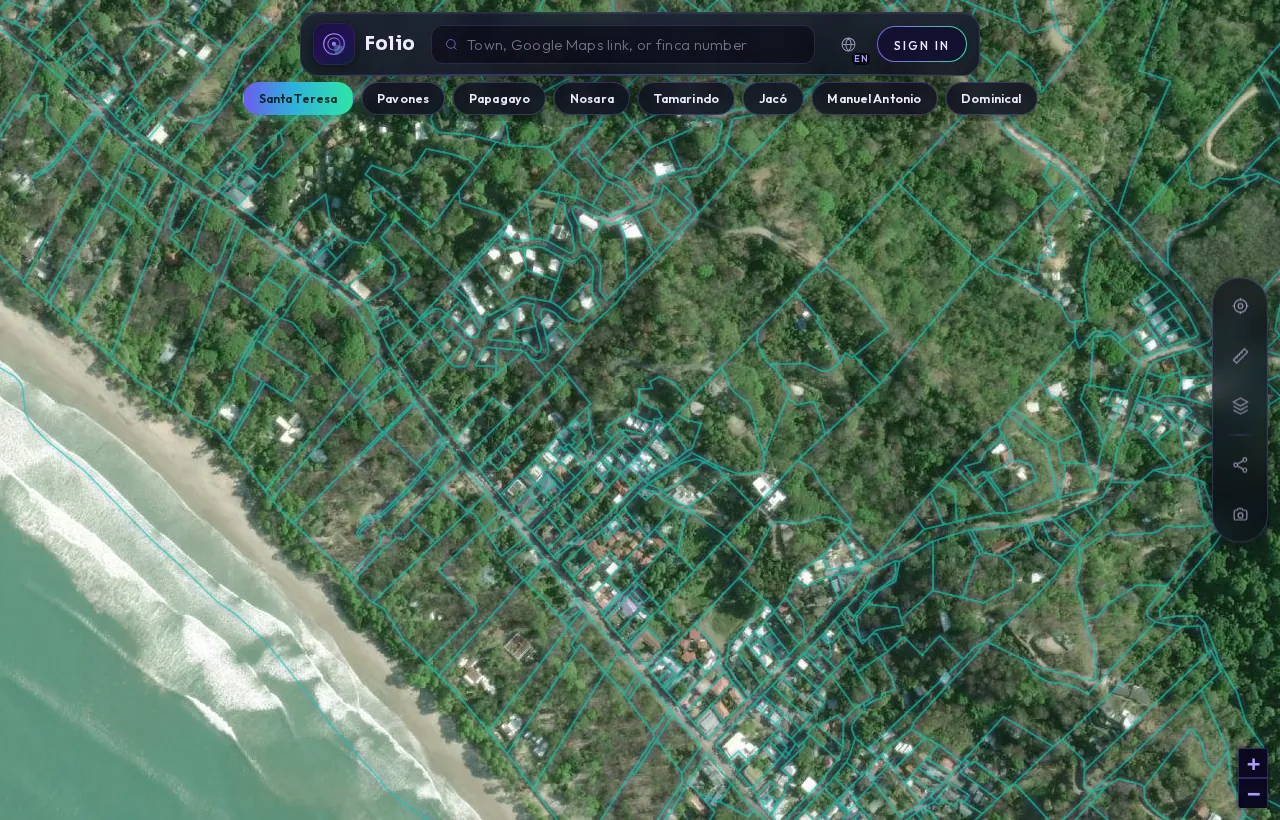
Any parcel, in the Folio app.
Search a town, a Google Maps link or a finca and Folio outlines the registered parcel from the national cadastre, with the maritime line, protected areas and water on top of it, before you call a lawyer or put down a deposit.
What a small sample of certificates showed
Counts come from 13 recent paid Folio reports, a small sample and not a national rate.
What does LINDEROS mean on a registry certificate?
On a Registro Nacional certificate, the field labelled LINDEROS holds the legal boundaries of the finca. It describes the property by its neighbours: what lies to the north, what lies to the south, and so on around all four sides.
The wording is a plain description of neighbours. A side may border a public road, a river or stream, another registered finca, or the remaining land of the larger property it was split from. Nothing in the field is decorative. Each line is a statement about what the land you are buying touches.
The field can look like boilerplate, but it is one of the few places on the record where the registry tells you, in words, how the property sits in relation to the land around it.
Where do linderos appear in the certificación literal?
The full registry certificate, called a certificación literal, follows a consistent order. You can request one through the Registro Nacional's digital services, and our guide on searching the Costa Rica property registry yourself walks through how.
In the certificates we read, the record runs in three parts:
- The description of the finca. This is where you find NATURALEZA (what the land is, for example a lot for building), the location, LINDEROS, the area, PLANO (the linked cadastral survey plan), IDENTIFICADOR PREDIAL (a parcel identifier code), VALOR FISCAL (a fiscal value in colones) and the owner.
- ANOTACIONES SOBRE LA FINCA. Notes on the property itself, such as a deed presented to the registry but not yet fully recorded.
- GRAVAMENES o AFECTACIONES. Gravámenes (encumbrances) and afectaciones (legal limitations), each starting with a heading line that names its type.
Linderos sit in the first block, next to the area and the plano. That placement matters. They are meant to be read together, not in isolation.
What can linderos tell you as a buyer?
Read slowly, the boundary text answers questions a listing never will. Here is what to look for.
- Legal access. If no side borders a public road, ask how the property is reached. Access may depend on an easement over a neighbour's land. If that easement is registered, it would appear in the GRAVAMENES o AFECTACIONES block further down the certificate.
- Water. A river, stream or spring named as a boundary is a prompt to ask about protection strips and water rules that may limit where you can build.
- Origin. A side described as bordering the rest of a larger finca suggests the lot was split off from a parent property. Restrictions recorded on the parent can travel down to the lot.
- Consistency with what you were shown. If the seller walked you along a road frontage on the east, but the registry places the road on the west, something needs explaining.
- Consistency with the plano. The boundaries in the registry should describe the same shape and neighbours as the cadastral plan linked to the finca.
None of these is a verdict. Each one is a specific question you can hand to your attorney.
Tap any lot in the free Folio map to see its official boundary.
Check it freeWhat do linderos not tell you?
It is just as important to know what the field leaves out. The LINDEROS field is a written description, and written descriptions have limits.
- They do not locate the line on the ground. A boundary that says "a public road" does not tell you where the road edge, the fence or the survey markers actually sit today.
- They may be old. Neighbouring land changes hands, gets split, or gets a new road. The text can describe neighbours as they were when the entry was written.
- They do not list encumbrances. An easement crossing your lot, a forestry limitation or a lawsuit annotation appears in the separate blocks further down, not in the boundaries.
- They do not settle disputes. If a neighbour's fence sits inside the line, the certificate alone will not tell you who is right. Boundary conflicts are legal matters for an attorney, and if one reaches court it falls to the Poder Judicial.
Which document carries more weight when the registry text, the plano and the fence disagree is a legal question. Ask your attorney to confirm which rule applies to your property rather than assuming.
How do linderos connect to the plano and to easements?
The boundaries describe the outline. The plano catastrado is the surveyed drawing of that outline, with measured sides and a recorded area. When the two describe different neighbours or a different frontage, that mismatch is worth raising before you sign anything.
Easements are the other half of the picture. If the linderos suggest a lot has no road frontage, look in the GRAVAMENES o AFECTACIONES block for a servidumbre (easement). These entries carry their own labels:
| Label on the certificate | What it records |
|---|---|
| A FAVOR DE LA(S) FINCA(S) | The finca or fincas that benefit from the easement |
| EN CONTRA DE LA(S) FINCA(S) | The finca or fincas that carry the burden |
| LONGITUD / ANCHO / RUMBO | The length, width and direction of the easement strip |
| CITAS | The registry reference of the document behind the entry |
| CANCELACIONES PARCIALES | Whether part of the entry has been cancelled |
Read the boundaries and the easement together. If a right-of-way benefits your lot, ask your attorney whether it runs from a public road to a side that the linderos say touches the burdened neighbour. If your finca appears under EN CONTRA, someone else has a recorded right to cross or use part of your land, and the strip's width and direction tell you roughly how much.
Across a small sample of 13 recent paid Folio reports, 5 certificates carried at least one servidumbre entry, and 4 of those were servidumbres de paso (right-of-way easements). That is a small sample, not a national rate, and it does not measure how often boundary and easement questions appear together. It does show why the encumbrance block is worth reading alongside the boundaries.
Get the free Costa Rica buyer's checklist
What to ask for, what to pull from the registry and what to confirm on the map before you sign anything. One short email, no spam.
How should you read the linderos on a certificate?
You do not need training as a surveyor to get value from this field. A methodical read takes a few minutes.
- Read each side and write down, in plain English, what it borders.
- Sketch a rough box with those neighbours on it. You will spot an odd shape or missing frontage faster on paper.
- Compare the sketch with the plano number shown in the PLANO field and with the plan itself.
- Compare both with what you saw on site and with any boundary shown on a cadastral map.
- Scroll down to the encumbrance block and check whether any easement, reservation or limitation explains what the boundaries suggest, such as missing road access or a river edge.
- Note anything that does not fit, and bring the list to your attorney.
Our guide on how to check a property title in Costa Rica covers the rest of the certificate, from ownership to annotations, so you can put the boundary reading in context.
Which question should you put to your attorney?
Bring one direct question, in writing, along with the certificate and the plano:
"Do the linderos on the registry, the plano catastrado and the physical boundaries on site all describe the same property, and if any of them differ, what does that mean for my purchase and how should it be fixed before closing?"
That single question covers access, frontage, encroachment and survey accuracy. It also invites your attorney to explain which document governs if there is a conflict, and whether a new survey or a correction at the registry is needed.
A few follow-ups are worth adding where the boundaries raise them:
- If no side touches a public road: what recorded easement gives access, and does it reach the lot?
- If water is named as a boundary: what protection strips or reservations affect building near it?
- If the lot came from a larger finca: which reservations from the parent property still apply?
Folio shows what the public records say. Your attorney or notary is the person who tells you what those records mean for your deal.
Know what you're buying before the deposit.
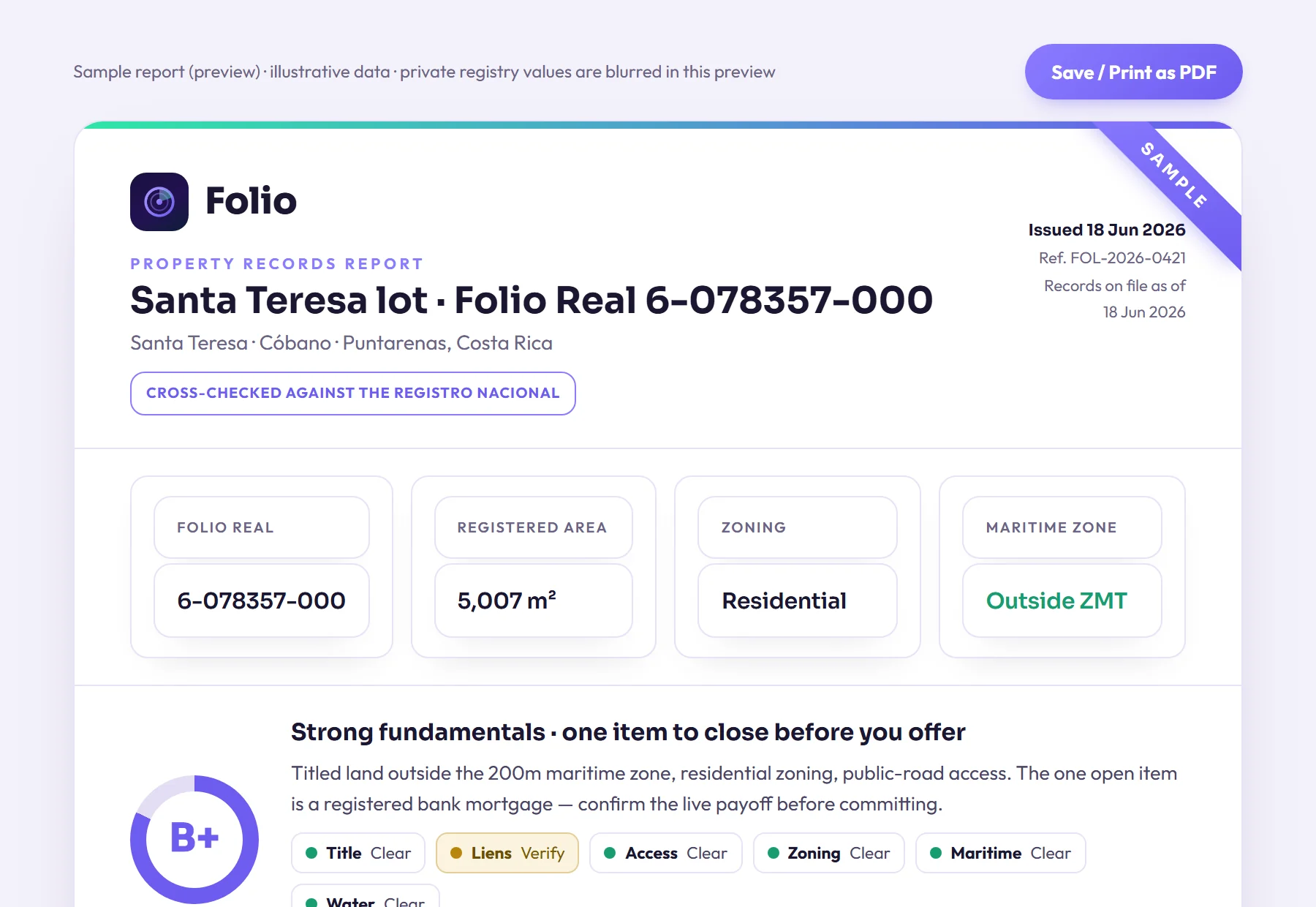
Most problems with a lot don't show up in the listing, and often the seller doesn't know about them either. Folio lets you find them now, before you pay a lawyer to start the purchase.
Frequently asked questions
Are linderos the same as the plano catastrado?
No. Linderos are the written boundary description on the registry record, naming what lies on each side of the finca. The plano catastrado is the surveyed plan with measured sides and area. They should describe the same land, and your attorney should check that they do.
Can linderos prove where my fence should be?
Not on their own. They describe neighbours in words, so they do not fix the exact position of a line on the ground. If a fence and the paperwork seem to disagree, ask your attorney how to resolve it, which may involve a surveyor.
What if the linderos show no public road on any side?
Treat it as a question about access. Look in the encumbrances block of the certificate for a servidumbre de paso (right-of-way easement) that benefits the property, and ask your attorney to confirm it actually connects the lot to a road.
Do linderos show liens or lawsuits on the property?
No. Liens, easements, legal limitations and annotations such as lawsuits appear in separate blocks further down the certificate. Read the whole record, not just the description of the finca.
Sources
- Registro Nacional digital services (certificaciones and registry consultations), Registro Nacional de Costa Rica
- Poder Judicial de Costa Rica, Poder Judicial
- Folio data: Registro Nacional certificates pulled for recent paid Folio reports, aggregated and anonymized.
Educational, not legal advice. Folio reports what public records show; it does not replace a licensed Costa Rican attorney, notary or surveyor. Confirm material facts with them before any transaction. Photos are illustrative.