Look at the easement entry on the registry certificate: the field A FAVOR DE LA(S) FINCA(S) names the property that benefits, and EN CONTRA DE LA(S) FINCA(S) names the property that carries the burden. Compare both with the finca you are buying. If your finca appears under "en contra de", the easement is a burden on your land; if it appears under "a favor de", it is a right your land enjoys over a neighbor's.
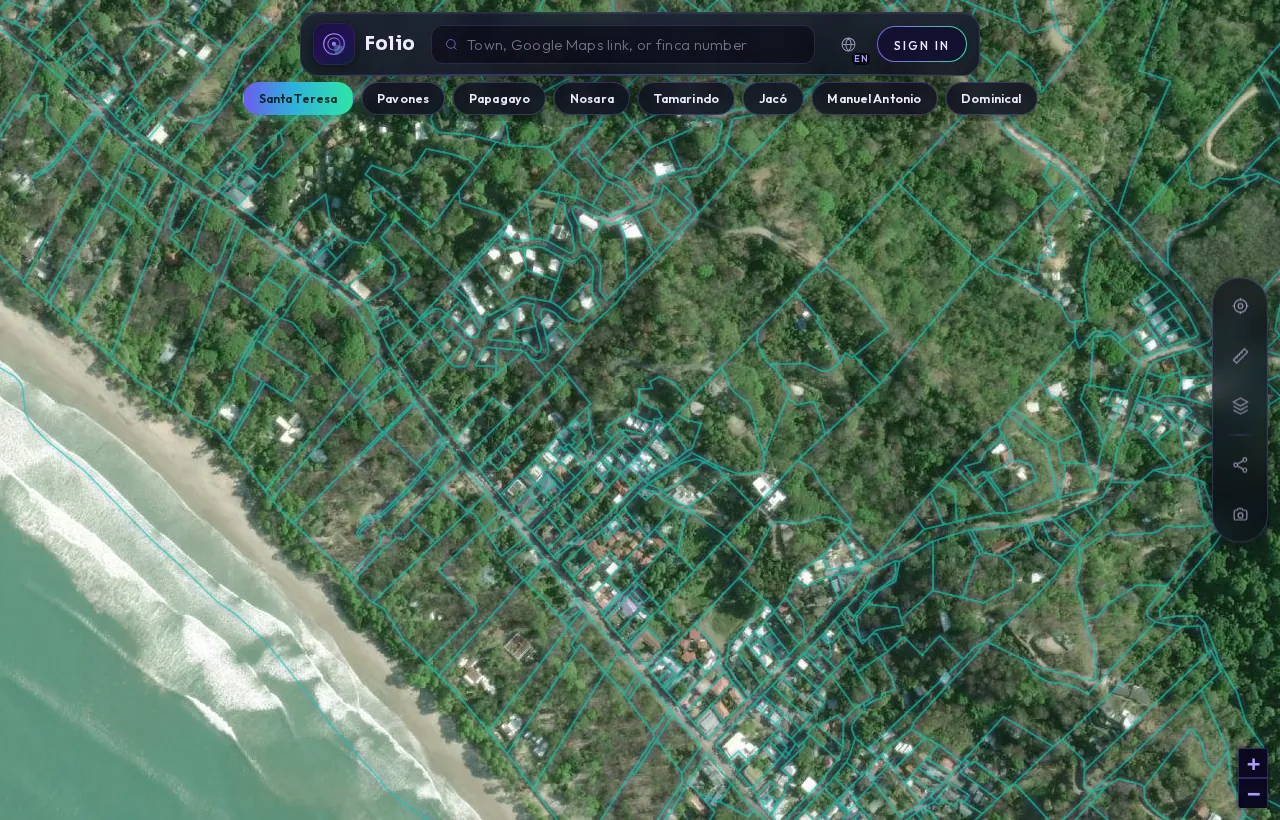
Any parcel, in the Folio app.
Search a town, a Google Maps link or a finca and Folio outlines the registered parcel from the national cadastre, with the maritime line, protected areas and water on top of it, before you call a lawyer or put down a deposit.
Easements in a small sample of reports
From 15 recent Folio verified reports pulled in September and October 2026; a small sample, not a national rate.
Where does the easement show up on the certificate?
A Costa Rica property record is read from the Registro Nacional as a certificación literal (a literal certificate that reproduces what the registry holds for a finca). You can request one through the Registro Nacional digital services. The layout is consistent once you have seen a few.
The certificate first describes the finca itself: NATURALEZA (what the land is, for example a lot for building), location, LINDEROS (boundaries to the north, south, east and west), area, PLANO, IDENTIFICADOR PREDIAL, VALOR FISCAL and the owner. Then comes a block called ANOTACIONES SOBRE LA FINCA (annotations on the property), and then a block called GRAVAMENES o AFECTACIONES (encumbrances or limitations).
Easements, called servidumbres, live in the GRAVAMENES o AFECTACIONES block. Each entry starts with a heading line naming its type, such as SERVIDUMBRE DE PASO (right of way) or SERVIDUMBRE DE VISTA (view easement). Do not read NATURALEZA as the type of the easement. It is not. NATURALEZA describes the finca; the heading line describes the entry.
Which fields tell you who benefits and who carries the burden?
Inside an easement entry, these are the labels that answer the question. They are the field names we see on the certificates we pull for verified reports.
| Field label | What it tells you |
|---|---|
| A FAVOR DE LA(S) FINCA(S) | The finca or fincas that benefit from the easement (in legal terms, the dominant property) |
| EN CONTRA DE LA(S) FINCA(S) | The finca or fincas that carry the burden (the servient property) |
| AFECTA A FINCA | The finca the entry affects |
| LONGITUD / ANCHO / RUMBO | Length, width and direction of the easement strip |
| CITAS | The registry reference of the document (deed, resolution or court filing) behind the entry |
| MONTO | An amount stated in the entry; in our sample, a nominal value on easements |
| CANCELACIONES PARCIALES | Whether part of the entry has been cancelled |
| ANOTACIONES DEL GRAVAMEN | Notes recorded against that specific entry |
The reading itself is simple. Take the finca number of the property you are buying and find it in the entry. Under en contra de, your land carries the easement: someone else has a right over part of it. Under a favor de, your land holds the right over a neighbor's land.
The heading line can also carry a hint. Some entries are headed with wording such as "sirviente" (servient), which signals the burdened side. Treat that as a clue, not the answer. The two fields are what you rely on.
Why it matters which side you are on
The same heading, SERVIDUMBRE DE PASO, can mean two opposite things for a buyer. On one certificate it means neighbors may cross your lot along a defined strip. On another it means your lot has a recorded right to cross someone else's land, which may be how you reach the road.
So an easement on your certificate is not automatically bad news. A right-of-way in your favor can be the reason a landlocked lot is usable at all. A right-of-way against you may limit where you can build, fence or plant. You only know which story you are reading once you have checked both fields.
View easements work the same way. A SERVIDUMBRE DE VISTA in your favor may protect an outlook; one against you may restrict how or where you build, depending on its terms. Your attorney reads the underlying deed to see what is actually restricted.
Look up a lot's area and boundary on the free Folio map.
Check it freeHow common are easements on the records we pull?
Folio pulls a certificación literal for every paid verified report. Across a small sample of 15 recent reports, here is what the GRAVAMENES o AFECTACIONES block contained. This is a handful of reports from the last two months, not a national rate, and it should not be read as one.
- 13 of 15 reports (87%) had at least one entry under gravámenes o afectaciones.
- 6 reports (40%) had some kind of servidumbre.
- 5 reports (33%) had a servidumbre de paso, the most frequent easement type in the sample.
- 1 report (7%) had a servidumbre de vista.
- Only 2 reports (13%) had no gravámenes and no anotaciones at all.
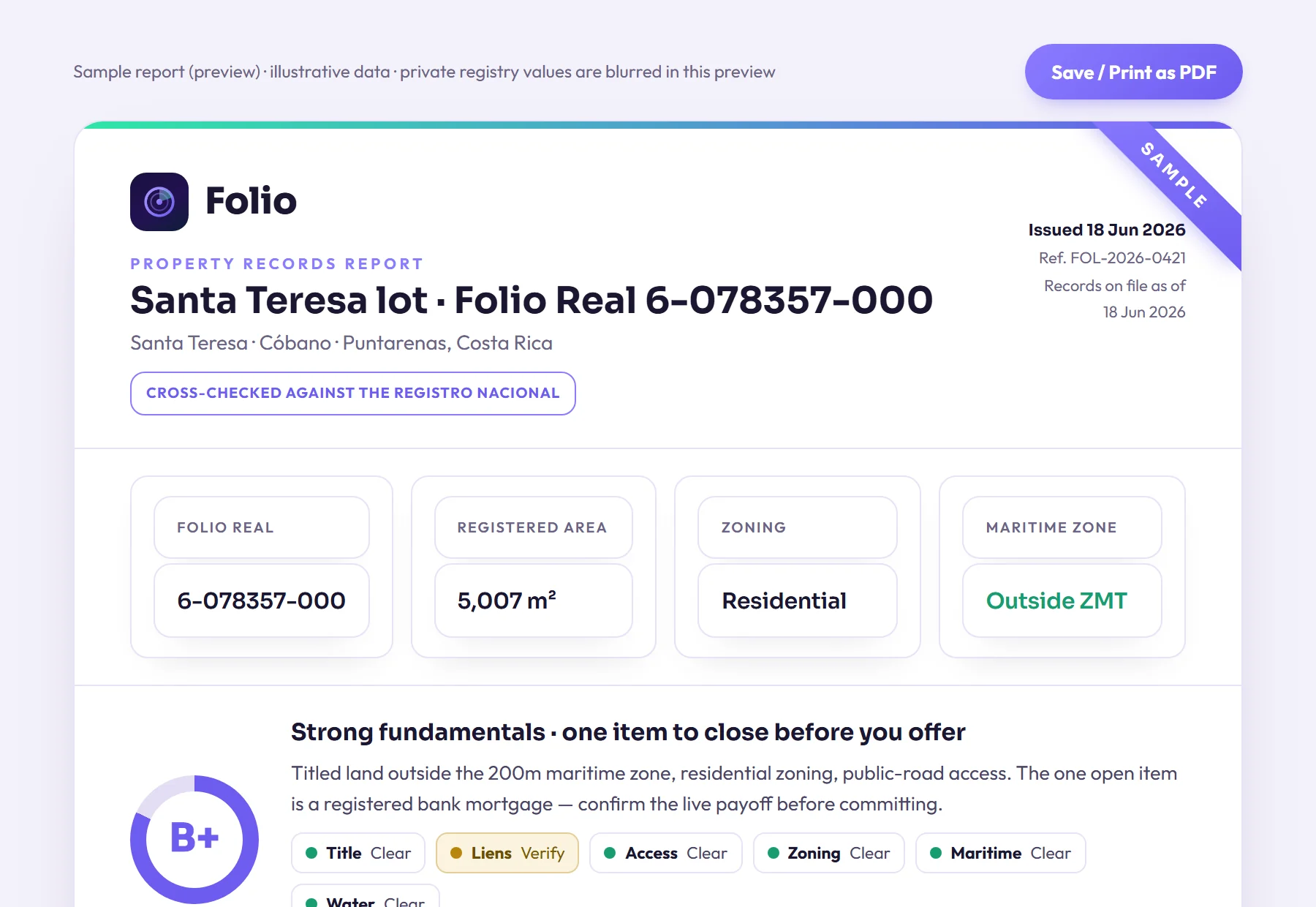
The takeaway for a buyer is modest but practical: in this sample, seeing an easement on a certificate was not unusual. The question is not whether one exists but which way it runs and what it allows. You can see how these entries are presented to clients in what a Folio property report includes.
What the certificate does not tell you
The registry entry is a legal record. It is not a site visit and not a survey. Several things a buyer cares about are outside what those fields can answer.
- Whether the strip exists on the ground. LONGITUD, ANCHO and RUMBO describe the easement on paper. They do not confirm that a road, path or gate is where the record says.
- Whether it matches the survey plan. The PLANO field gives the linked cadastral plan, but you still need to compare the drawing with the easement description. Our guide to the plano catastrado explains how to read one.
- The full terms. Rules on use, maintenance or vehicle access sit in the deed referenced under CITAS, not in the summary fields.
- What MONTO means for you. In our sample it appeared on easements as a nominal value recorded in the entry. Do not assume it is a price or a fee you owe; ask your attorney what it represents.
- Whether the other finca still exists in the same form. If the benefiting or burdened finca has had lots split off (see SEGREGACIONES on that finca's own record), it can be worth checking how the easement carried over.
- Disputes. A disagreement between neighbors may never reach the registry. If a lawsuit was annotated on the finca, it appears as a separate entry; court files themselves sit with the Poder Judicial.
Get the free Costa Rica buyer's checklist
What to ask for, what to pull from the registry and what to confirm on the map before you sign anything. One short email, no spam.
A quick reading routine for your certificate
- Confirm the certificate is for the finca you are actually buying, by matching the finca number and PLANO with the seller's documents.
- Go to the GRAVAMENES o AFECTACIONES block and list every entry whose heading starts with SERVIDUMBRE.
- For each one, note whether your finca appears under A FAVOR DE or EN CONTRA DE.
- Write down LONGITUD, ANCHO and RUMBO so you can compare them with the plano and with what you see on site.
- Check CANCELACIONES PARCIALES and ANOTACIONES DEL GRAVAMEN for changes recorded after the easement was created.
- Copy the CITAS reference so your attorney can pull the original deed.
Fold these notes into your wider property due diligence checklist, alongside liens, annotations and the survey.
Which question should you put to your attorney?
Once you know which side your finca sits on, the most useful single question is this: "Given that this finca appears under [a favor de / en contra de] in this easement, what exactly does the deed behind the CITAS reference allow, and does that match the plano and the ground?"
That one question makes your attorney or notary read the source document rather than the summary, and tie it to the physical lot. Depending on the answer, follow-ups can include:
- If the easement is in your favor: does it give legal access to a public road, and is the path physically usable?
- If it is against you: where can you build or fence without interfering with it, and who is responsible for upkeep?
- Has anything been cancelled or noted on the entry since it was created?
- Do any of the other entries on the certificate, such as reservations or forestry limitations, overlap with the easement strip?
The registry shows what is recorded. Your attorney tells you what it means for your purchase and which rules apply.
Know what you're buying before the deposit.
Most problems with a lot don't show up in the listing, and often the seller doesn't know about them either. Folio lets you find them now, before you pay a lawyer to start the purchase.
Frequently asked questions
What does "servidumbre a favor de" mean on a Costa Rica certificate?
It introduces the finca or fincas that benefit from the easement. If the property you are buying is listed there, your land holds a right over another property, such as a right of way across a neighbor's lot.
What does "en contra de" mean in an easement entry?
EN CONTRA DE LA(S) FINCA(S) names the finca that carries the burden of the easement. If your finca is listed there, someone else has a recorded right over part of your land, and your attorney should explain what that right allows.
Is an easement on my certificate always a problem?
No. An easement in your favor can be a benefit, for example the recorded access that lets you reach a road. Even one against you may be manageable, but you need the deed behind the CITAS reference read by an attorney to know its real scope.
Does the MONTO on an easement mean I have to pay something?
Not on its own. In the certificates we have reviewed, MONTO on easements appeared as a nominal value stated in the entry. Ask your attorney to confirm what it represents in your specific deed.
Can the free Folio map show me easements?
No. The free map shows the finca number, lot area, perimeter, boundary from the cadastre and a maritime zone flag. Easements, liens and other encumbrances appear only in the $29 verified report, which is delivered within 24 hours.
Sources
- Registro Nacional digital services (certificaciones and registry consultations), Registro Nacional de Costa Rica
- Poder Judicial de Costa Rica, Poder Judicial
- Folio data: Registro Nacional certificates pulled for recent paid Folio reports, aggregated and anonymized.
Educational, not legal advice. Folio reports what public records show; it does not replace a licensed Costa Rican attorney, notary or surveyor. Confirm material facts with them before any transaction. Photos are illustrative.