Ley Forestal and Ley de Aguas reservations are entries in the GRAVAMENES o AFECTACIONES block of a Registro Nacional certificate. They record that the finca is subject to forestry or water law restrictions, often inherited from an older parent property. They are common and rarely a reason to walk away on their own, but they can limit what you may cut, build or use, so your attorney should read the full text before you sign.
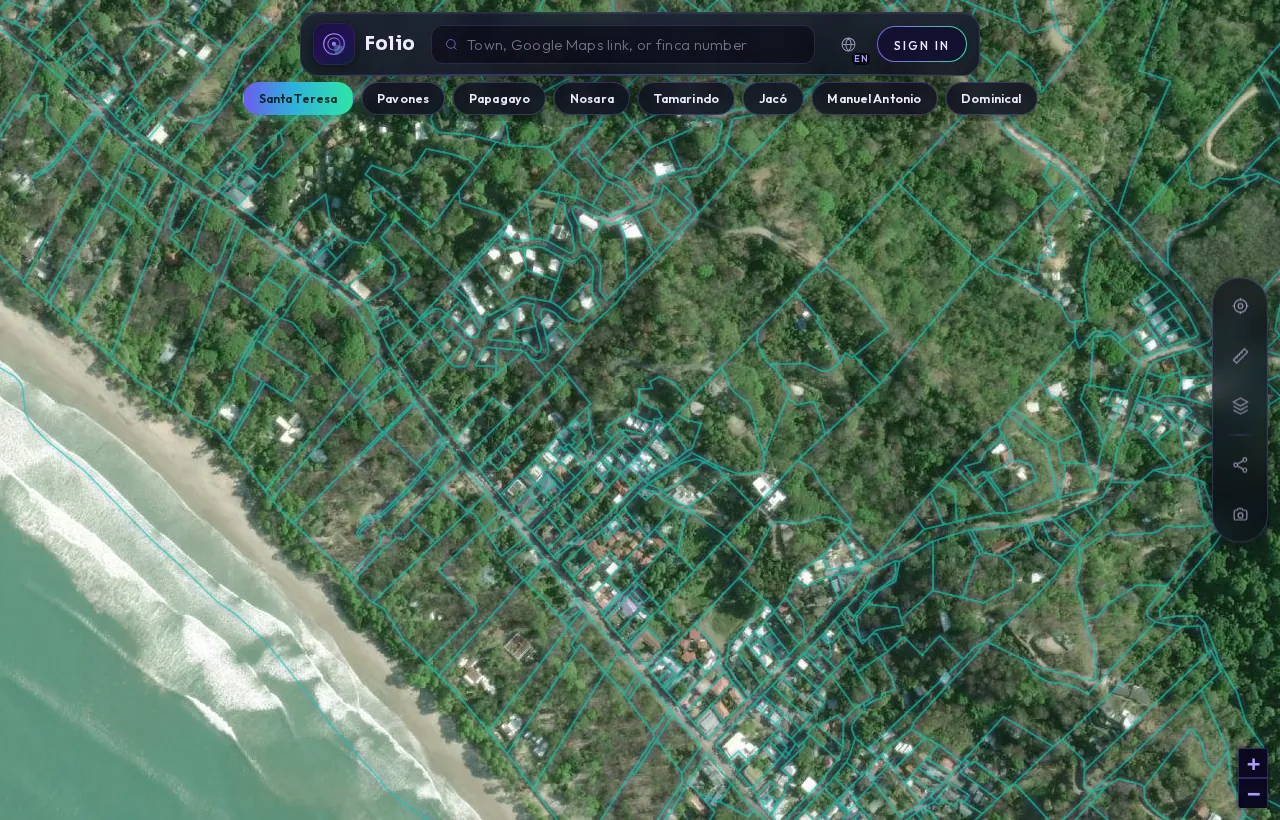
Any parcel, in the Folio app.
Search a town, a Google Maps link or a finca and Folio outlines the registered parcel from the national cadastre, with the maritime line, protected areas and water on top of it, before you call a lawyer or put down a deposit.
What turned up in our recent reports
Counts come from 21 paid Folio reports issued September to November 2026, a small sample and not a national rate.
A Ley Forestal or Ley de Aguas reservation is a line on the title telling you the land is subject to a public law restriction. It is not a debt and not a lawsuit. It is a warning that the state has a say over trees, water or roads on or near the lot. Most buyers first meet these entries on the certificación literal (the full registry certificate) and are unsure whether to worry. This post explains what the entries look like and how often they turned up in our own recent reports, and it lists the questions to put to your attorney.
Where do these reservations appear on the certificate?
A Registro Nacional certificate follows a fixed order. It first describes the finca itself: NATURALEZA (what the land is, for example a lot for building), LINDEROS (boundaries to the north, south, east and west), area, PLANO (the cadastral survey plan), IDENTIFICADOR PREDIAL, VALOR FISCAL and the owner. Then come two blocks: ANOTACIONES SOBRE LA FINCA and GRAVAMENES o AFECTACIONES.
The reservations sit in the second block, among the gravámenes (encumbrances) and afectaciones (legal limitations). Each entry starts with a heading line that names its type, such as RESERVAS LEY FORESTAL, RESERVAS LEY DE AGUAS or RESERVAS LEY DE CAMINOS. Read the heading, not the NATURALEZA field. NATURALEZA describes the land, never the encumbrance.
You can order certificates through the Registro Nacional digital services. The challenge is not getting the document. It is reading it correctly.
How often did they show up in our reports?
We reviewed the certificates behind 21 paid Folio reports from September to November 2026. That is a small sample of recent orders, not a national rate, and you should not read it as one. It does show what a buyer is likely to see on a typical certificate.
Of those 21 reports, 19 (90%) had at least one entry under GRAVAMENES o AFECTACIONES. Only 2 (10%) had nothing at all in either block. A clean certificate was the exception, not the rule.
| Entry type seen on the certificate | Reports | Share of reports |
|---|---|---|
| Reservas y restricciones (generic, carried from a parent finca) | 5 | 24% |
| Afectaciones y limitaciones Ley Forestal 7575 | 3 | 14% |
| Reservas Ley de Caminos (roads law) | 2 | 10% |
| Reservas Ley Forestal (forestry reservation) | 1 | 5% |
| Reservas Ley de Aguas (water law) | 1 | 5% |
| Servidumbre of any kind (easement) | 9 | 43% |
One certificate can carry several entries, so the rows do not add up. Easements were the most frequent single type, with rights of way (servidumbre de paso) in 7 reports (33%). Statutory reservations were less frequent but far from rare.
What is the difference between a Ley Forestal reservation and an afectación?
On these certificates we saw two different forestry headings. One reads RESERVAS LEY FORESTAL. In our sample its text carried a restriction such as a prohibition on cutting trees. The other reads AFECTACIONES Y LIMITACIONES LEY FORESTAL 7575, a forest protection limitation recorded against the finca.
Both point to the same practical question: is any part of the land forest, protected cover or a protection strip, and what does that stop you from doing? The registry entry alone rarely answers that. It tells you a restriction exists. It does not map where the trees are or how far a protected area reaches.
That is why the reservation should push you toward a land use check. A uso de suelo (land use certificate) from the municipality, a site visit and, for larger projects, environmental review are where the practical limits get confirmed. If you plan to clear land or build at scale, SETENA is the national environmental authority your attorney or consultant will likely deal with. Ask your attorney which rule applies to your specific plans.
Tap any lot in the free Folio map to see its official cadastre boundary.
Check it freeWhat does a Ley de Aguas reservation mean for you?
A RESERVAS LEY DE AGUAS entry flags that water law restrictions attach to the finca. In practice buyers tend to ask about rivers, streams, springs and wells on or near the lot, and whether they can actually use the water.
Two things are worth separating. The reservation on the title is a restriction. Your right to take water is a different matter, usually handled through a concession or a utility connection, and it does not come with the land simply because a stream runs through it. Our guide on water rights and Costa Rica property covers that side in detail.
The national body for water concessions is MINAE's Dirección de Agua. If the lot depends on a well or a spring, ask your attorney to confirm what is registered there before closing.
And the Ley de Caminos reservations?
RESERVAS LEY DE CAMINOS appeared in 2 of our 21 reports (10%). These entries relate to roads law and typically matter when a lot fronts a public road. The question for you is practical: could a road setback or widening reserve take part of the frontage you planned to build near?
Roads reservations are easy to confuse with a servidumbre de paso, which is a private right of way between fincas. They are not the same. An easement entry names the benefiting finca (A FAVOR DE LA(S) FINCA(S)), the burdened finca (EN CONTRA DE LA(S) FINCA(S)) and usually LONGITUD, ANCHO and RUMBO (length, width and direction). A roads reservation is a public law matter, not a deal between neighbours.
Get the free Costa Rica buyer's checklist
What to ask for, what to pull from the registry and what to confirm on the map before you sign anything. One short email, no spam.
Why do so many titles carry reservations from a parent finca?
The most common reservation type in our sample was the generic RESERVAS Y RESTRICCIONES, in 5 reports (24%). These usually come down from an older parent finca. When a large property is split, the new lots (listed under SEGREGACIONES on the parent) can inherit the restrictions recorded on it decades earlier.
So a forestry or water entry on a small residential lot does not always mean there is forest or a river on that lot today. It may simply be history the registry carries forward. It may also be very current. You only find out by reading the full text and comparing it with the plano and the ground.
How do you read the entry itself?
Each reservation has supporting fields. These are the ones to look at with your attorney:
- CITAS: the registry reference of the underlying document. This is how your attorney pulls the deed or resolution that created the reservation.
- AFECTA A FINCA: the finca the entry affects. Check it matches the one you are buying.
- CANCELACIONES PARCIALES: whether part of the entry has already been cancelled.
- ANOTACIONES DEL GRAVAMEN: notes recorded against that specific entry.
- INICIA EL / FINALIZA EL: start and end dates, where the entry has them.
Also read the other block. In 4 of our reports (19%), ANOTACIONES SOBRE LA FINCA held something. That included a sale deed presented but not yet fully recorded, administrative warnings, and registry freezes (inmovilización por inconsistencia) citing an administrative file, each seen in 2 reports (10%). One report carried a lawsuit annotation (demanda). Your attorney can follow a court reference through the Poder Judicial. These items usually deserve more attention than a routine forestry reservation.
What should you ask before you buy?
- Get the full certificación literal, not a summary, and list every heading in both blocks.
- For each Ley Forestal, Ley de Aguas or Ley de Caminos entry, ask your attorney to pull the document behind the CITAS reference.
- Confirm whether the restriction is inherited from a parent finca or created for this lot.
- Compare the reservation with the plano and a site visit: is there forest, water or road frontage where you plan to build?
- Obtain a uso de suelo before committing to a building plan.
- If water use matters, confirm the concession or connection separately from the title.
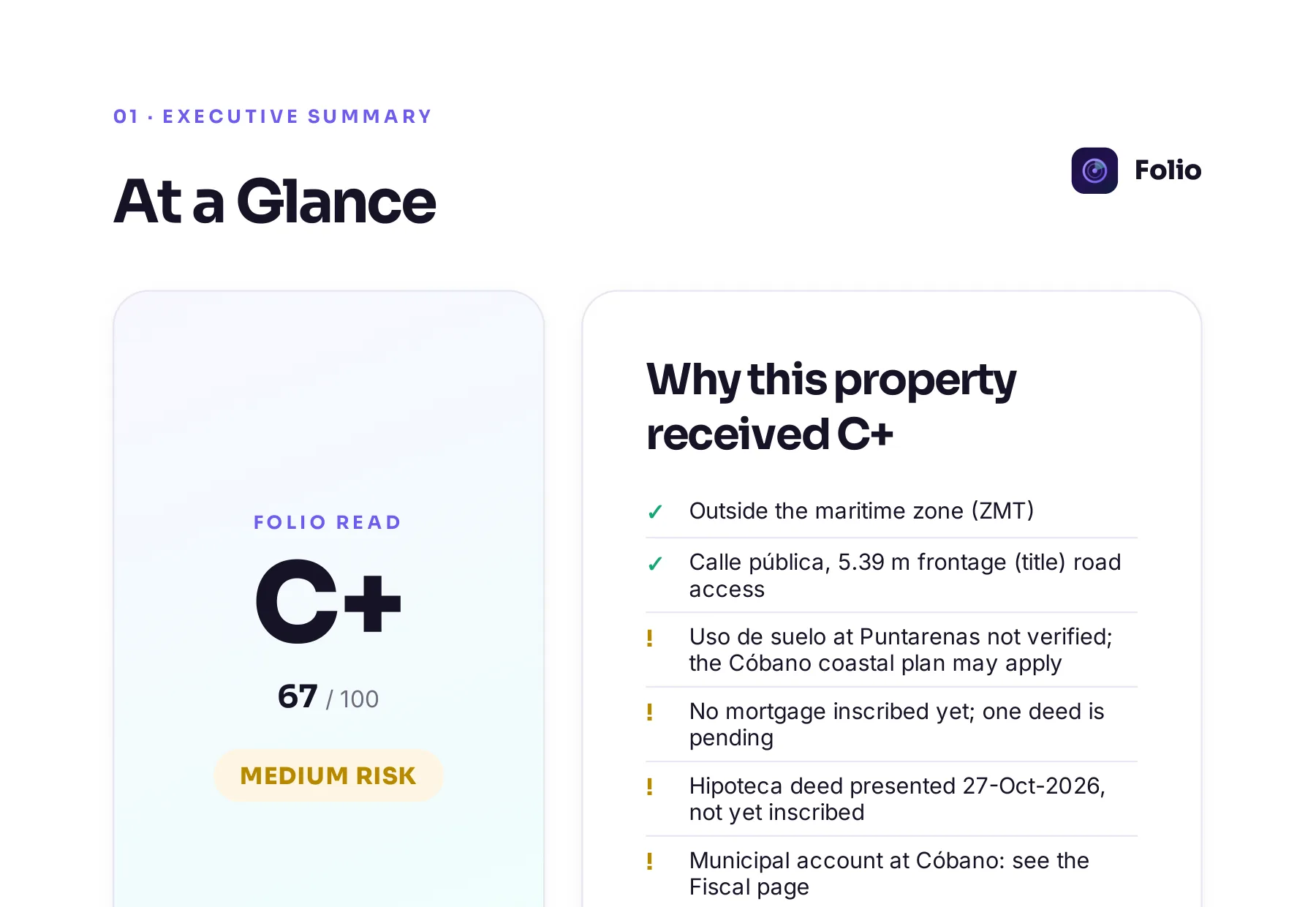
A Folio verified report puts these entries in plain English, alongside owner, liens, easements and nearby rivers and wells. Our page on what a Folio property report includes explains the scope. Folio shows what the public records say. Your attorney or notary advises on what it means for your purchase.
Know what you're buying before the deposit.
Most problems with a lot don't show up in the listing, and often the seller doesn't know about them either. Folio lets you find them now, before you pay a lawyer to start the purchase.
Frequently asked questions
Does a Ley Forestal reservation mean I cannot build on the lot?
Not necessarily. The entry says a forestry restriction applies, but it does not by itself show where protected cover lies or how much of the lot it touches. A uso de suelo, a site visit and your attorney's reading of the underlying document are how you find out what you can actually build.
Are these reservations common on Costa Rica titles?
In our small sample of 21 recent paid reports, 19 had at least one entry under GRAVAMENES o AFECTACIONES, and generic reservations from a parent finca appeared in 5. That is not a national rate, but it shows a certificate with no entries at all is unusual.
Does a Ley de Aguas reservation give me the right to use the river on my land?
No. The reservation is a restriction recorded on the title, not a right to take water. Water use usually depends on a concession or a utility connection, which your attorney should confirm separately.
Can a forestry or water reservation be removed from the title?
Sometimes part of an entry is cancelled, which shows up under CANCELACIONES PARCIALES. Whether a reservation can be cancelled depends on the document behind it and the law it rests on, so ask your attorney to review it.
Does the free Folio map show these reservations?
No. The free map shows the finca number, area, perimeter, boundary and a maritime-zone flag. Encumbrances, reservations and the registered owner are only in the $29 verified report.
Sources
- Registro Nacional digital services (certificaciones and registry consultations), Registro Nacional de Costa Rica
- Poder Judicial de Costa Rica, Poder Judicial
- Dirección de Agua (MINAE), MINAE, Dirección de Agua
- SETENA, Secretaría Técnica Nacional Ambiental, SETENA
- Folio data: Registro Nacional certificates pulled for recent paid Folio reports, aggregated and anonymized.
Educational, not legal advice. Folio reports what public records show; it does not replace a licensed Costa Rican attorney, notary or surveyor. Confirm material facts with them before any transaction. Photos are illustrative.