A clean Costa Rica title is a Registro Nacional certificate whose ANOTACIONES SOBRE LA FINCA block and GRAVAMENES o AFECTACIONES block are both empty, with an owner, plano and description that match what you are being sold. In our small sample of 19 recent verified reports, only 2 titles (11%) looked like that. Most titles carried at least one entry, and the most frequent were easements and reservations rather than freezes or lawsuits.
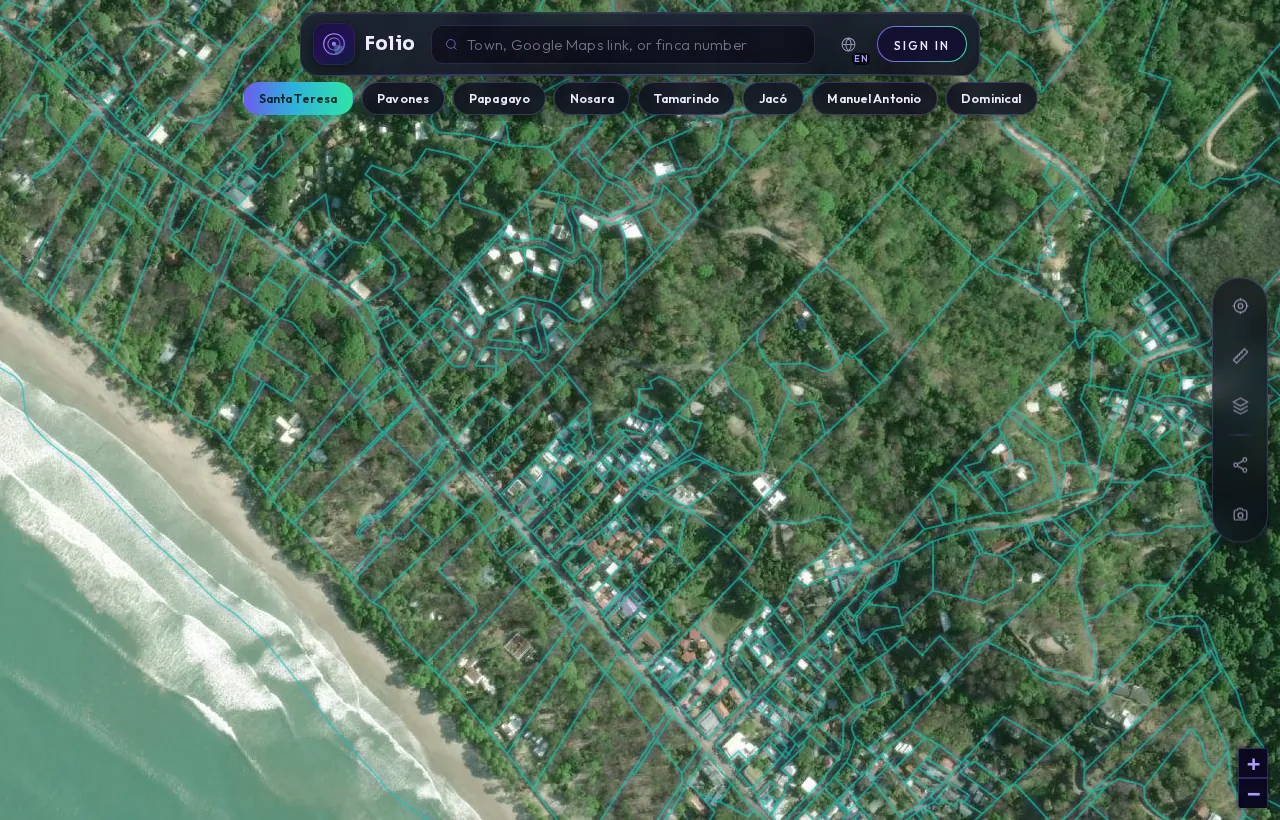
Any parcel, in the Folio app.
Search a town, a Google Maps link or a finca and Folio outlines the registered parcel from the national cadastre, with the maritime line, protected areas and water on top of it, before you call a lawyer or put down a deposit.
What our 19 recent reports showed
Counts come from Registro Nacional certificates pulled for 19 paid Folio reports from September to November 2026, a small sample and not a national rate.
A truly clean title was rare in our sample. In the Registro Nacional certificates we pulled for 19 paid reports between September and November 2026, only 2 had nothing at all in either the anotaciones (annotations) block or the gravámenes (encumbrances) block. The other 17 carried something, even if that something was an ordinary right-of-way.
That sample is small and recent, so please read it as a snapshot of what crossed our desk, not as a national rate. It is still useful, because it shows what "clean" looks like on the actual document and how far most titles sit from it.
What does the registry certificate actually contain?
The document behind every title check is the certificación literal, a full extract of the finca (registered property) issued by the Registro Nacional. You can request one yourself through the registry's digital services portal. The layout is consistent, which makes it easier to read once you know the order.
- The description of the finca. This includes NATURALEZA (what the land is, for example a lot for building), the location, LINDEROS (boundaries described by what lies north, south, east and west), the area, the PLANO (cadastral survey plan number), the IDENTIFICADOR PREDIAL (a parcel code), the VALOR FISCAL (a fiscal value in colones) and the registered owner.
- ANOTACIONES SOBRE LA FINCA. Notes recorded against the property as a whole, such as a deed presented but not yet fully recorded, an administrative warning or a registry freeze.
- GRAVAMENES o AFECTACIONES. Encumbrances and limitations: easements, mortgages, reservations carried from older parent fincas, and legal limitations such as forest protection.
Each entry inside those last two blocks begins with a heading line naming its type, for example SERVIDUMBRE DE PASO or INMOVILIZACION POR INCONSISTENCIA. One point to keep straight: NATURALEZA describes the land itself. It does not tell you the type of an encumbrance. The heading line of each entry does that.
What does a clean title look like on paper?
On a clean certificate, the two blocks after the property description simply have nothing in them. There is no easement, no mortgage, no reservation, no pending deed and no freeze. That was the case on 2 of the 19 certificates we reviewed.
An empty set of blocks is only half of it, though. A title you can work with also needs the description to line up with reality and with the deal in front of you. Before you call a title clean, check that:
- the registered owner is the person or entity actually signing the sale;
- the PLANO on the certificate is the survey plan you have been shown;
- the area and LINDEROS are consistent with that plan and with what you see on the ground;
- the SEGREGACIONES field makes sense (whether lots have been split off from this finca, and whether that matches what you are being sold);
- the certificate states FINCA SE ENCUENTRA EN ZONA CATASTRADA where you expect the area to be cadastrally surveyed.
Our guide on how to check a property title in Costa Rica walks through this comparison in order.
Tap any lot on the free Folio map to see its cadastre boundary and area.
Check it freeWhat did the other 17 titles have registered against them?
In our sample, 17 of 19 reports (89%) had at least one entry under GRAVAMENES o AFECTACIONES, and 4 (21%) had at least one entry under ANOTACIONES SOBRE LA FINCA. Some titles had several types at once, so the rows below overlap.
| Entry type seen | Reports | Share of 19 |
|---|---|---|
| Any servidumbre (easement) | 7 | 37% |
| Servidumbre de paso (right-of-way) | 6 | 32% |
| Reservas y restricciones (generic, carried from a parent finca) | 5 | 26% |
| Forest protection limitation | 3 | 16% |
| Roads law reservation | 2 | 11% |
| Inmovilización por inconsistencia (registry freeze) | 2 | 11% |
| Advertencia administrativa (administrative warning) | 2 | 11% |
| Hipoteca (mortgage) | 1 | 5% |
| Demanda (lawsuit annotation) | 1 | 5% |
| Obligaciones (registered obligations) | 1 | 5% |
| View easement, water law reservation, forestry reservation | 1 each | 5% each |
The pattern is worth taking in. The most frequent entries were easements and reservations carried from older parent fincas. The entries that usually need the most attention, such as freezes, lawsuit annotations and mortgages, were much less frequent in this sample, but they did appear.
Is a title with entries still a "clean" title?
It can be, but that is a judgment for your attorney. A right-of-way easement that gives your lot access to the road is something you may actually want on the record. When you read an easement, look at the fields that define it: A FAVOR DE LA(S) FINCA(S) (who benefits), EN CONTRA DE LA(S) FINCA(S) (who carries the burden), and LONGITUD, ANCHO and RUMBO (length, width and direction of the strip). Whether your lot is the one benefiting or the one burdened changes the picture completely.
Generic reservas y restricciones carried from a parent finca are similar. They can be carried from an older parent finca onto lots segregated from it. They are not automatically a problem, but your attorney should read the CITAS (the registry reference to the underlying document) to see what was actually reserved.
Forest protection limitations deserve more care. They can affect what you are allowed to clear or build, so ask your attorney to confirm which rules apply to the specific land before you plan around it.
Get the free Costa Rica buyer's checklist
What to ask for, what to pull from the registry and what to confirm on the map before you sign anything. One short email, no spam.
Which entries should stop you until they are explained?
Some entries are not routine, and a buyer should pause on them until a lawyer has read the underlying file.
- Inmovilización por inconsistencia. A registry freeze over an inconsistency. In our sample, the text of these entries cited an administrative file (expediente). Until it is resolved, ask your attorney whether the property can be transferred at all.
- Advertencia administrativa. An administrative warning that the registry has flagged something on the record.
- Demanda. A lawsuit annotated on the finca. The CITAS field points to the court filing, and you can ask your attorney to check its status with the Poder Judicial. In our sample, the lawsuit annotation also showed an amount in its MONTO field.
- A pending deed. A sale deed presented to the registry but not yet fully recorded may mean someone else's transaction is in progress on the same property.
- Hipoteca or obligaciones. A registered mortgage or other registered obligation on the property. Ask your attorney how it will be cancelled at or before closing.
Also look at CANCELACIONES PARCIALES and ANOTACIONES DEL GRAVAMEN inside each entry. They tell you whether part of an encumbrance has already been cancelled, or whether notes have been added to it since it was first recorded.
What does an empty certificate not tell you?
The registry certificate reflects the public record on the day it is issued. An empty set of blocks does not tell you whether someone is occupying the land, whether the fence matches the LINDEROS, whether municipal taxes are current, or where the property sits relative to the maritime zone on the coast. A new filing could also be presented after the certificate date, so ask your attorney whether to recheck close to signing.
That is also a reason to ask your attorney whether title insurance makes sense on top of a records search. Our guide to title insurance in Costa Rica explains where it fits and where it does not.
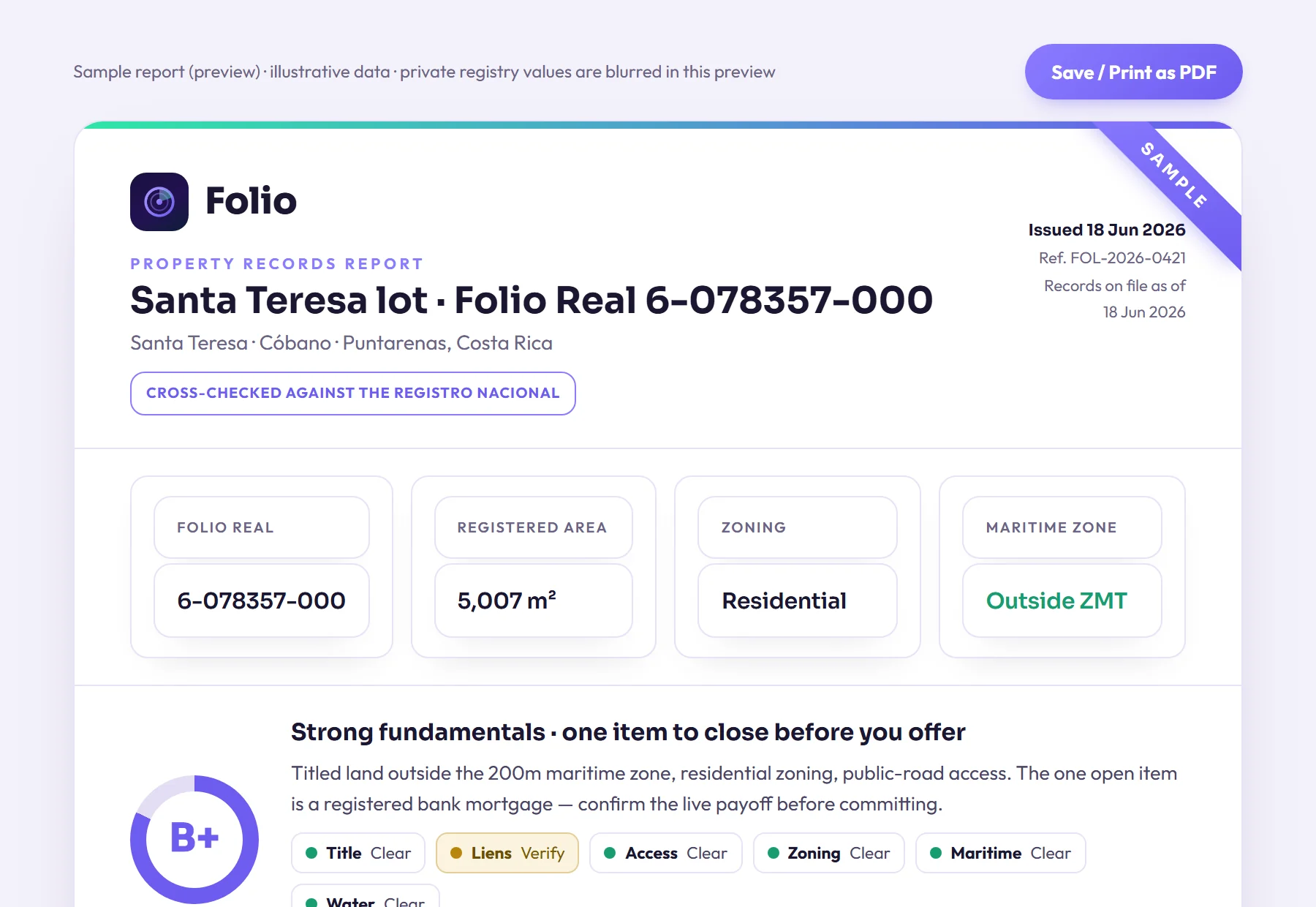
For our part, Folio shows what the public records say. The $29 verified report is a human-checked title and records search covering the registered owner, liens, taxes, water rights and the exact maritime line, delivered within 24 hours. You can see the full scope in what a Folio property report includes. Your attorney or notary is the one who advises you on what those findings mean for your purchase.
Know what you're buying before the deposit.
Most problems with a lot don't show up in the listing, and often the seller doesn't know about them either. Folio lets you find them now, before you pay a lawyer to start the purchase.
Frequently asked questions
How common is a completely clean title in Costa Rica?
In our small sample of 19 recent verified reports, only 2 (11%) had nothing in either the annotations block or the encumbrances block. That is a snapshot of recent paid reports, not a national rate. In that sample, most titles carried at least one entry.
Does an easement mean the title is not clean?
Not necessarily. A right-of-way easement was the single most frequent entry type in our sample and can exist to give a lot access to the road. What matters is whether your lot benefits from it or carries it, and how wide and long the strip is.
What is the difference between anotaciones and gravámenes?
Anotaciones sobre la finca are notes against the property as a whole, such as a pending deed, an administrative warning or a registry freeze. Gravámenes o afectaciones are encumbrances and limitations, such as easements, mortgages and reservations. Both blocks need to be read before you can call a title clean.
Does the free Folio map show whether a title is clean?
No. The free map shows the finca number, lot area, perimeter and boundary from the official cadastre, plus a maritime-zone flag. Owner, liens and encumbrances only appear in the verified report, and an attorney should interpret them.
Sources
- Registro Nacional digital services (certificaciones and registry consultations), Registro Nacional de Costa Rica
- Poder Judicial de Costa Rica, Poder Judicial
- Folio data: Registro Nacional certificates pulled for recent paid Folio reports, aggregated and anonymized.
Educational, not legal advice. Folio reports what public records show; it does not replace a licensed Costa Rican attorney, notary or surveyor. Confirm material facts with them before any transaction. Photos are illustrative.