The identificador predial is a parcel identifier code printed in the property description of a Costa Rica registry certificate, next to fields such as LINDEROS (boundaries), PLANO and VALOR FISCAL. It helps tie the registry record to a specific parcel, but it says nothing about who owns the land, what easements or liens burden it, or whether the registry has frozen it. Ask your attorney to confirm that the identifier, the finca number and the plano all describe the same land you were shown.
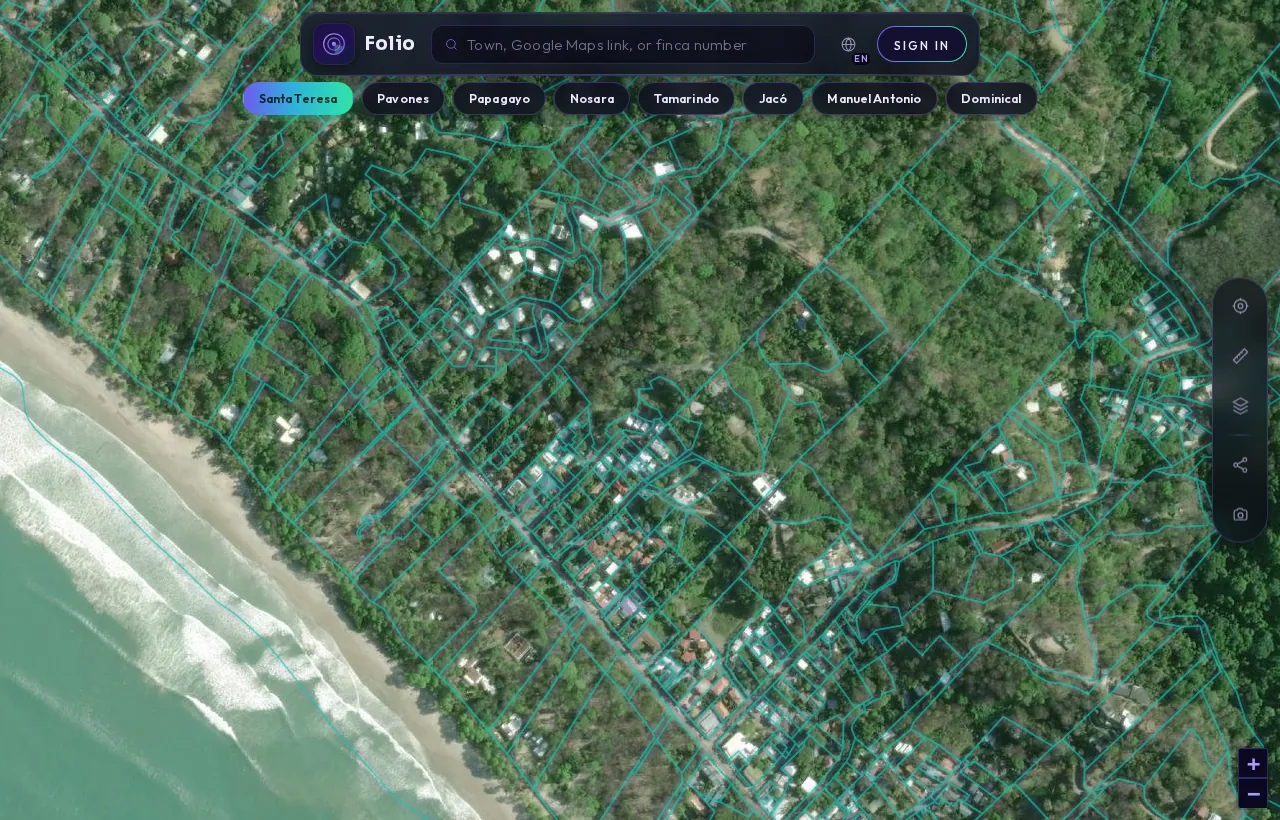
Any parcel, in the Folio app.
Search a town, a Google Maps link or a finca and Folio outlines the registered parcel from the national cadastre, with the maritime line, protected areas and water on top of it, before you call a lawyer or put down a deposit.
What 11 recent certificates actually contained
These counts come from a small sample of 11 Folio verified reports from September and October 2026, each built on a Registro Nacional certificación literal, so they are not a national rate.
What does IDENTIFICADOR PREDIAL mean on a registry certificate?
IDENTIFICADOR PREDIAL is a field label on the certificación literal, the full registry certificate the Registro Nacional issues for a finca (a registered property). The field holds a parcel identifier code. In plain terms, it is a reference that points from the legal record to a parcel of land.
We see this label on the certificates we pull for paid Folio reports. It sits in the description of the property, not in the section that lists problems. That placement tells you what kind of information it is: descriptive, not a warning and not a clearance.
This guide does not cover how the code is assigned. If you want the formal definition or the rule behind it, ask your attorney or notary to confirm which rule applies.
Where does the identificador predial appear on the certificate?
A certificación literal follows a predictable order. Once you know it, the identificador predial is easy to find, and so is everything it leaves out.
- The description of the finca. NATURALEZA (what the property is, for example a lot for building), the location, LINDEROS (the boundaries, described by what lies to the north, south, east and west), the area, PLANO (the cadastral survey plan number), IDENTIFICADOR PREDIAL, VALOR FISCAL (a fiscal value in colones) and the registered owner.
- ANOTACIONES SOBRE LA FINCA (annotations on the property): documents and notices that are pending or that flag the record.
- GRAVAMENES o AFECTACIONES (encumbrances or affectations): easements, reservations, limitations and obligations that burden the land.
You may also see FINCA SE ENCUENTRA EN ZONA CATASTRADA, a statement that the finca lies in a cadastrally surveyed zone, and SEGREGACIONES, which shows whether lots have been split off from this finca.
What does the identificador predial tell a buyer?
Its main value is as a cross-check. You are usually juggling several references for the same land: the finca number in the draft deed, the plano number on the survey, the boundaries in LINDEROS and the lot you saw on site. The identificador predial is one more anchor that should line up with the rest.
- It is a parcel reference recorded by the registry itself, not supplied by the seller or an agent.
- It sits beside the PLANO number, so you can read both together and ask whether they point to the same parcel.
- Ask your attorney whether, read with the zona catastrada statement, it shows anything about how the legal record and the cadastral survey relate for this finca.
Treat it as an identity field. It helps answer "is this the right piece of land?" It does not answer "is there anything wrong with this piece of land?"
Tap any lot on the free Folio map to see its cadastre boundary and area.
Check it freeWhat does the identificador predial not tell you?
Almost everything a buyer worries about sits in other blocks of the same certificate. The identifier does not show the owner, liens, easements, reservations, lawsuits or registry freezes. A tidy descriptive section says nothing about what comes after it.
Our own sample shows why this matters. Across 11 recent Folio verified reports from September and October 2026, each built on a certificación literal pulled from the Registro Nacional, 10 (91%) had at least one entry under GRAVAMENES o AFECTACIONES. Only 1 report (9%) had no gravámenes and no anotaciones at all. This is a small sample of paid reports, not a national rate, so read it as an illustration of what certificates in this sample contained, not a forecast for any property.
| Entry seen in the sample | Reports | Share of the 11 |
|---|---|---|
| Any servidumbre (easement) | 5 | 45% |
| Servidumbre de paso (right-of-way easement) | 4 | 36% |
| Anotaciones sobre la finca (any) | 3 | 27% |
| Reservas y restricciones carried from an older parent finca | 3 | 27% |
| Inmovilización por inconsistencia (registry freeze) | 2 | 18% |
| Advertencia administrativa (administrative warning) | 2 | 18% |
| Demanda (lawsuit annotation) | 1 | 9% |
None of these would show up in the identificador predial field. Each appears as its own entry, with a heading line naming its type (for example SERVIDUMBRE DE PASO or INMOVILIZACION POR INCONSISTENCIA) and fields such as CITAS, the registry reference of the deed, resolution or court filing behind the entry.
Note that NATURALEZA describes the finca itself, not the type of an encumbrance. The entry headings further down are where the burdens are named.
How does it relate to the finca number and the plano?
Think of three labels for one piece of land. The finca number identifies the property in the legal registry. The PLANO number identifies the cadastral survey that draws its shape and area. The identificador predial is the parcel identifier code shown alongside them. Our guide to what a plano catastrado is explains the survey side in more detail.
When these references agree with each other and with LINDEROS, the paperwork tells a consistent story. When something does not line up, such as boundaries that differ from the survey or a plano that seems to belong to another parcel, take it to your attorney before you sign anything.
In our sample, 2 reports (18%) carried an inmovilización por inconsistencia whose text cited an administrative file (expediente). We make no claim that those inconsistencies involved the identifier. The point is simpler: when the registry flags a record as inconsistent, that flag lives in the annotations, not in the descriptive fields.
Get the free Costa Rica buyer's checklist
What to ask for, what to pull from the registry and what to confirm on the map before you sign anything. One short email, no spam.
Which question should you put to your attorney?
Keep it concrete. A good version is:
"Do the finca number, the PLANO, the IDENTIFICADOR PREDIAL and the LINDEROS on the current certificación literal all describe the parcel I was shown, and is there anything in the annotations or encumbrances that affects it?"
That covers identity and condition together. Follow-ups worth asking:
- Does the area on the certificate match the area on the plano and on the ground?
- Are there SEGREGACIONES that change what is actually left in this finca?
- For each easement, which fincas appear under A FAVOR DE LA(S) FINCA(S) (those that benefit) and EN CONTRA DE LA(S) FINCA(S) (those that carry the burden), and what do LONGITUD, ANCHO and RUMBO say about the strip's length, width and direction?
- Do any entries show CANCELACIONES PARCIALES (partial cancellations) or ANOTACIONES DEL GRAVAMEN (notes against that entry) that change their meaning?
Your attorney or notary advises on what each entry means for your purchase. The certificate shows what the records say. It does not decide whether the deal is sound.
Where can you see the identificador predial yourself?
Certificates and registry consultations are available through the Registro Nacional's digital services at rnpdigital. Read the descriptive block first, note the identifier and plano, then read every annotation and encumbrance entry to the end.
If the certificate carries a demanda (a lawsuit annotation on the finca), the CITAS field gives the reference of the court filing. Ask your attorney whether and how to follow it up through the Poder Judicial. In our sample, the MONTO field (an amount stated in the entry) appeared on a lawsuit annotation and on easements, where it was a nominal value.
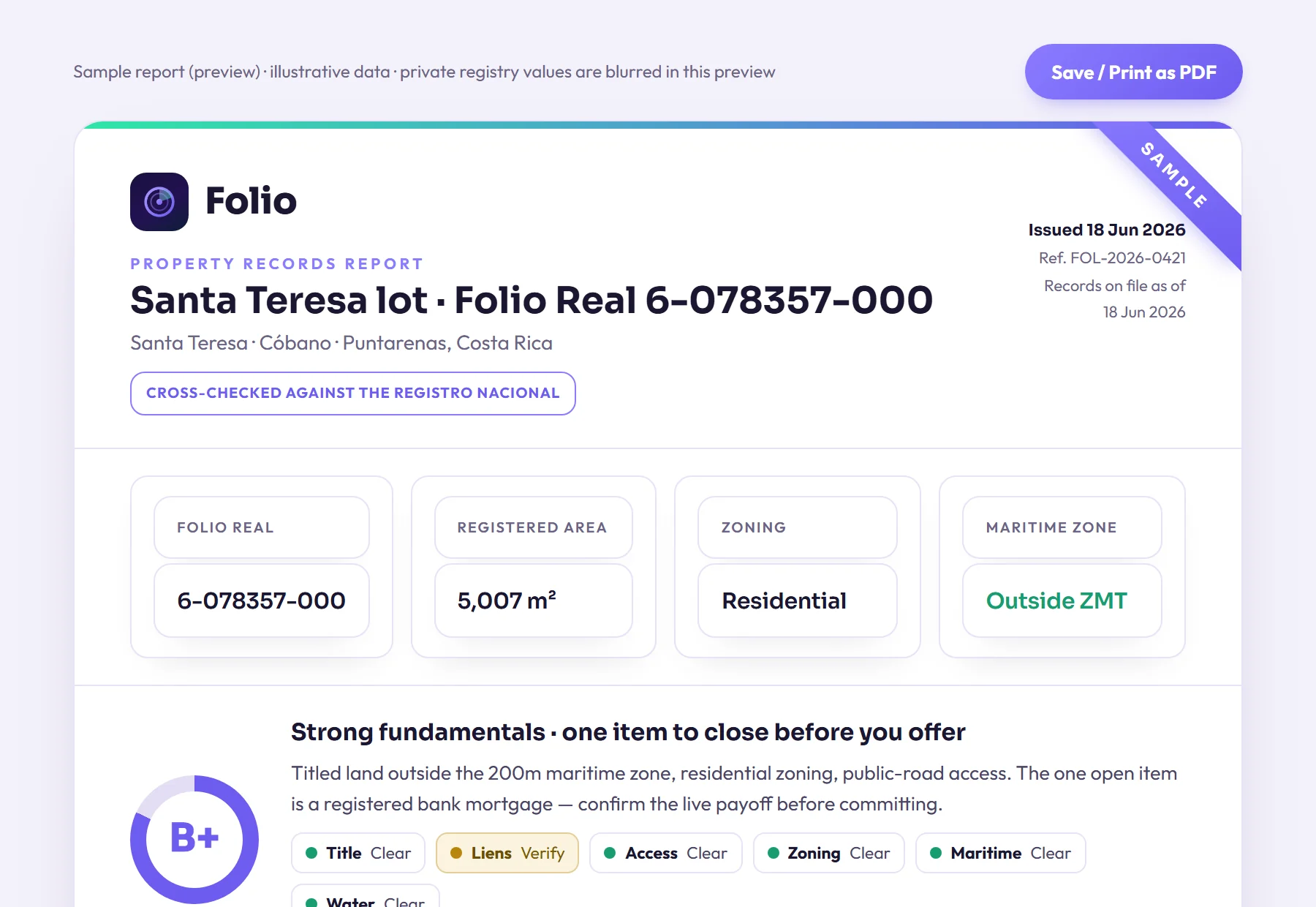
A Folio verified report is a human-checked title and records search covering the registered owner, liens, taxes, water rights and the exact maritime line, for $29, delivered within 24 hours. Our page on what a Folio property report includes sets out what you receive, and the due diligence checklist shows where the registry check fits among the other checks before you buy.
Know what you're buying before the deposit.
Most problems with a lot don't show up in the listing, and often the seller doesn't know about them either. Folio lets you find them now, before you pay a lawyer to start the purchase.
Frequently asked questions
Is the identificador predial the same as the finca number?
No. The certificate shows the finca number, the PLANO and the IDENTIFICADOR PREDIAL as separate pieces of information in the property description. They should all point to the same land, and your attorney can confirm that they do.
Does an identificador predial on the certificate mean the property has no problems?
No. The identifier is a descriptive field and says nothing about owners, liens, easements, lawsuits or registry freezes. In a small sample of 11 recent Folio reports, 10 had at least one entry under GRAVAMENES o AFECTACIONES, which is why the rest of the certificate needs a full reading.
Where on the certificación literal is the identificador predial?
In the first block, which describes the finca. It sits with NATURALEZA, LINDEROS, the area, PLANO, VALOR FISCAL and the owner, before the ANOTACIONES SOBRE LA FINCA and GRAVAMENES o AFECTACIONES blocks.
What should I do if the identifier, plano and boundaries do not seem to match?
Pause and ask your attorney or notary before signing or paying anything. A mismatch between the registry description and the survey can have several explanations, and only a professional who reviews the full record can tell you which applies.
Sources
- Registro Nacional digital services (certificaciones and registry consultations), Registro Nacional de Costa Rica
- Poder Judicial de Costa Rica, Poder Judicial
- Folio data: Registro Nacional certificates pulled for recent paid Folio reports, aggregated and anonymized.
Educational, not legal advice. Folio reports what public records show; it does not replace a licensed Costa Rican attorney, notary or surveyor. Confirm material facts with them before any transaction. Photos are illustrative.