Before buying property in La Fortuna, confirm in the public records who the registered owner is, what encumbrances sit on the title, and whether the registered plano matches the land on the ground. Then confirm, separately, that the lot has a legal water source and that the municipality's land use rules allow what you plan to build. Water and land use deserve their own attention on any inland lot.
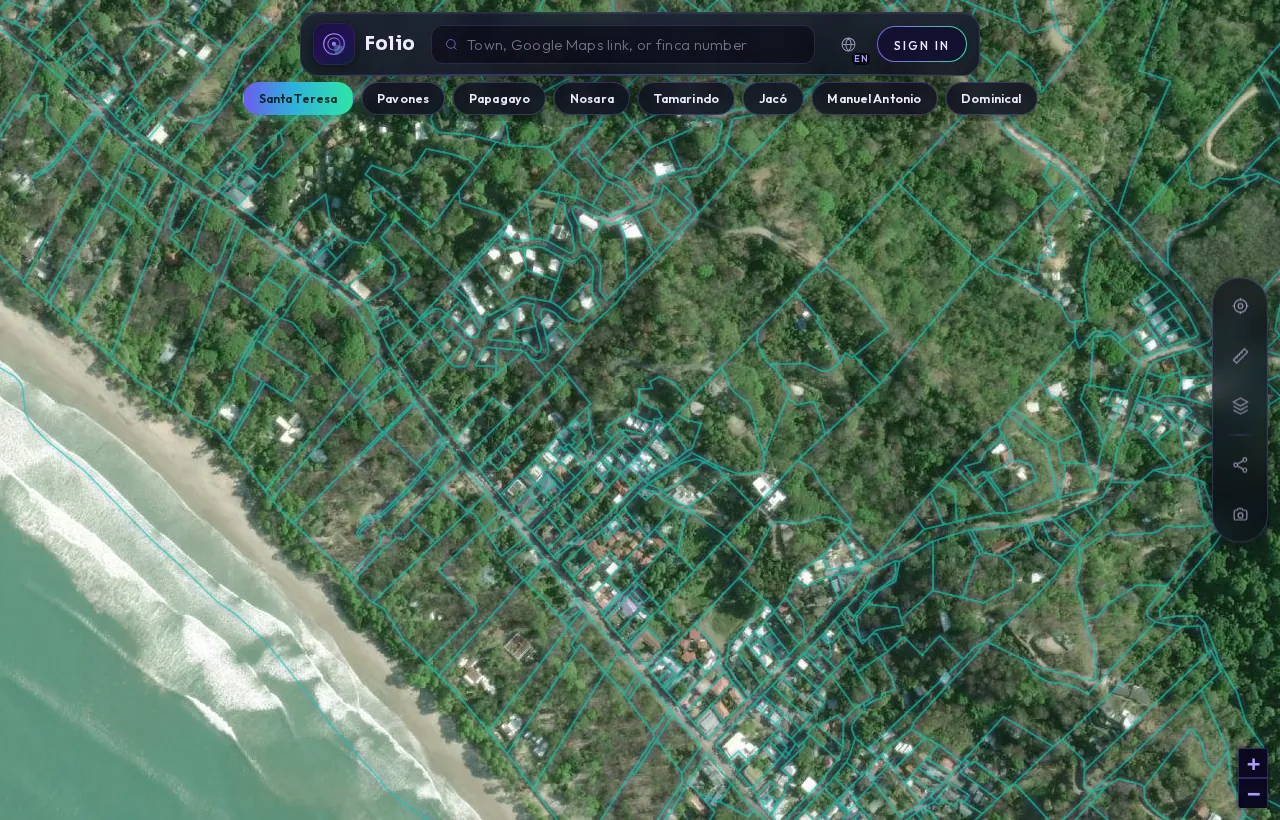
Any parcel, in the Folio app.
Search a town, a Google Maps link or a finca and Folio outlines the registered parcel from the national cadastre, with the maritime line, protected areas and water on top of it, before you call a lawyer or put down a deposit.
See every parcel in La Fortuna on the map
What should you check first when buying property in La Fortuna?
Start with the title, not the view. In La Fortuna the questions that matter most are the ones every Costa Rica purchase shares: who legally owns the lot, what is registered against it, and whether the surveyed boundary matches what the seller is showing you. After that come two questions that weigh heavily in an inland, river-rich town near a national park: where the water comes from, and what you are allowed to build.
This note walks through those records in a sensible order. It does not quote town statistics or prices. Folio also publishes a La Fortuna property check page. The rest of this note explains what to look for in the records.
Who owns the lot, and what is registered against it?
The Registro Nacional (National Registry) is the official record of ownership in Costa Rica. Its digital services let you request a certificación (an official certificate) of a property's registry entry. That entry is the document your attorney will read line by line.
When you or your attorney read it, look for:
- The registered owner. The person or company signing your contract should be the one on the registry. If a company owns the lot, your attorney will also want to confirm who can legally sign for it.
- Gravámenes (encumbrances). These include hipotecas (mortgages), servidumbres (easements) and other rights held by third parties. Some are harmless, such as a utility easement. Others may need to be cancelled before closing, so ask your attorney which ones apply.
- Anotaciones (annotations). These are notes that something is pending against the property, such as a lawsuit or a prior sale document waiting to be registered. An annotation can complicate your purchase even when the title otherwise looks clean.
Read the entry as close to closing as practical. It describes the property on the day it is issued, and new documents can be registered after that.
Does the plano match the land you walked?
The plano catastrado (registered survey plan) is the official drawing of the lot's shape, area and position. The cadastre holds the boundary; the registry holds the ownership. In a well-documented purchase the two agree with each other and with the fences on the ground.
When land is split over time, problems can arise: boundaries that drifted from the plano, access roads that cross a neighbour's land without a registered easement, or a seller showing more ground than the plano covers. Ask three plain questions:
- Does the area on the plano match what the seller describes?
- Does the lot touch a public road, or does access depend on an easement? If so, is that easement registered?
- Do the fences, river edges and markers you see roughly follow the plano's lines?
If any answer is unclear, a topógrafo (licensed surveyor) can walk the boundary and compare it to the plano before you commit.
Why is water the key La Fortuna question?
Abundant rain and rivers do not mean a lot has legal water. In Costa Rica, using water from a well, spring or stream is generally regulated by the state, and the right to use it is not automatically part of owning the land. The office responsible is MINAE's Dirección de Agua, which handles water concessions and well permits.
For a lot in or around La Fortuna, find out which of these applies:
- A public or community water connection. Many rural areas are served by a local water association or the public utility. Ask for written confirmation that a connection exists or can be granted for this lot, and on what terms.
- A well or spring with a concession. Ask for the concession or permit documents and check that they relate to this specific property and current owner.
- Water taken informally. A pipe from a stream with no paperwork is a question for your attorney before you sign, not after.
Folio's guide to water rights and Costa Rica property explains the documents in more detail and what to ask a seller for.
Tap any La Fortuna lot in the free app to confirm its boundary and area.
Check it freeWhat can you build here? Land use and environmental review
A clean title tells you who owns the land. It does not tell you what you can do with it. La Fortuna sits in the canton of San Carlos, so building questions go to the Municipalidad de San Carlos. The key document is the certificado de uso de suelo (land use certificate), which states what the zoning allows on that lot. Our uso de suelo guide covers how to request one and how to read it.
Some projects also need environmental viability from SETENA, the national environmental review agency. Whether yours does depends on the type and size of the project and the site. Ask your attorney or engineer to confirm which review applies before you budget for construction.
Around La Fortuna, several site features can affect what you are permitted to do:
- Rivers and streams. Land along watercourses may carry protection setbacks that restrict building. Ask your attorney whether any apply.
- Forest cover. Wooded land can come with limits on clearing.
- Slopes and terrain. Steep ground near the volcano and the lake can raise engineering and permitting questions.
- Proximity to protected areas. Land near Arenal Volcano National Park or other protected land may face added scrutiny.
Is the maritime zone a concern in an inland town?
The zona marítimo terrestre (maritime terrestrial zone) is the coastal strip with its own special rules. La Fortuna is inland, so for most lots here it is not the central issue it is on the Pacific beaches. Folio's map still shows a maritime-zone flag for every lot. If you ever see that flag on a La Fortuna lot, treat it as a reason to ask questions.
The bigger inland equivalents may be the river, forest and protected-area questions above. Give them the attention a coastal buyer would give the maritime line.
Get the free Costa Rica buyer's checklist
What to ask for, what to pull from the registry and what to confirm on the map before you sign anything. One short email, no spam.
How do Folio's two options differ?
A quick map lookup and a records search are different tools.
The free map covers the cadastre side only: tap a lot to see its finca number, lot area, perimeter and boundary, plus a maritime-zone flag. It is a fast way to confirm you are looking at the right parcel and that its size matches the listing.
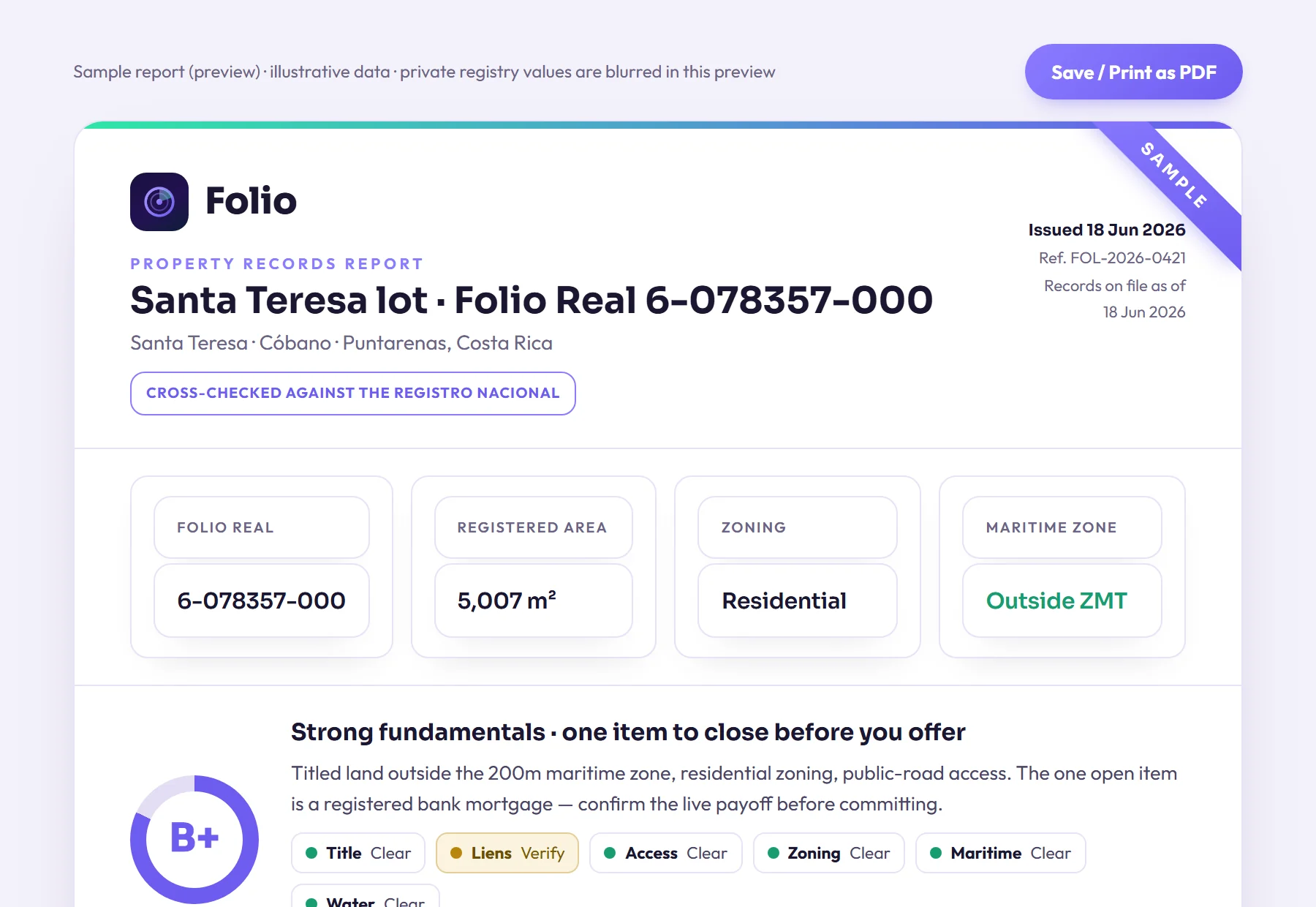
The verified report covers the title side. It costs $29 and is a human-checked title and records search covering the registered owner, liens, taxes, water rights and the exact maritime line, delivered within 24 hours. Ownership, liens and water rights appear only in this report.
Neither option replaces your attorney or notary. Folio shows what the public records say. Your lawyer advises on what it means for your purchase.
Which records should you pull, and in what order?
- Map the lot and confirm its cadastral boundary and area match the listing.
- Get the registry entry: owner, gravámenes and anotaciones.
- Get the plano catastrado and compare it to the ground, ideally with a surveyor.
- Confirm the water source and its paperwork with the Dirección de Agua or the local provider.
- Request the uso de suelo from the Municipalidad de San Carlos.
- Ask whether your project needs SETENA review.
- Confirm municipal property taxes are paid up.
- Have your attorney review everything before you sign or pay a deposit.
Town-specific questions to ask the seller
- Where does the water come from, and can you show me the documents?
- Is access by public road or by easement, and is the easement registered?
- Does any river or stream cross or border the lot?
- Was the lot split from a larger farm, and when was the current plano drawn?
- Do you have a recent uso de suelo for this lot?
- Are there any disputes with neighbours over fences or access?
Know what you're buying before the deposit.
Most problems with a lot don't show up in the listing, and often the seller doesn't know about them either. Folio lets you find them now, before you pay a lawyer to start the purchase.
Frequently asked questions
What is the first record to check when buying property in La Fortuna?
Start with the Registro Nacional entry for the property. It shows the registered owner, encumbrances such as mortgages and easements, and any pending annotations. Everything else builds on knowing who owns the lot and what is attached to it.
Does a La Fortuna property automatically come with water rights?
No. In Costa Rica the right to use water from a well, spring or stream is generally regulated separately from land ownership. Ask the seller for the concession, permit or utility connection documents, and have your attorney confirm they apply to this lot.
Do I need to worry about the maritime zone in La Fortuna?
La Fortuna is inland, so the coastal maritime zone is not usually the main concern. River setbacks, forest cover and nearby protected areas may matter more here. If a lot ever shows a maritime-zone flag, ask questions before going further.
What is the difference between Folio's map and the verified report?
The map shows cadastre data: finca number, lot area, perimeter, boundary and a maritime-zone flag. The $29 verified report is a human-checked records search covering the registered owner, liens, taxes, water rights and the exact maritime line, delivered within 24 hours.
Can Folio replace my attorney for a La Fortuna purchase?
No. Folio shows what the public records say about a lot. An attorney or notary reviews those records, advises you on the risks and handles the legal side of the transfer.
Sources
- Registro Nacional digital services (certificaciones and registry consultations), Registro Nacional de Costa Rica
- SETENA, Secretaría Técnica Nacional Ambiental, SETENA
- Folio data: Folio's town page.
Educational, not legal advice. Folio reports what public records show; it does not replace a licensed Costa Rican attorney, notary or surveyor. Confirm material facts with them before any transaction. Photos are illustrative of the region.